
Not all employer branding tools are platforms. Learn the 6 must-have features, the comparison framework, and the 5 questions that separate real software from a careers site with a coat of paint.
An employer branding platform is the software layer where you stop guessing what candidates think of your company — and start operating it like a product. Most TA teams still treat employer brand as a campaign budget. The winners treat it as infrastructure.
If you're evaluating tools, this guide gives you the must-have features, the comparison framework, the ROI math, and the five questions that will tell you whether what you're being sold is a brand platform — or a glorified job board with better fonts.
What you need to know in 60 seconds
- → An employer branding platform is software that turns your employer brand from one-off campaigns into a continuously measured, candidate-facing experience — content, community, assessment, and analytics in one place.
- → LinkedIn data shows a strong employer brand cuts cost per hire by up to 50% and reduces turnover by 28% — but only if you can measure the brand, not just the spend.
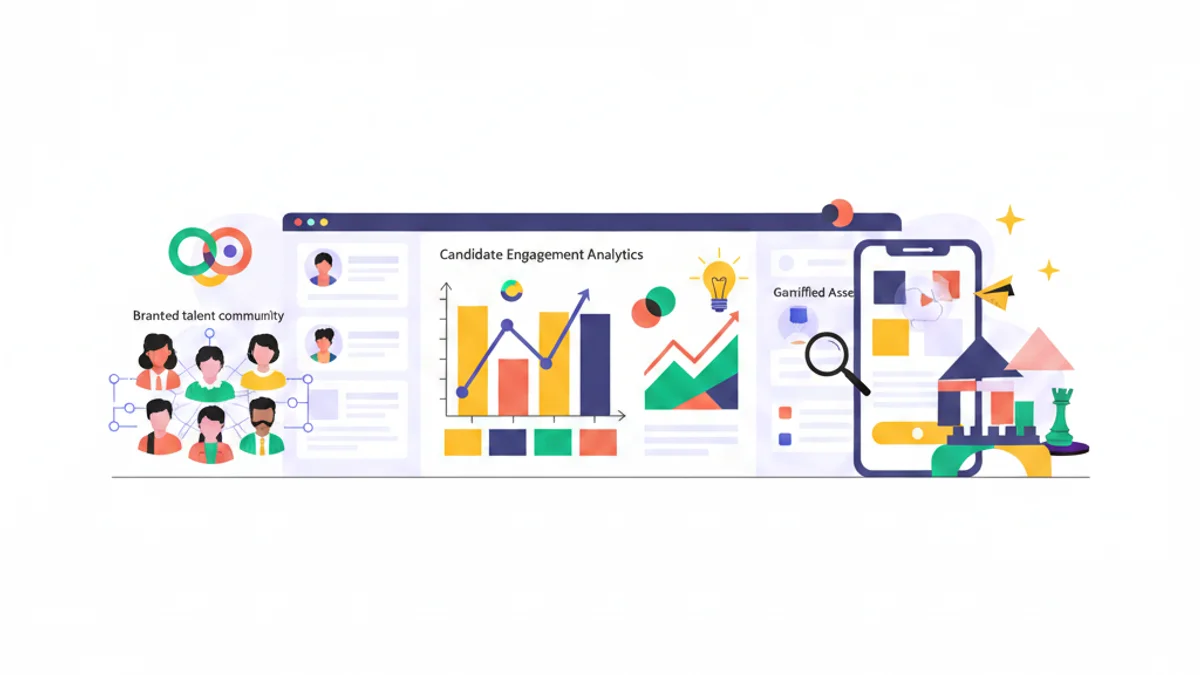
- → Six must-have features: branded talent community, gamified assessments, candidate journey analytics, content publishing, multi-channel distribution, and a manager-friendly admin layer.
- → HEINEKEN Romania used Jobful's platform to increase applications 43% and rebuild its young-talent brand without a Super Bowl budget.
- → If your shortlist can't show you a real engagement score per candidate, it's a careers site — not an employer branding platform.
What Is an Employer Branding Platform?
An employer branding platform is a single piece of software that owns the candidate-facing side of your employer brand — content, community, assessment, and analytics — and feeds the data back to your TA team in real time. Think of it as the operating system for your reputation in the talent market.
It is not a careers site builder. It is not an ATS. It is not a social media scheduler. Those tools each handle one slice. A real employer branding platform binds them together so a single candidate's interaction — watching a culture video, completing a gamified challenge, joining a community — becomes one continuous, measurable story.
According to LinkedIn's Global Talent Trends, companies with a strong employer brand see 50% lower cost per hire and twice the applications per role. The catch: you cannot manage what you cannot see. That is exactly what a platform layer fixes.
Quick definition for buyers
A modern employer branding platform consolidates four jobs: publish (content + EVP storytelling), engage (community + nurture), assess (gamified skills + culture fit), and measure (per-candidate engagement + brand KPIs).
If a vendor only handles publishing or only handles assessment, you'll end up stitching three tools together — and inheriting the same data silos you tried to escape.
Lower cost per hire when employer brand is strong
LinkedIn Global Talent Trends
Turnover reduction reported by strong-brand employers
LinkedIn Talent Solutions
Of candidates research employer brand before applying
Glassdoor Site Survey
Why Job Boards and Career Sites Aren't Enough Anymore
Job boards and static career sites broadcast — they don't build relationships. They give you applicants. They don't give you a brand. And in 2026, the gap between those two outcomes is where your hiring budget quietly bleeds out.
A LinkedIn Talent Insights report found that 75% of job seekers research a company's employer brand before they ever click "Apply." If the only surface they can find is your careers page — three stock photos and a list of openings — they leave. Worse, they leave a review.
Here's the operational problem: traditional EB tools were built for a 2015 mindset. Publish a page. Run a campaign. Measure clicks. None of that touches the actual unit of brand value — the candidate experience itself.
What the old stack delivers
- ✗ A static careers page, no engagement loop
- ✗ Pageview metrics with no candidate identity
- ✗ Job board ad spend treated as "brand budget"
- ✗ Three vendors for content, community, and assessment
- ✗ Zero visibility into who's actually interested
What an employer branding platform delivers
- ✓ A branded talent community with identity per candidate
- ✓ Behavioural signals — challenges, content, attendance
- ✓ Brand KPIs tied to time-to-fill and quality of hire
- ✓ One vendor, one schema, one analytics layer
- ✓ A pipeline that warms up before the role opens
The 6 Must-Have Features of a Modern Employer Branding Platform
Six capabilities separate real employer branding software from a careers site with a coat of paint. Use this list as your shortlisting filter — anything missing means you'll end up integrating a second tool inside 12 months.
A Branded Talent Community
Not a CV database — a private space candidates actually log into, with your colours, your content, and your culture. This is the asset that compounds; a community of 10,000 engaged candidates is worth more than 10x that in a static database that no one revisits.
If candidates can't identify themselves, opt in, and return, you don't have a community — you have a contact list.
Gamified Assessments and Challenges
Brand isn't a slogan. It's the experience candidates have with you before they apply. Gamified challenges — case studies, simulations, mini-projects — let candidates feel your company while giving you behavioural data far richer than any CV.
Research from Aberdeen Group found gamified hiring lifts candidate engagement by 48% versus traditional applications.
Candidate Journey Analytics
You need a per-candidate engagement score — not just "how many people visited the site." That score becomes the bridge between "brand work" and "hiring outcome." Without it, every CFO conversation about EB ROI goes nowhere.
Best-in-class platforms track challenge completions, content views, event attendance, and re-engagement frequency in one dashboard.
Content Publishing Built for Recruiters
Your TA team is not your marketing department. They need a publishing layer with templates, scheduling, and brand controls — without an agency in the middle. Stories, employee spotlights, day-in-the-life videos, project case studies. All shippable in minutes, not weeks.
If publishing requires a ticket to IT or a brief to marketing, your platform isn't doing its job.
Multi-Channel Distribution
Strong brand content goes everywhere — LinkedIn, Instagram, TikTok, university partnerships, employee referrals. A real employer branding platform pushes content out with consistent tracking, so you can see which channel actually fed your community.
Bonus: native QR codes for events and recruiter cards mean offline-to-online attribution finally works.
A Manager-Friendly Admin Layer
Hiring managers should be able to log in, view their pipeline, share content, and recommend candidates without three days of training. If the platform is so complex that only the EB lead can use it, it'll quietly die when she changes jobs.
Look for role-based dashboards, single sign-on, and the kind of UX that reminds you of consumer software — not 2008 HR tech.
Employer Branding Platform vs Traditional EB Tools
Most TA leaders inherited a Frankenstein stack: a careers site builder, a survey tool, a social scheduler, maybe an "employer branding agency" retainer. Here is how that stack compares to a real platform on the things that decide whether you'll fill the role next quarter.
| Capability | Traditional EB Stack | Employer Branding Platform |
|---|---|---|
| Candidate identity | Anonymous pageviews | Identified community member with profile |
| Brand measurement | Glassdoor stars + bounce rate | Per-candidate engagement score tied to hires |
| Content publishing | Agency briefs, 6-week turnaround | In-house templates, ship in a day |
| Candidate experience | Read job description, click apply | Try a challenge, watch culture videos, join community |
| Pipeline ownership | Job board owns the audience | You own a renewable audience asset |
| Cost per hire trend | Rises with media inflation | Falls as community grows (compound effect) |
| ROI conversation with CFO | "Trust me, the brand is stronger" | € saved per role, with named candidates |
How to Measure ROI from Your Employer Branding Platform
ROI from employer branding software comes from three places: lower cost per hire, faster time-to-fill, and higher quality of hire. Each one needs a baseline number before you switch on the platform — otherwise the post-launch story is anecdote, not analysis.
According to the Society for Human Resource Management (SHRM), the average cost per hire is around $4,700. For specialised or hard-to-fill roles, that figure can easily triple. Even a 20% reduction across 100 hires is a million-dollar line item — well above the cost of any platform on your shortlist.
Cost per hire
Track media spend, agency fees, and time spent per hire before and 6 months after launch. Strong brand pulls applications you'd otherwise have to pay job boards for.
Time to fill
When a role opens, do you start from zero or from a warm community? The delta is your time-to-fill saving — usually measured in weeks, not days.
Quality of hire
Behavioural data (challenges, attendance, engagement) is a better predictor than interviews alone. Tie 90-day performance back to source and watch the gap.
Audience growth
The platform's flywheel metric. A community that grows 20% quarter on quarter compounds — and starts to subsidise every other hiring KPI.
For a deeper view of the financial model — including a CFO-ready spreadsheet template — see Jobful's CFO business case guide. The math translates one-to-one to an EB platform investment.
5 Questions to Ask Before You Buy
Use these on every vendor demo. If they can't answer two of them with specifics, the platform is a marketing site dressed up as software.
Can you show me an engagement score for a single candidate?
If the answer is "we track pageviews," walk away. The brand-to-hire bridge starts with identifying interest at the individual level.
How long does it take a hiring manager to publish a "day in the life" video?
Five minutes is the right answer. Two days means you'll never publish, and the platform becomes shelfware.
How does the platform integrate with our existing ATS?
A real platform sits beside your ATS, not against it. Bidirectional sync, named integrations (Workday, SmartRecruiters, SAP, etc.) — these are non-negotiable.
Can I see a customer case study with a hard number on cost per hire or time to fill?
"Improved engagement" isn't a metric. Insist on numbers like HEINEKEN's 43% application lift or Wyndham's 290% application growth — anything less is a brochure.
What happens to the community if we churn?
Data portability is the silent dealbreaker. Make sure you can export candidate data and content rights — your community should outlive your contract.
How Jobful's Platform Works in Practice — HEINEKEN Romania
HEINEKEN Romania didn't need another careers site. They needed to convince young Romanian talent that a 150-year-old brewer could be a tech-savvy place to build a career — and to do it without HQ-level media spend.
Using Jobful's platform, they built a branded talent community combining gamified challenges (product simulations, supply-chain puzzles, marketing case studies), employee-led storytelling, and event-driven campus activations. Candidates didn't just "apply" — they competed, learned, and self-identified as serious about the brand before HR ever saw their CV.
Result: applications climbed 43% and the company built a measurable reputation as the most innovative FMCG employer in CEE, validated by independent young-talent surveys. The community now feeds every entry-level role they open — turning recruiting from a quarterly scramble into a steady-state pipeline.
Why this works
One asset, three jobs. The same community surface served as the careers site, the candidate database, and the brand campaign measurement layer. No duplication. No data silos.
Behaviour beats branding budget. A candidate who completed three challenges and joined two events is worth more than a million ad impressions. The platform let HEINEKEN see and act on that signal.
Compound returns. Each new piece of content fed an existing audience rather than chasing fresh paid reach. Cost per hire dropped while quality went up.
See more examples in Jobful's case study library — including Wyndham Hotels (290% application lift), Raiffeisen Bank, and Regina Maria.
The Bottom Line: Buy a Platform, Not a Project
An employer branding platform earns its place by turning brand from a cost line into a compounding asset. The platforms that fail are the ones that ship a careers site and call it strategy. The platforms that win are the ones that build you a community you own — and give you per-candidate data your CFO can defend.
If you're shortlisting right now, the test is simple: can the vendor show you a candidate, name them, and tell you how engaged they are with your brand? Everything else — the prettier dashboards, the AI-this and AI-that — is downstream of that one capability.
See an employer branding platform built around your community
Walk through Jobful's platform with a real talent community, real per-candidate analytics, and the same playbook HEINEKEN and Wyndham use.
Frequently Asked Questions
Get More Insights Like This
Join 5,000+ HR professionals receiving monthly insights.