
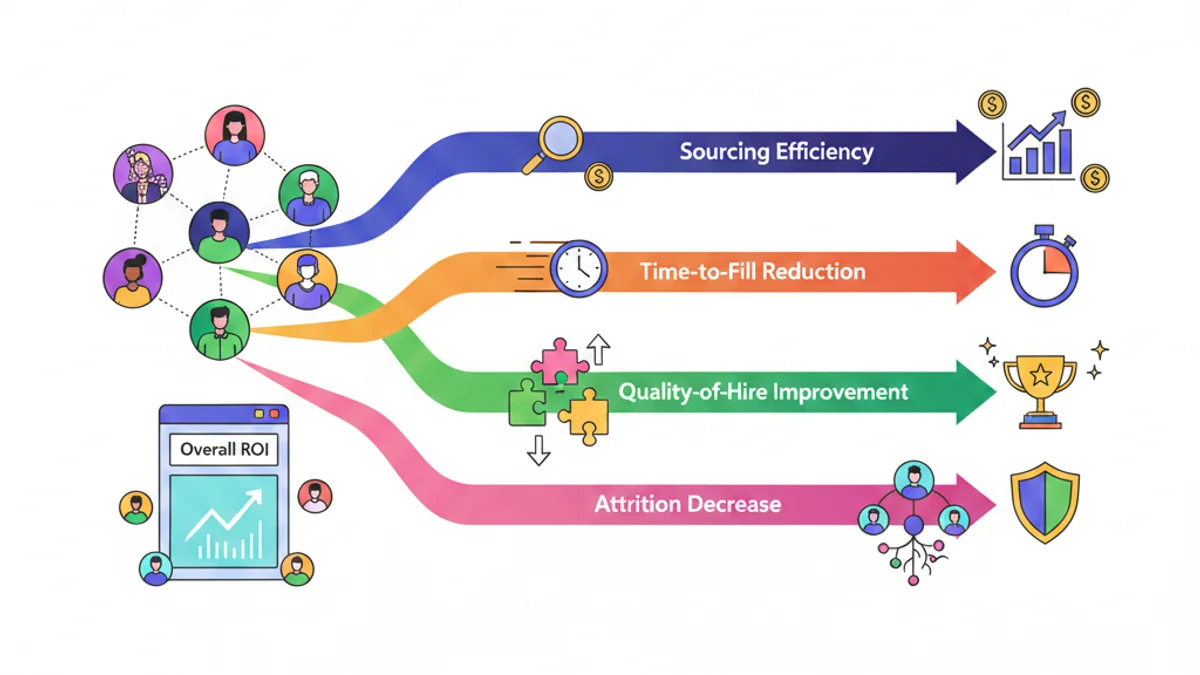
How to frame talent community investment as a financial return — not a recruitment ask. The four-cost-line ROI model CFOs actually approve.
Most talent acquisition leaders walk into the CFO's office with a recruitment wishlist and walk out with a budget cut. The pattern repeats every planning cycle. The problem isn't the request — it's the framing. Finance doesn't buy activity. It buys cash flow. A proper talent community ROI model reframes recruitment from a cost centre into a measurable return on invested capital, and it's the conversation every CHRO should already be prepared to have.
This is the executive playbook. It's the numbers your finance team wants to see, the formulas that hold up under scrutiny, and the proof points that move a talent community platform from "nice to have" to a line in the operating plan. Let's get to the model.
What you need to know in 60 seconds
- → The talent community ROI formula runs on four cost lines: sourcing, time-to-fill, quality-of-hire, and attrition — not headcount optimism.
- → SHRM pegs average cost-per-hire at $4,683; companies with engaged talent communities consistently cut that by 30–55% after year one.
- → LinkedIn reports an average time-to-fill of 44 days. Pre-built pipelines compress that to 12–18 days, translating directly into recovered revenue for revenue-generating roles.
- → The quality-of-hire layer compounds: Gartner finds a bad hire costs up to 30% of first-year salary. A community that pre-qualifies on signals reduces that exposure.
- → Build the business case with a 90-day pilot, not an annual forecast. Pilots beat projections in the CFO's office, every time.
- → HEINEKEN Romania saw +43% more applications; Wyndham Hotels saw +290% — both used community-driven hiring to hit financial targets, not HR vanity metrics.
Average cost-per-hire across industries
SHRM Talent Acquisition Benchmarking Report
Average time-to-fill for professional roles
LinkedIn Talent Solutions
Of first-year salary lost on a bad hire
Gartner HR Research
Why Most Talent Acquisition Budgets Die in Committee
TA budgets get cut because they read like HR wishlists, not investment memos. Finance leaders don't dismiss recruitment — they dismiss vague claims. "We'll hire faster" and "we'll attract better candidates" aren't financial arguments. They're adjectives.
The gap is translation. According to a 2024 Deloitte Human Capital Trends report, only 18% of HR leaders believe their function is viewed as a strategic business partner at the board level. That number tracks with the same complaint in every boardroom: HR talks in activities, finance thinks in outcomes.
A proper talent community ROI case flips the script. It doesn't ask for money to build a community. It asks for money to avoid the cost of not having one — measured in agency fees, lost revenue per vacant day, and preventable attrition. Finance understands avoided cost. That's the vocabulary shift that unlocks the approval.
The Talent Community ROI Formula: Four Cost Lines That Actually Move
A credible talent community ROI model rests on four cost lines — not five, not ten. Any model with more variables becomes unauditable. Any model with fewer misses the compounding effect.
Here's the formula in the form your finance team will actually review:
| Cost Line | What It Captures | Typical Community Impact |
|---|---|---|
| Sourcing cost | Agency fees, job board spend, recruiter hours per hire | 30–55% reduction post year one |
| Time-to-fill | Days vacant × daily revenue or coverage cost per role | Compression of 26+ days on pre-engaged roles |
| Quality-of-hire | Performance rating + 12-month retention × salary | Fewer mis-hires from better pre-qualification signals |
| Attrition | Replacement cost + productivity ramp for leavers | Community-sourced hires show stronger fit and retention |
The model's ROI output is simple math: (Year-1 avoided cost across all four lines) ÷ (Platform + implementation investment). If the ratio is above 2x, you have a defensible case. If it's above 3x, it's a no-brainer conversation. Most mid-market deployments land between 3.5x and 6x in year one, according to benchmarks we've seen across our customer base.
A quick note on what this model deliberately excludes: brand lift, candidate NPS, and engagement metrics. Those matter — but they're leading indicators, not financial outputs. Put them in the appendix, not the executive summary.
Cost-Per-Hire Reduction: Where the Savings Come From
Cost-per-hire is the line every CFO already tracks. SHRM's latest Talent Acquisition Benchmarking Report puts the industry average at $4,683 per hire, with significant variance by sector — tech and finance skew higher, hospitality and retail skew lower. That number is your baseline.
The savings from a talent community show up in three places. First, agency dependency drops — warm pipelines mean fewer emergency calls to external recruiters at 20–25% of salary. Second, job board spend concentrates on fewer, higher-quality postings. Third, recruiter capacity shifts from sourcing to closing, which is where the senior hours should be going anyway.
Traditional Reactive Sourcing
- ✗ Agency fees of 20–25% of annual salary per senior hire
- ✗ Job board spend with declining return per impression
- ✗ 60–80% of recruiter hours spent sourcing cold
- ✗ Pipeline restarts at zero for every new requisition
Talent Community-Led Sourcing
- ✓ Agency reliance drops as internal pipeline fills
- ✓ Paid media concentrated on community-growth, not reqs
- ✓ Recruiters spend time assessing, not hunting
- ✓ Warm candidates carry forward req-to-req
Apply honest math to your own number. If your fully-loaded cost-per-hire is $6,000 and you run 200 hires a year, a 35% reduction equals $420,000 in recovered budget — before you've touched time-to-fill or attrition. That's the first line on the ROI memo.
Time-to-Fill and Revenue Impact: The Line CFOs Care About Most
Time-to-fill is the line that most recruitment budgets under-sell. LinkedIn Talent Solutions reports an average of 44 days to fill a professional role; specialised or senior positions routinely stretch beyond 60. Every one of those days has a financial shadow.
For revenue-generating roles — salespeople, account managers, consultants — the math is direct. A role with a $500k annual quota contribution is burning roughly $1,370 per day vacant. A 30-day compression on time-to-fill recovers $41,000 per role, per fill. Multiply by annual hires in that category and the number becomes a headline.
For non-revenue roles — operations, support, specialists — use coverage cost: the premium of overtime, contract labour, or productivity drag on the team carrying the vacancy. Aptitude Research's 2024 Talent Acquisition Benchmarks note that companies with mature talent pipelines report time-to-fill reductions of 40–60% on pre-engaged candidates, because the sourcing phase collapses to zero.
The Quick Revenue Math Your CFO Will Run
Daily vacancy cost = (Annual revenue attributed to role ÷ 260 working days) — or coverage premium for non-revenue roles.
Days recovered = Baseline time-to-fill − new time-to-fill on community-sourced hires.
Annual recovery = Daily vacancy cost × Days recovered × Hires per year in category.
Quality-of-Hire and Attrition: The Compounding ROI Layer
Quality-of-hire is where the ROI compounds, and it's also the line most budget cases leave off entirely — which is why most budget cases fail. Gartner's HR Research puts the cost of a bad hire at up to 30% of the employee's first-year salary, once you factor in severance, re-recruitment, ramp loss, and team productivity damage.
A talent community reduces that risk because you're not hiring strangers. You're hiring people who've engaged with your brand, taken assessments, participated in challenges, and self-selected into alignment with your values. According to the Josh Bersin Company, organisations with structured talent pipelines report 20–30% higher 12-month retention on community-sourced hires than on job-board-sourced hires.
Attrition savings are particularly powerful in high-volume hiring. At Wyndham Hotels, the candidate volume and pre-qualification built through Jobful's community model didn't just deliver 290% more applicants — it surfaced better-fit candidates who stayed longer in roles where hospitality turnover routinely exceeds 70% annually. That's not a recruitment win. That's a P&L win.
The 90-Day Proof Plan: Pilot Before You Expand Budget
CFOs don't approve three-year platform commitments on hope. They approve pilots with observable milestones and kill switches. Structure your first talent community investment exactly the way your finance team would structure any capital deployment — as a staged proof.
Here's the 90-day plan that's worked across our deployments:
Days 1–30: Pick One High-Volume Job Family
Choose the role you hire most frequently — sales reps, nurses, baristas, graduate engineers. Volume gives you statistical honesty. A pilot on three executive searches proves nothing; a pilot on 40 entry-level hires proves everything.
Set the baseline on paper: current cost-per-hire, current time-to-fill, current 90-day retention. Have finance sign off on the baseline before the platform goes live. Never let the baseline get negotiated after results come in.
Days 31–60: Engage, Assess, and Pre-Qualify
Run gamified challenges, skills assessments, and employer content through the community. The goal isn't to fill roles yet — it's to generate behavioural signals on every member. Who completed the challenge? Who engaged with the content? Who scored well on the skills benchmark?
These signals replace the "hope and a CV" sourcing model with a ranked, warm, observable pipeline your hiring managers can actually trust.
Days 61–90: Convert and Measure
Close hires from the pre-qualified pipeline. Track the four cost lines against baseline: cost-per-hire, time-to-fill, offer acceptance rate, and 30-day retention as an early quality signal.
Deliver a one-page ROI memo to finance at day 90. Actual numbers, not projections. This becomes the foundation for phase-two budget approval — and the template that wins every subsequent renewal conversation.
One tactical note: pick a job family where your current process is clearly broken. Don't pilot against your best-performing category. Pilot against the one where attrition is high, cost-per-hire is spiralling, or time-to-fill is crushing managers. The gap is where the ROI shows up.
How HEINEKEN and Wyndham Quantified Their Talent Community ROI
Two case studies from our own customer base illustrate how the talent community ROI model plays out in real deployments — one in consumer goods, one in hospitality.
HEINEKEN Romania — +43% Applications from Gen Z
Facing declining Gen Z application rates, HEINEKEN built a gamified talent community with Jobful. The 43% increase in applications translated to measurable cost savings on external agency briefs, plus a younger, better-fit pipeline. The CFO-friendly framing wasn't "we built a cool community" — it was "we stopped paying agency premiums for Gen Z reach."
Wyndham Hotels — +290% Applicants Across Franchise Network
Wyndham's franchise network faced high hospitality attrition and chronic understaffing. A multilingual talent community drove 290% more applicants, compressed time-to-fill across properties, and reduced agency spend on seasonal hiring. The business case was signed off because every line of the ROI model was tied to a revenue-covering role.
The Pattern Across Deployments
Whether it's banking, healthcare at scale, or agency talent, the ROI story is remarkably consistent: community-driven hiring converts sourcing costs into owned pipeline assets. The investment pays back in year one. The compounding shows up in years two and three, as the community becomes a renewable resource rather than a spend line.
The common thread across every successful talent community ROI case isn't the platform itself — it's the discipline of measuring against the four cost lines. The leaders who win the budget are the ones who show up with numbers, not narratives.
Your CFO Meeting Is Next Week. Here's What to Walk In With.
Stop asking for recruitment budget. Start presenting a recovery plan. The talent community ROI case isn't built on optimism — it's built on four cost lines, a baseline the finance team signed off on, and a 90-day pilot with observable results.
The executives who move first on this capture the ROI early and compound the advantage. The ones who wait another planning cycle watch their peers build warm pipelines while they stay stuck on job boards. You already know which side of that you want to be on.
Ready to Build Your Talent Community ROI Case?
See how leading employers quantify the return on community-driven hiring — with real numbers, real pipelines, and a 90-day proof plan your CFO will approve.
Frequently Asked Questions
What is talent community ROI, and how is it different from standard recruitment ROI?
Talent community ROI measures the financial return of maintaining an engaged, warm candidate pipeline versus reactively sourcing for open roles. Standard recruitment ROI typically tracks cost-per-hire in isolation. Community ROI adds three compounding lines: time-to-fill compression, quality-of-hire improvement, and attrition reduction — producing a more complete financial picture for finance leaders.
How long before a talent community investment pays back?
Most mid-market and enterprise deployments achieve payback within 9–12 months on cost-per-hire reduction alone. Time-to-fill savings accrue immediately on pre-engaged roles, while quality-of-hire and attrition returns compound through years two and three. A structured 90-day pilot typically provides enough data to project full-year ROI with confidence.
What inputs does the CFO actually need to see in the business case?
Four numbers: current cost-per-hire, current time-to-fill (by job family), 12-month retention rate, and annual hiring volume. Finance teams don't need vanity metrics — they need a baseline and a projected delta. Keep the model to one page, show the avoided-cost math, and attach the 90-day pilot plan as the risk-mitigation proof.
Is talent community ROI only measurable for high-volume roles?
No — but high-volume roles give you the cleanest signal. The four cost lines apply to every role category, including senior and specialist hires. For low-volume, high-value roles, the ROI often concentrates in quality-of-hire and attrition avoidance rather than pure cost-per-hire reduction. Pick your pilot category based on where the current process is most obviously broken.
How does a talent community platform differ from an ATS for ROI purposes?
An ATS is a transactional system — it processes applications against open requisitions. A talent community platform is an asset — it builds, nurtures, and pre-qualifies a renewable pipeline independent of active openings. The ROI frame is fundamentally different: ATS reduces administrative cost per req, while a community reduces total cost of acquisition over time and lowers dependence on external agencies.
What's the biggest mistake HR leaders make when presenting talent community ROI?
Leading with engagement metrics instead of avoided cost. Candidate NPS, community size, and engagement rates are real — but they're leading indicators, not financial outputs. Open the CFO conversation with the four cost lines and the avoided-cost total. Put the engagement data in the appendix as supporting evidence for why the model holds up.
Frequently Asked Questions
Get More Insights Like This
Join 5,000+ HR professionals receiving monthly insights.