
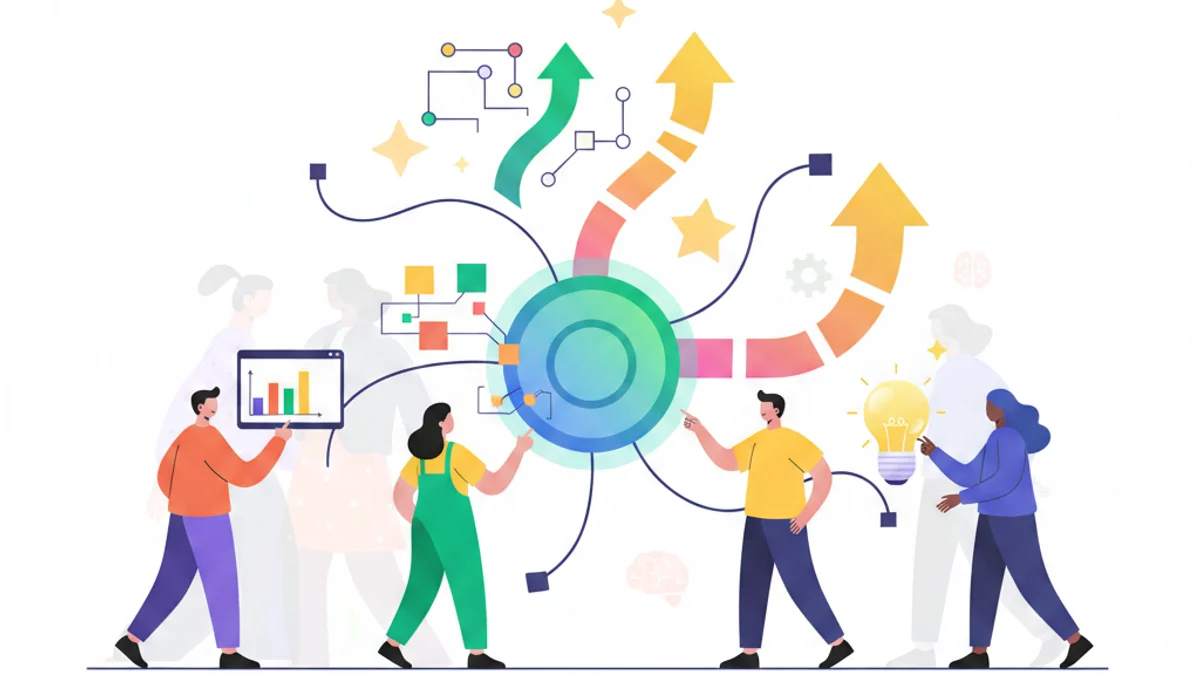
The talent shortage isn't a temporary problem. It's a structural one — driven by skills half-lives shrinking, technology reshaping roles faster than education systems adapt, and demographics that won't reverse. Workforce transformation is the answer. Not reactive hiring, not inflated job requirements, not waiting for a unicorn candidate who doesn't exist. Here's how to build the workforce you need from the talent you already have access to.
TL;DR
The talent shortage is structural, not temporary. The WEF’s Future of Jobs Report 2025 finds 44% of workers’ core skills will change by 2030, 22% of jobs will be disrupted, and 77% of employers plan to respond by upskilling their existing workforce. The companies winning aren’t just training people more — they’re redesigning how talent is attracted, developed, matched, and retained as an integrated system. This guide covers the five transformation levers that actually move the needle.
Key Takeaways
- →The talent shortage is structural. Demographics, shrinking skills half-lives, and the pace of technological change mean the gap will widen without active intervention.
- →75% of organisations struggled to fill full-time roles in 2024. The cause isn’t lack of applicants — it’s applicants whose skills don’t match what’s needed.
- →44% of workers’ core skills will change by 2030. Organisations that aren’t developing talent continuously are falling behind in real time.
- →Upskilling existing talent is consistently cheaper and faster than external hiring — and produces better cultural fit, lower attrition, and stronger institutional knowledge.
- →Skills-based hiring widens the qualified candidate pool immediately, without lowering standards — just changing how standards are assessed.
Why the Talent Shortage Isn’t Going Away
There’s a version of the talent shortage narrative that treats it like a weather system — something to wait out, manage through, and eventually watch pass. Most HR strategies have been written with that assumption. Post more jobs. Increase the salary range. Wait for the market to rebalance.
The problem with that assumption is that the talent shortage isn’t a weather system. It’s a structural condition — the product of forces that are accelerating, not reverting. Three of them are worth understanding directly.
First, the pace of technological change is outrunning talent development systems. The World Economic Forum’s Future of Jobs Report 2025 projects that 22% of jobs will be disrupted by 2030, creating 170 million new roles while displacing 92 million. Educational systems that take four years to produce a graduate can’t keep pace with an economy that creates and obsoletes job categories in half that time. The pipeline will always lag. The question is how wide you allow the gap to become.
Second, skills themselves have a shorter half-life than ever. LinkedIn data projects that by 2030, 70% of the skills used in most jobs will have changed. The average half-life of skills is now under five years — in some technical fields, as low as two and a half. That means a workforce that isn’t continuously developing is continuously becoming less capable relative to what’s needed. You can’t hire your way out of that. The talent you hire today starts depreciating immediately.
Third, credential requirements are artificially narrowing the candidate pool. In the US alone, degree requirements automatically exclude 64% of working-age adults from roles many of them could perform. The WEF estimates this kind of gatekeeping contributes significantly to the mismatch between the 9.9 million open jobs and the 5.8 million unemployed Americans — a gap that isn’t about total bodies, but about artificial barriers to capable talent. These barriers exist in most economies to varying degrees.
According to SHRM’s 2024 Talent Trends report, 75% of organisations struggled to fill full-time roles, citing skills gaps as the primary cause. Not too few applicants — too few applicants with the right skills. That distinction matters enormously for how you respond. If the problem is volume, post more. If the problem is skills, you need a different strategy entirely.
The Five Levers of Workforce Transformation
Workforce transformation isn’t a single initiative. It’s a set of interlocking changes to how talent is acquired, developed, and deployed — each one addressing a different dimension of the talent shortage. Here are the five with the highest leverage.
Lever 1: Skills-Based Hiring — Widen the Pool Without Lowering the Bar
The fastest way to increase the supply of qualified candidates is to change how qualification is assessed. Skills-based hiring replaces or deprioritises credential requirements — degrees, certifications, years of experience — with direct assessment of relevant capability. Candidates prove what they can do through challenges, practical tests, and portfolio evidence rather than through proxies that correlate with capability but don’t measure it.
The impact on candidate pool size is immediate and significant. The WEF has identified skills-first approaches as one of the most effective strategies for addressing global talent shortages — specifically because they access talent that traditional credential requirements systematically exclude: career changers, self-taught practitioners, candidates from non-traditional educational backgrounds, and people whose most relevant skills are recent and therefore not yet reflected in formal qualifications.
This isn’t about accepting lower standards. It’s about applying higher ones — because a well-designed skills challenge is a more reliable predictor of job performance than a degree certificate. You end up with better information about more candidates. Both outcomes serve the organisation.
Lever 2: Internal Mobility — The Pipeline You Already Have
Most organisations are sitting on an underutilised talent asset: their existing workforce. The employees already inside the organisation carry institutional knowledge, established relationships, and proven cultural alignment that no external hire can match immediately. When a skills gap emerges, the first question should be whether it can be closed internally before the first external job posting goes live.
Internal mobility programmes — structured pathways for employees to move laterally, upward, or into emerging roles — address talent shortages from the inside. Deloitte research shows that skills-based organisations are 98% more likely to retain top performers than organisations without structured development pathways. The mechanism is intuitive: employees who can see a clear path for growth within the organisation are significantly less likely to look for it outside.
The practical infrastructure for internal mobility includes: a skills inventory that maps current employee capabilities; visibility into open roles and project opportunities across the organisation; a development framework that connects current skills to required skills for adjacent roles; and a culture that actively encourages and rewards internal moves rather than treating them as a threat to the losing manager’s headcount.
Lever 3: Integrated Upskilling — Continuous Development as a Business Process
The WEF’s Future of Jobs Report 2025 found that 77% of employers plan to upskill their existing workforce in response to AI and automation. The challenge isn’t the decision to upskill — most organisations have made that decision. The challenge is making upskilling systematic rather than episodic.
Episodic upskilling — a training day here, a conference budget there, a LinkedIn Learning subscription that nobody uses — doesn’t close structural skills gaps. It produces isolated capability improvements that rarely transfer to business outcomes. Systematic upskilling is different. It starts with a clear view of the skills the organisation needs now and in two to three years. It maps those needs against the current workforce’s capabilities. And it builds a continuous development programme designed to close the specific gaps that matter, rather than offering a generic catalogue and hoping people self-direct toward what the business needs.
The most effective approach integrates upskilling into the talent lifecycle end-to-end:
- Pre-hire: Learning pathways for near-miss candidates who have the right foundations but need targeted development before they’re ready to join — converting future potential into current pipeline.
- Onboarding: Role-specific learning tracks that accelerate time-to-productivity and reduce the productivity ramp-up cost of every new hire.
- In-role: Continuous development tied to performance goals and career progression, delivered in formats that fit into the working day rather than requiring extended absences.
- Transition: Reskilling support for employees whose current roles are being transformed by automation, retaining institutional knowledge while developing new capability.
Around three-quarters of Millennials and Gen Z workers say they would quit a job that didn’t offer the chance to learn new skills, according to WEF research. Integrated upskilling isn’t just a supply-side strategy for closing skills gaps — it’s a retention strategy for the workforce segment that will dominate the labour market for the next three decades.
Lever 4: Proactive Talent Pipelines — Hiring Before You Need To
Reactive recruitment — sourcing from scratch when a role opens — is the most expensive and least effective way to fill positions in a tight talent market. The candidates you most want are rarely available on the exact timeline you need them. The ones who are available immediately are often the ones with fewer options — which tells you something.
Proactive talent pipelines change the economics of hiring by building and maintaining relationships with qualified candidates before specific roles open. A talent community platform does this at scale: candidates engage with employer content, complete challenges, develop skills, and maintain a relationship with the brand — all while recruiters build knowledge of their capabilities and availability. When a role opens, the first candidates to evaluate are the ones already in the community, pre-qualified and pre-engaged.
The time savings are significant — Jobful clients consistently report reductions in time-to-hire of up to 40% when recruiting from an active talent community versus cold sourcing. The quality improvement is equally significant: community candidates have already demonstrated their skills through challenges, expressed genuine interest in the employer, and developed familiarity with the company culture. That’s a materially different starting point than a cold application from a job board.
Lever 5: People Analytics — Anticipating Gaps Before They Become Crises
Most workforce planning is still retrospective: we notice a skills gap when a role is hard to fill, a project stalls, or an employee leaves and we realise we don’t have the capabilities to replace what they did. By then, the cost of the gap is already accruing.
People analytics changes this by building predictive capability into workforce planning. With the right data infrastructure, HR can identify which teams are at retention risk before people leave, which skills are becoming obsolete in the current workforce before they become gaps, which roles are likely to open based on historical attrition and growth patterns, and which internal candidates are ready for development into future-critical capabilities.
A recent survey found that four in five executives say generative AI will change employee roles and skills — but only 28% have assessed the potential impact of generative AI on their current workforce. That gap between awareness and action is exactly the space where people analytics creates value: turning a vague sense that change is coming into specific, actionable data about what needs to change, for whom, and when.
Reactive vs. Transformative: What the Difference Looks Like
| Dimension | Reactive approach | Transformative approach |
|---|---|---|
| Hiring trigger | Role opens → start sourcing | Talent community built → roles filled from pipeline |
| Candidate qualification | Credentials + CV screening | Skills challenges + demonstrated capability |
| Skills gap response | Post externally, hope the right candidate applies | Upskill internally + targeted external pipeline |
| Near-miss candidates | Declined, ATS archived, forgotten | Added to community, given learning pathway, nurtured to future hire |
| Workforce planning | Annual headcount planning based on current needs | Predictive analytics based on attrition patterns, skills trends, business roadmap |
| Learning & development | Separate function with its own budget and calendar | Integrated into talent lifecycle from pre-hire through succession |
The Cost of Inaction
It’s tempting to treat workforce transformation as a long-term investment that can be deferred while more urgent fires are fought. The problem with that logic is that the talent shortage is itself one of the urgent fires — and it’s burning hotter every quarter you don’t act.
Gallup estimates that a 100-person company spends an average of $2.6 million annually replacing lost talent, with the cost of replacing a single employee running from half to twice their annual salary. That’s the reactive cost of not having a development and retention strategy that gives people reasons to stay.
Skills-based organisations — those that have made the shift to assessing capability over credentials, developing talent continuously, and building proactive pipelines — are 98% more likely to retain top performers than those that haven’t. That single metric, multiplied across an organisation’s headcount, represents an enormous financial difference over three to five years.
The talent shortage will get harder to solve from a standing start every year you wait. The organisations building their transformation infrastructure now are buying time advantage. Every cohort that completes a skills pathway, every community member who converts to a hire, every internal mobility move that retains an employee who would otherwise have left — these compound. The reactive organisation gets more reactive. The transformative organisation gets better at transformation. The gap between them is not closing.
Where to Start
Workforce transformation doesn’t require a five-year programme before you see results. The five levers described above each have entry points that deliver value within a single hiring cycle. Here’s a practical sequencing:
- Month 1–3: Audit your top three hardest-to-fill roles. Identify what credential requirements are genuinely predictive of performance and which ones are inherited habit. Remove the latter. Add one skills challenge to the process for each role. Measure completion and quality.
- Month 3–6: Map your current workforce skills against the capabilities your business will need in two years. Identify the five highest-priority gaps. Design development pathways for each. Begin recruiting for talent community membership, not just open roles.
- Month 6–12: Activate your talent community platform. Begin nurturing near-miss candidates with learning pathways. Implement internal mobility visibility so employees can see and act on development opportunities within the organisation.
- Year 2+: Build predictive people analytics. Track skills development outcomes alongside business performance metrics. Scale the programmes that demonstrate ROI. The transformation becomes self-sustaining when the data makes the case for continuous investment.
None of these steps require you to wait until the whole system is designed. Each one delivers value immediately and creates the foundation for the next. That’s the point of a transformation approach: you don’t need to have solved the problem before you start improving it.
Build the Workforce Infrastructure That Outlasts Any Talent Shortage
Jobful integrates skills-based assessment, talent community management, learning pathways, and people analytics in one platform — designed to shift your organisation from reactive hiring to proactive workforce development.
- ✓ Gamified challenges that assess skills before the first interview
- ✓ Integrated learning pathways that develop near-misses into future hires
- ✓ Up to 40% reduction in time-to-hire from talent community vs. cold sourcing
Key Statistics
44%
of workers’ core skills will change by 2030
WEF Future of Jobs Report 2025
75%
of organisations struggled to fill full-time roles in 2024
SHRM 2024 Talent Trends
98%
more likely to retain top performers: skills-based orgs vs. traditional
Deloitte Human Capital Research
Frequently Asked Questions
What is workforce transformation?
Workforce transformation is the deliberate redesign of how an organisation attracts, develops, deploys, and retains talent to keep its workforce capabilities aligned with evolving business needs. It includes skills-based hiring, internal mobility pathways, integrated upskilling, proactive talent pipelines, and people analytics — working as an integrated system rather than isolated initiatives.
What is causing the current talent shortage?
The talent shortage has structural causes: technological change outpacing talent development systems, skills with shrinking half-lives becoming obsolete faster than workforces can adapt, demographic trends reducing available talent pools, and credential requirements artificially excluding capable candidates. These forces are accelerating, not reversing. Reactive hiring strategies address symptoms; workforce transformation addresses causes.
How does skills-based hiring help address the talent shortage?
Skills-based hiring removes or deprioritises degree requirements and evaluates demonstrated capability instead. In the US, degree requirements automatically exclude 64% of working-age adults from roles many could perform. Skills-based hiring doesn’t lower standards — it changes how they’re assessed. Candidates prove capability through challenges and practical tests rather than credentials that proxy for it. The WEF identifies skills-first approaches as one of the most effective strategies for addressing global talent shortages.
What is the ROI of upskilling vs. hiring externally?
Upskilling is consistently more cost-effective than external hiring for closing skills gaps. Gallup estimates a 100-person company spends $2.6 million annually replacing lost talent. Upskilling avoids most of those costs while improving retention: skills-based organisations are 98% more likely to retain top performers, according to Deloitte. Upskilled employees also carry institutional knowledge and cultural alignment that new hires take months or years to develop.
How does a talent community help with workforce transformation?
A talent community transforms recruitment from reactive campaign to proactive pipeline. Candidates engage with the employer brand, complete challenges, and develop skills before any specific role opens. When a role does open, the first candidates to consider are pre-qualified and pre-engaged — significantly reducing time-to-hire. With integrated learning pathways, near-miss candidates are developed into future hires rather than discarded, compounding the pipeline value over time.
Frequently Asked Questions
Get More Insights Like This
Join 5,000+ HR professionals receiving monthly insights.