3 claps
Workforce strategy has moved from HR to the CEO's desk. Here's how forward-thinking leaders are using internal talent intelligence, active talent communities, and behavioural data to build organisations that transform at speed.

This page didn't load correctly. Please check your connection and try again.
Workforce strategy has moved from HR to the CEO's desk. Here's how forward-thinking leaders are using internal talent intelligence, active talent communities, and behavioural data to build organisations that transform at speed.
The conversation has changed. Workforce strategy used to live in HR. Today it sits on the CEO's desk, surfaces in board risk reviews, and drives capital allocation decisions at the highest level of the organisation.
This isn't a trend. It's a structural shift — driven by a future of jobs that's transforming faster than traditional hiring cycles can follow, and by a growing recognition that talent is no longer an operational input. It's a strategic variable that determines whether organisations can adapt, compete, and survive.
CEOs who treat workforce strategy as an HR deliverable are already behind. The ones building durable competitive advantage are treating it the same way they treat capital strategy: with foresight, with intelligence, and with an infrastructure that can respond at speed.
Boards have always cared about talent at the executive level — succession planning, C-suite appointments, leadership pipelines. What's changed is the depth of that interest. According to the World Economic Forum's Future of Jobs Report 2025, 39% of existing workforce skills will be transformed or obsolete by 2030. That's not a talent acquisition problem. That's a strategic planning problem — and it lands squarely in the CEO's remit.
McKinsey's research reinforces the stakes: companies in the top quartile for talent management practices generate up to 3.5× more total shareholder return than peers in the bottom quartile. Talent strategy, executed well, is a financial multiplier. Executed poorly — or left to operate reactively — it's a drag on every other strategic initiative the organisation is trying to run.
The shift is also being driven by volatility. Rapid AI adoption, geopolitical disruption, supply chain restructuring, and accelerating automation mean that the workforce a company needs today may be materially different from the one it needs in eighteen months. Reactive hiring — posting a job when a gap appears — is structurally incapable of keeping pace with that rate of change.
CEOs who want to move fast need a talent infrastructure that moves fast with them. That starts with understanding what they already have.
Of current workforce skills will be transformed or obsolete by 2030
World Economic Forum, Future of Jobs 2025
Higher total shareholder return for top-quartile talent management companies
McKinsey Global Institute
Of HR leaders say workforce resilience is now a board-level priority
Deloitte Global Human Capital Trends 2025
Most workforce strategy conversations focus on one thing: who to hire next. That's the wrong starting point. Before any organisation looks outward for talent, it needs a clear-eyed view of what it already has on payroll.
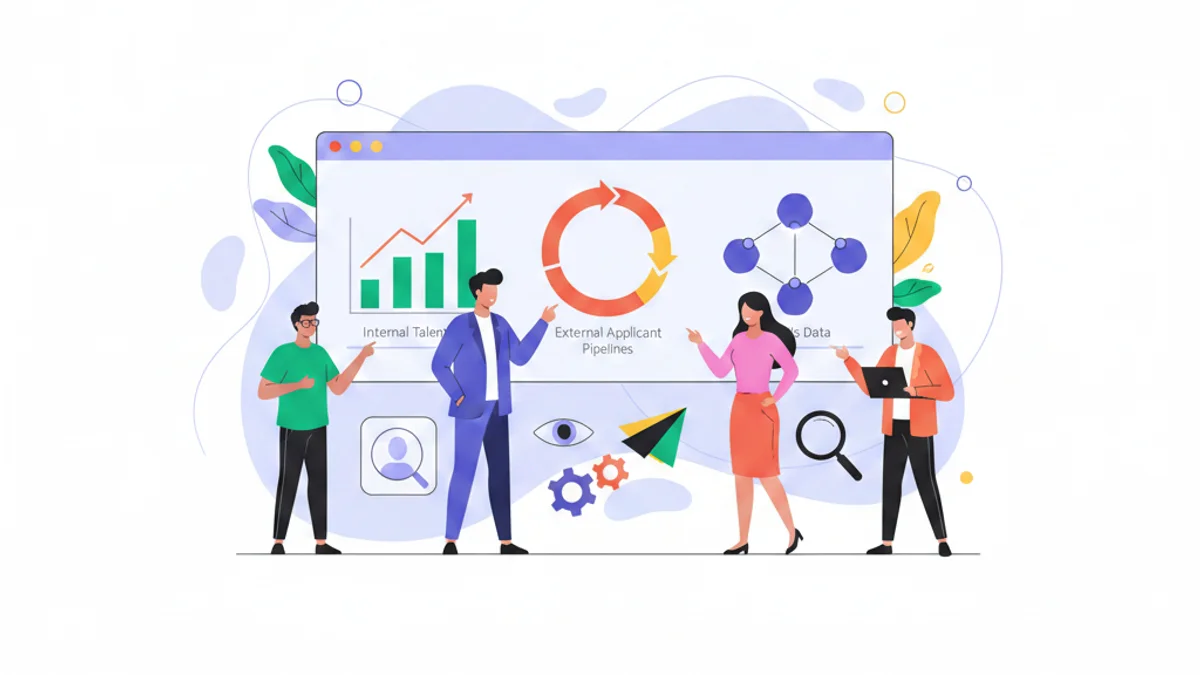
Every organisation is sitting on two distinct talent pools — and most are actively managing only one of them.
The external talent pool is the pipeline of future candidates: past applicants, community members, referrals, event registrants, and passive candidates who've signalled interest in the organisation. This is the pool most TA teams think about when they talk about talent pipelines.
The internal talent pool is the current headcount — every employee across every function, level, and location. This pool is larger, better-known, and more immediately deployable than any external pipeline. It's also almost universally under-mapped. Most organisations know who their people are. Far fewer know what their people are capable of, how they behave under pressure, which direction they're growing — and which direction they're not.
Most executives can answer "how many people do we have?" and "what do they cost?" Far fewer can answer: "Which 15% of our workforce is driving 60% of our strategic outcomes? Which 10% is most at risk of leaving in the next 12 months? And which employees are unlikely to make the transition to the capabilities our strategy requires?"
Those are the questions that separate tactical headcount management from genuine workforce strategy. And they require a different kind of intelligence infrastructure to answer.
Not all employees contribute equally. This isn't a controversial observation — it's a well-documented reality of organisational performance. Research by McKinsey found that in complex, knowledge-intensive roles, top performers deliver 400% more output than average performers. In highly leveraged roles — software engineering, strategic sales, product innovation — the gap is wider still.
These are your 3× and 10× contributors. The professionals who don't just do their jobs — they amplify the work of everyone around them, accelerate strategic initiatives, and carry institutional knowledge that can't be replaced with a job posting. Losing one of them to a competitor typically costs the organisation far more than their salary: it costs momentum, institutional memory, and often client relationships that were built on personal trust.
The problem is identification. Traditional performance management systems — annual reviews, OKR scores, manager ratings — are blunt instruments. They measure what happened, not why. They reflect the outcomes of behaviour without capturing the behavioural signals that predict future performance or flight risk.
This is where talent intelligence — built on engagement data, skills signals, and behavioural patterns — changes the equation. An internal talent community platform that runs gamified challenges, tracks engagement with learning content, and monitors participation signals can surface a much richer picture of who your real performers are and how engaged they remain with the organisation's direction.
Employees who voluntarily engage with role-adjacent challenges — especially those above their current level — are signalling growth orientation and strategic ambition. These are the professionals most likely to step into expanded responsibilities when the organisation needs to move fast. Passive completion tells a different story: adequate but not accelerating.
Sustained high engagement with internal community content — culture updates, strategic communications, development opportunities — correlates strongly with retention and performance. A declining engagement trajectory, even in a technically strong performer, is an early warning signal that deserves a conversation before it becomes a resignation letter.
Employees who actively develop skills outside their current function are building the versatility that makes organisations genuinely agile. Internal talent intelligence that surfaces these cross-functional signals gives workforce planners visibility of internal mobility candidates before a vacancy creates urgency — turning succession planning from a reactive exercise into a proactive one.
High-value contributors tend to be disproportionately active in organisational communities — mentoring peers, contributing to knowledge bases, participating in cross-team initiatives. These behaviours are difficult to capture in a performance review but highly visible in a talent community platform that tracks engagement at the interaction level.
Every workforce transformation has two groups of people: those who lean into change, and those who resist it. The second group is not monolithic — it includes employees who are genuinely struggling with the pace of change and need support, alongside those who have made a deliberate choice not to adapt. Both represent transformation risk. They require different responses.
According to research by Gartner, only 46% of employees feel they have the skills needed to perform effectively in their current role after a major organisational change. That readiness gap widens substantially when the change involves new technology, new ways of working, or significant role redesign. Left unaddressed, it slows transformation timelines, creates pockets of friction in change programmes, and — at its most acute — produces active resistance that undermines initiatives from within.
For CEOs leading planned transformation, the strategic question is how to identify this risk early — before it becomes a programme failure — and how to manage it in a way that's both humane and commercially responsible.
Behavioural intelligence provides part of the answer. Employees who disengage from learning opportunities, who consistently avoid challenges at the edge of their comfort zone, or whose skills engagement has plateaued despite organisational investment in development, are surfacing signals that warrant attention. The goal is not to label people as "resistors" — it's to identify where targeted support, role adjustment, or honest conversation is needed before the transformation timetable forces a harder decision.
The aim of this intelligence is not punitive — it's diagnostic. When HR and people leaders can see these patterns early, they can act early: targeted support, honest development conversations, role redesign, or in some cases, a respectful transition plan that serves both the individual and the organisation. The alternative — discovering the depth of the readiness gap only when the transformation is already underway — is a far more expensive and disruptive outcome for everyone involved.
Internal talent intelligence tells you what you have. External talent community strategy determines what you can access — and how fast.
The traditional model of external talent acquisition is structurally reactive: a role opens, a job is posted, a search begins. For specialist and senior roles, that process typically takes six to twelve weeks from posting to offer. For leadership roles, considerably longer. In a business environment where strategic pivots can happen in days, that timeline is a competitive liability.
An active external talent community eliminates most of that lag. Instead of starting from zero when a need emerges, organisations with a pre-built, actively engaged talent pool can move from identification to shortlist in days — because the relationship work has already been done. Candidates in an active community know the employer brand, have demonstrated relevant capabilities through challenges, and have signalled their intent through sustained engagement.
According to Jobful platform data, organisations with active talent communities fill roles up to 4× faster than those relying on open-market sourcing — with measurably higher candidate quality at shortlist stage. The investment in community building isn't a recruitment cost. It's an agility investment that pays dividends every time the business needs to move at speed.
Strategic talent community building happens continuously — not in response to open roles. The organisation identifies the skill clusters and functional areas it will need in the next 12–24 months and builds community pipelines around those profiles today. When the business need materialises, the pipeline is already warm.
This is workforce foresight in practice: not predicting the future perfectly, but reducing the time and cost of responding to it when it arrives.
The talent communities that convert are those where candidates receive something worth engaging with: skills challenges that develop real capabilities, employer brand content that reflects genuine culture, and early access to opportunities that make membership feel exclusive rather than transactional.
Job alerts are not community engagement. They're a broadcast channel. True community requires reciprocal value — and the organisations that deliver it build the kind of candidate loyalty that withstands competitive offers from elsewhere.
When a role opens, the shortlisting process should start with a data query, not a sourcing campaign. Filter the community by skills signals, engagement level, intent score, and role fit — and surface the candidates who are most ready, most qualified, and most likely to say yes. The search is already done.
This is what separates a talent community from a talent database: the intelligence layer that makes the data actionable when the moment demands it.
Talent intelligence is only as good as the signal it generates. And the quality of the signal depends entirely on the quality of the experience that produces it.
Generic assessments produce generic data. A standardised cognitive test tells you something about processing speed; it tells you almost nothing about how a candidate approaches ambiguity, how they respond to setbacks, or whether their values align with your organisation's direction. Behavioural intelligence — built through personalised, engaging experiences — is a fundamentally richer source of insight.
Gamification is the delivery mechanism. Not gamification in the superficial sense of badges and leaderboards — but genuinely engaging, role-relevant challenges that candidates and employees want to complete because they're interesting, because they develop real skills, and because they create a fair and transparent picture of capability. According to a 2024 report by TalentLMS, 89% of employees say gamified experiences make them feel more productive and engaged at work.
The personalisation dimension matters as much as the gamification. When the experience adapts to the individual — presenting challenges at the right level, serving content relevant to their function and development trajectory, and reflecting the employer brand in a way that resonates with their priorities — it generates engagement data that is genuinely predictive. This is the intelligence layer that transforms both internal talent management and external community engagement from gut-feel exercises into data-driven strategic capabilities.
Role-relevant, adaptive challenges that reveal how candidates and employees actually think, problem-solve, and perform under realistic conditions — not how well they can describe past experience in writing.
Every interaction — challenge attempt, content engagement, community participation — generates a behavioural data point that builds toward a multi-dimensional talent profile. Aggregated over time, these signals predict performance and flight risk with far more accuracy than CV review alone.
Content, challenges, and communications adapt to each individual based on their function, level, skills profile, and engagement history. The result is an experience that feels relevant rather than generic — and generates higher-quality signal as a consequence.
Aggregated signals feed into dynamic intent and readiness scores — for external candidates (how engaged and likely to convert) and internal employees (how ready for the next step, and how aligned with the organisation's transformation direction).
Jobful is built for exactly this strategic context. The platform connects internal and external talent management into a single intelligence ecosystem — giving organisations the tools to map their current workforce, build active external pipelines, engage both groups with personalised experiences, and surface the intelligence needed to make workforce strategy decisions with confidence rather than instinct.
| Strategic Capability | What Jobful Delivers | Business Outcome |
|---|---|---|
| External Talent Community | Branded community platform, engagement flows, gamified challenges for external candidates | Active pipeline ready before vacancies open — up to 4× faster time-to-hire |
| Internal Talent Engagement | Internal community, skills challenges, development content, and engagement tracking for current employees | Visibility of 3× performers, flight risk signals, and transformation readiness scores |
| Gamified Assessments | Role-relevant, adaptive challenges that generate behavioural intelligence across both pools | Richer, more predictive talent data than CV review or standard testing alone |
| Personalised Experience | Adaptive content and challenge paths that respond to individual profile, function, and trajectory | Higher engagement, better signal quality, stronger employer brand perception |
| Workforce Intelligence | Intent scoring, readiness mapping, pipeline analytics — queryable in real time | Strategic foresight: skills gap visibility, scenario modelling, succession planning |
| Employer Branding Integration | Culture content distribution through community touchpoints — internal and external | Consistent brand experience across the full talent lifecycle, from first touchpoint to employee exit |
Raiffeisen Bank's deployment of Jobful illustrates the internal intelligence use case: building an active talent community across their workforce gave HR leaders genuine real-time visibility of their talent landscape for the first time — enabling proactive pipeline management and succession planning that had previously been impossible with their legacy ATS infrastructure.
HEINEKEN Romania's experience demonstrates the external pipeline impact: by building an active talent community anchored in gamified challenges, they achieved 43% more applications while simultaneously improving the signal quality of every application — reducing screening time and increasing the percentage of candidates who reached final stages from a standing start.
Workforce strategy infrastructure — talent community platforms, behavioural intelligence tools, internal engagement systems — is often evaluated as a recruitment cost. That framing undersells both the investment and its return.
The right frame is agility infrastructure. The organisations that build it before they need it — before the restructure, before the market shift, before the technology change — are the ones that respond in weeks rather than quarters. Those that don't build it spend the crisis period scrambling for talent that their better-prepared competitors already have in a warm pipeline.
For a CEO, that's not an HR investment. It's a strategic risk management decision.
The future of jobs is not waiting for organisations to get ready. It's arriving in waves — AI capability shifts, skills obsolescence cycles, demographic changes in the labour market, and the ongoing restructuring of what work actually looks like. CEOs who are navigating this landscape reactively are perpetually catching up.
The answer is not to predict the future with precision — it's to build the capability to respond to it at speed. Active talent communities, internal and external, are the infrastructure that makes speed possible. Behavioural intelligence is the system that makes the right decisions visible. And a platform that connects all of this — that makes talent strategy queryable, actionable, and continuously updated — is what separates organisations that lead transformation from those that survive it.
Workforce strategy is the CEO's agenda item. Jobful is built to support the ambition that comes with it.
See how Jobful connects internal talent intelligence, external talent community, and personalised engagement into a single platform built for strategic workforce leadership.
Workforce strategy is the systematic approach to building, developing, and deploying talent in alignment with business goals — covering both current headcount and future hiring pipelines. It has become a CEO priority because skills obsolescence, AI-driven role transformation, and market volatility mean that talent decisions now directly determine an organisation's ability to execute its strategy. Reactive hiring can no longer keep pace with the speed at which the business environment changes.
An external talent pool is a pre-built pipeline of future candidates — past applicants, community members, referrals, and passive talent engaged through an active talent community. An internal talent pool is the current headcount: every employee across the organisation, mapped by skills, performance trajectory, engagement level, and transformation readiness. Effective workforce strategy actively manages both, using intelligence from each to inform decisions about the other.
Gamification generates behavioural signal data that traditional assessments cannot produce at scale. When candidates and employees engage with role-relevant challenges, their approach, persistence, problem-solving patterns, and skill development trajectory all become visible as data points. Aggregated over time, these signals build a multi-dimensional talent profile that predicts performance, flight risk, and transformation readiness with far greater accuracy than CV review or annual performance ratings alone.
High-value contributors — the 3× and 10× performers who drive disproportionate organisational outcomes — are often not fully visible through standard performance management systems. Talent intelligence platforms that track engagement with development content, skills challenge completion patterns, cross-functional collaboration signals, and engagement trajectory over time surface a richer picture of who is genuinely accelerating the organisation — and who is at risk of leaving or disengaging.
Workforce agility is the organisational capability to redeploy, upskill, and acquire talent at the pace the business requires — rather than at the pace traditional hiring allows. In practice, it means having active external talent pipelines that reduce time-to-hire from weeks to days, internal talent maps that identify mobility candidates before vacancies create pressure, and skills intelligence that surfaces readiness gaps before they become programme blockers.
Transformation resistance exists on a spectrum — from employees who need structured support to adapt, to those who have made a choice not to grow in the direction the organisation requires. Early identification through behavioural signals allows people leaders to intervene with targeted support, role redesign, or honest development conversations before the transformation timetable forces a harder decision. The goal is diagnostic, not punitive: addressing the readiness gap humanely and early produces better outcomes for the individual and the organisation than discovering it mid-programme.
Join 5,000+ HR professionals receiving monthly insights.