16 claps
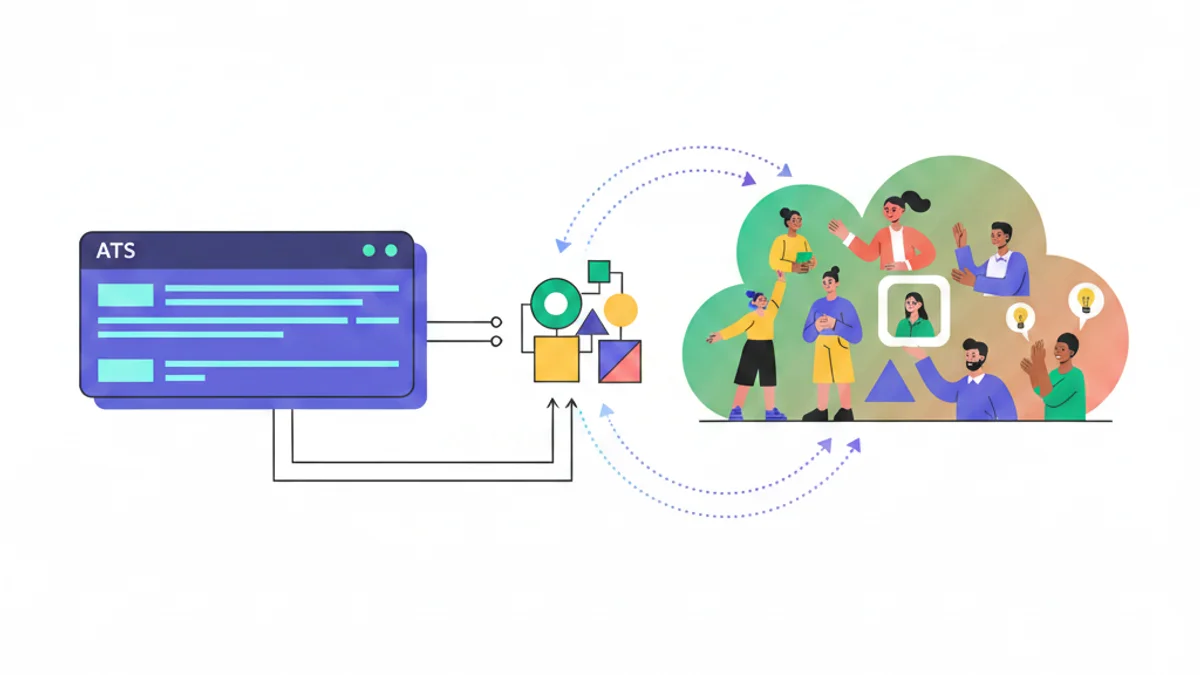
An ATS tracks applicants. A talent community engages prospects. Here is the decision framework — and the four-question audit — that tells you whether to replace your ATS or extend it.

This page didn't load correctly. Please check your connection and try again.
An ATS tracks applicants. A talent community engages prospects. Here is the decision framework — and the four-question audit — that tells you whether to replace your ATS or extend it.
Your ATS is not the problem. The way you are using it is. Most ATSs were built for one job — moving named applicants from "applied" to "hired" — and they do that well. The trouble starts when TA leaders ask the same tool to engage talent that has not applied yet, nurture passive prospects, and predict who will actually perform once hired. That is talent community work. And no major ATS has been engineered for it.
This piece is for the CHRO, Head of TA, or HR Director staring at a renewal contract and asking the right question: do we replace the ATS, or extend it with a talent community platform? Both answers are valid. The wrong answer costs you 12–18 months and seven figures.
An applicant tracking system was designed to manage the legal and operational paperwork of hiring people who have already raised their hand. Job requisition workflow, EEO/GDPR compliance, interview scheduling, offer management, hand-off to onboarding — that is the job an ATS does. And for that scope, modern ATSs are perfectly competent.
The trouble is what happens before someone applies. According to LinkedIn's 2024 Future of Recruiting report, only 30% of the workforce is actively job-seeking at any moment. The other 70% is passive. Your ATS cannot reach them — it has no surface area for non-applicants. It is structurally a black box: data goes in when someone applies, and very little comes out before that.
Here is the unintended consequence. TA teams sit on databases of 50,000–500,000 historical applicants and treat them as a "talent pool." But the engagement rate on these databases averages under 1% (Aptitude Research, 2024). They are not pools. They are graveyards.
Of enterprise ATS records are dormant after 12 months
Bersin by Deloitte, 2024
Of the workforce is passive — invisible to your ATS
LinkedIn Future of Recruiting, 2024
Average engagement rate on historical ATS databases
Aptitude Research, 2024
A talent community turns your candidate database into a live, two-way relationship. Where the ATS is a transaction log — application in, decision out — a talent community is a continuous engagement layer that exists whether or not a job is open. It is where passive talent learns about your company, completes challenges, signals interests, and self-qualifies before any role goes live.
Three capabilities define a real talent community — and they are precisely the three an ATS does not provide.
Branded content, learning paths, gamified challenges that prospects engage with months before a role opens — building familiarity, fit, and intent data your ATS will never see.
Course completions, challenge scores, event attendance, time-on-task. Real performance predictors — not credentials. Gamified assessments score 65%+ on job-performance prediction versus 14% for unstructured interviews (Schmidt and Hunter, meta-analysis).
Members come back to a community. They do not come back to an ATS. That difference is everything when your time-to-hire benchmark is 12 days, not 60.
A talent community is a branded, opt-in environment where prospective candidates engage with your employer brand through content, assessments, and challenges — generating consent-based first-party data that flows into hiring decisions when roles open. It is not a CRM. It is not a careers page. And it is definitely not an ATS module bolted on as "candidate relationship management."
Replace the ATS only when it is structurally blocking you. Extend it when the engagement gap — not the system of record — is what's broken. Most TA leaders confuse the two and reach for "rip and replace" when "layer and integrate" would have delivered the same business outcome in a third of the time.
Here is the decision in plain language. Three conditions. All three must be true to justify replacement.
Your ATS cannot expose stable APIs, lacks webhooks for state changes, or charges per-API-call in a way that makes integration economically irrational. If extending requires you to scrape your own data through a fragile UI, the ATS is the bottleneck.
Test: count the workarounds your team built in the last 12 months. More than five? Structural.
Some legacy ATSs reject any data record without a job-application context. If a prospect cannot exist without an open requisition, your community layer cannot deposit data into the ATS at all — and you end up with two parallel systems.
Test: ask your vendor to demo storing a "prospect" record (no job, no requisition). If they cannot, it is structural.
According to Aptitude Research, the median ATS replacement runs 14 months and consumes 1.8x its license cost in change-management spend. Run the math: if the savings from consolidating 3 tools into 1 are €400K/year, replacement is justifiable up to ~€800K total switch cost. Above that, the payback breaks.
Test: get an itemised migration quote — data, integrations, training, parallel-run period. Compare to 24 months of consolidation savings.
If all three conditions hold, replace. If any one of them does not, extend.
Run this audit in a single afternoon with your TA leadership team. The answers tell you which path fits — without weeks of vendor demos.
An ATS and a talent community are not interchangeable. They overlap on roughly 15% of features and diverge sharply on the rest. Reading the table below as "two products doing the same thing" is what leads to bad procurement decisions.
Treat the ATS as the system of record. Treat the talent community as the system of engagement. The two should integrate — not compete.
| Capability | ATS (system of record) | Talent community (system of engagement) |
|---|---|---|
| Primary unit of data | Application against a requisition | Member relationship over time |
| Pre-applicant engagement | None — record requires a job | Core function — challenges, content, events |
| Behavioural data capture | CV fields, screening answers | Challenge scores, course completions, time-on-task |
| Compliance and audit | Strong — built for EEO/GDPR | Consent-based; integrates with ATS audit trail |
| Time-to-hire impact | Marginal — workflow only | Direct — pre-qualified pipeline at requisition open |
| Brand-building surface | Job-postings only | Branded environment, content, gamified challenges |
| Re-engagement | Manual mass-mail; low return rate | Designed for repeat visits; community dynamics |
| Best-fit owner | Recruiting operations / compliance | Talent acquisition + employer brand |
Whichever route you choose, do not let it stretch past 90 days for the first measurable outcome. If a vendor cannot promise a working pilot in that window, walk away. The HEINEKEN Romania deployment hit measurable lift in week 7. Read the full case study.
Map your ATS data model. Confirm available APIs and webhooks. Connect the talent community platform to the ATS so member-to-applicant conversion is automatic. No manual exports.
Pick one role family — early-career, technical, or volume hospitality. Stand up a branded community space, three challenges, and a content calendar. Measure member acquisition, challenge completion, and intent-to-apply.
Open the next requisition for that role family. Convert qualified members directly into your ATS — they enter pre-screened. Report time-to-hire, quality-of-hire signal, and cost-per-hire deltas to your CHRO and CFO.
Replacement is a 9–14 month commitment. Do not pretend it is shorter. The 90-day window here is for the decision and procurement phase only — vendor selection, statement of work, and parallel-run plan. Actual cutover happens later.
If you are replacing, build the community-first capability into the new platform's procurement requirements from day one. Do not buy an ATS and bolt on a community later. That is how you end up with the same problem in a new wrapper.
Extending the ATS with a talent community changes how you report to the executive team. The metrics shift from operational to strategic — and your CFO will start paying attention to recruiting numbers in a way they never did before.
Three reporting changes show up immediately:
Community size and engagement become predictive metrics. Boards start asking "how many qualified members do we have for next quarter's hiring plan?" — before requisitions open.
Wyndham Hotels reduced reliance on paid sourcing channels after launching a branded talent community — application volume rose 290% with no incremental ad spend.
Industry benchmark sits at 36–60 days (SHRM). Community-first hiring routinely lands at 12–18 days because pre-qualified members are already in the funnel when the requisition opens.
Behavioural signals from community challenges feed into 6- and 12-month performance reviews. You finally have a feedback loop between hiring decisions and business outcomes.
When the talent community sits alongside the ATS, recruitment stops being a cost line and starts being a workforce-readiness asset. CHROs report headcount confidence, not headcount panic. CFOs see pipeline value the way they see sales pipeline value.
That is the strategic difference. Not "another tool" — a different conversation with your executive team.
If you remember nothing else: replace your ATS only when it blocks integration; extend it when the gap is engagement, not workflow.
Eight in ten enterprises end up extending. The minority who replace are usually escaping a 10-year-old platform that never modernised. Either way, the talent community is the layer doing the strategic work — and the ATS becomes what it was always meant to be: the quiet, reliable system of record behind it.
See how Jobful's talent community layer plugs into your existing ATS — and delivers a measurable lift in 90 days, without ripping anything out.
Join 5,000+ HR professionals receiving monthly insights.