
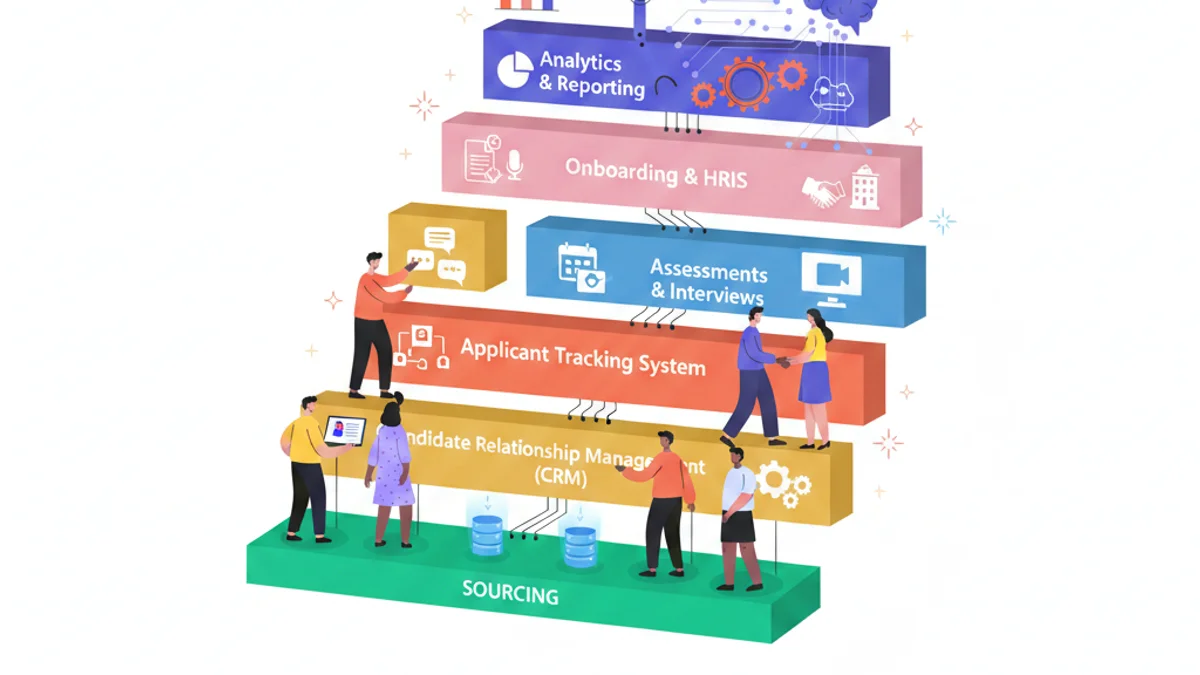
Most enterprise TA teams run 6–12 disconnected recruitment tools — creating integration debt, duplicated spend, and data blind spots. Here's the 30-day audit framework to fix that.
Your talent acquisition tech stack is either your competitive edge or your biggest bottleneck. There is no middle ground. Most enterprise TA teams today operate with six to twelve disconnected tools — an ATS that can't talk to their CRM, a sourcing tool that feeds data nowhere, and a reporting layer built on manual exports. The result: slower hiring, duplicated spend, and recruiters who spend more time managing software than managing candidates.
This guide gives TA Directors and CHROs a practical framework for auditing what they have, identifying what's costing them, and deciding whether consolidation is the right move in 2026.
What you need to know in 60 seconds
- → The average enterprise recruitment tech stack now spans 6–12 tools — creating integration debt, duplicated costs, and data blind spots that slow hiring decisions.
- → According to Aptitude Research, organisations with integrated TA tech stacks fill roles 30% faster than those with fragmented toolsets — the gap is widening as AI adoption accelerates.
- → A 30-day tech stack audit follows five steps: map your current tools, score integration quality, calculate true cost of ownership, identify redundancy, and build a consolidation brief.
- → Unified platforms win on data continuity and candidate experience — not just cost. A single data layer means every recruiter works from the same picture of the same candidate.
- → HEINEKEN Romania consolidated community engagement, gamified assessment, and employer branding into one platform — the result was 43% more qualified applications with no increase in sourcing spend.
- → The right question isn't "which tools are best?" but "which tools do we actually need to meet this year's hiring targets?" Audit first, evaluate second.
What a Talent Acquisition Tech Stack Actually Includes
A talent acquisition tech stack is the full set of software tools a recruiting function uses — from the first moment a candidate discovers your employer brand to the day they sign their offer letter. That's the definition. What it looks like in practice varies enormously by organisation size, hiring model, and how much legacy debt has accumulated over the years.
Most stacks have grown organically rather than by design. A team adds an interview scheduling tool because the ATS one is clunky. They bolt on a sourcing platform because LinkedIn Recruiter doesn't integrate cleanly. Six years later, the stack has ten subscriptions, three of which are used by fewer than two people.
Understanding what you have — properly categorised — is the prerequisite to any intelligent consolidation decision. Modern TA stacks cover six distinct functional layers.
Layer 1: Sourcing & Attraction
Job boards, LinkedIn Recruiter, employer branding platforms, social recruiting tools, and talent community software. This layer generates the top of your candidate funnel.
Layer 2: Applicant Tracking
Your ATS is the system of record — the central database for active applications, pipeline stages, and recruiter workflows. Workday, Greenhouse, Lever, SmartRecruiters, and SAP SuccessFactors dominate the enterprise tier.
Layer 3: Screening & Assessment
Skills tests, gamified assessments, video interviews, cognitive assessments, and structured screening questionnaires. This layer determines who advances — and how reliably you can predict performance.
Layer 4: Interview & Scheduling
Calendar coordination, video interviewing platforms (Teams, Zoom, HireVue), and structured interview guides. The friction in this layer directly impacts offer acceptance rates.
Layer 5: Analytics & Reporting
Recruitment dashboards, time-to-fill tracking, source-of-hire attribution, and DEI metrics. In fragmented stacks, this layer is usually a spreadsheet pulling from five different exports.
Layer 6: Talent Community & CRM
Passive candidate nurturing, talent pool management, re-engagement campaigns, and community engagement tools. This layer is the one most teams underinvest in — and the one that pays the longest-term dividend.
Faster time-to-fill for organisations with integrated TA tech stacks vs fragmented toolsets
Aptitude Research, 2025
Of TA leaders say their tech stack has integration gaps that affect data quality and reporting
LinkedIn Talent Trends Report, 2025
Average annual cost of a mid-tier recruitment tech tool — most enterprises run 6–12 simultaneously
Fosway Group HR Realities Research, 2025
Warning Signs: When Your Recruitment Tech Stack Becomes a Liability
A bloated recruiting tech stack doesn't announce itself. It accumulates quietly — tool by tool, workaround by workaround — until one day your head of TA is spending two hours every Friday reconciling candidate data across three systems before they can produce a report the business actually uses.
According to a 2025 Fosway Group study, 47% of HR technology buyers in European enterprises report that their biggest recruitment technology problem is not the tools themselves — it's the integration between them. The tools work. The stack doesn't.
Here are the signals that your current TA tech stack is costing you more than it's worth.
Recruiters maintain manual tracking sheets alongside the ATS
If your team has built shadow systems in Excel or Notion to compensate for ATS limitations, the ATS is not doing its job. This is the clearest signal that your system of record has lost recruiter trust.
You can't answer "where did this hire come from?" without guesswork
Source-of-hire attribution requires a clean data flow from first touchpoint to offer. If sourcing, ATS, and career site are not integrated, every source-of-hire conversation becomes an estimate. You can't optimise what you can't measure.
Candidate data exists in multiple places with no single source of truth
When the same candidate appears in your LinkedIn CRM, your ATS, and your talent community platform as three separate records, your team is making decisions with incomplete information — and likely re-contacting people who've already applied or declined.
New tool onboarding takes weeks and faces internal resistance
When every new tool requires its own training programme, its own login, and its own change management effort, adoption is always partial. Partial adoption is worse than no adoption — it creates inconsistent data and two-tier workflows within the same team.
Monthly subscription costs are growing faster than hiring volume
This is the CFO's early warning signal. If your TA tech spend increases 20% year-over-year but your hiring output grew only 8%, the stack is not scaling efficiently. The maths will eventually prompt a forced consolidation — better to do it on your terms.
Fragmented Stack vs Unified Platform: The Real Trade-offs
Unified recruitment platforms are not the answer to every problem. Best-of-breed stacks still win in highly specialised scenarios — executive search, technical assessments for engineering roles, compliance-heavy regulated industries. The decision is never "unified vs best-of-breed" in the abstract. It's about which configuration best serves your specific hiring model at your current scale.
Here's how the two approaches compare across the dimensions that matter most.
| Dimension | Fragmented Best-of-Breed Stack | Unified Recruitment Platform |
|---|---|---|
| Data continuity | Requires custom integrations; gaps are common. Candidate records fragment across tools. | Single candidate record across all stages. Attribution and journey data are native. |
| Feature depth | Each layer can be best-in-class for its function. Maximum specialisation. | Core features are solid; very specialised use cases may need supplementary tools. |
| Recruiter experience | Multiple logins, context switching, different UX patterns per tool. High cognitive load. | Single interface, consistent UX. Onboarding faster, adoption higher. |
| Total cost | Higher per-tool costs plus integration maintenance. Hidden IT and admin overhead. | Typically 20–40% lower total cost of ownership. One vendor relationship to manage. |
| Candidate experience | Inconsistent — candidates may interact with four different interfaces in one process. | Consistent brand experience from first touchpoint to offer. Lower drop-off rates. |
| Reporting & analytics | Manual aggregation required. Reports are retrospective and time-consuming to produce. | Real-time dashboards. Metrics span the full funnel without data reconciliation. |
| Scalability | Each tool scales independently. Integration debt grows as hiring volume increases. | Scales with one contract. Capacity, features, and users expand in a single motion. |
| Best for | Highly specialised hiring needs, regulated industries, executive search, or niche technical hiring. | Mid-market to enterprise teams with high volume, multi-location, or multi-brand hiring. |
How to Audit Your TA Tech Stack in 30 Days
A tech stack audit answers one question: are you getting the return you're paying for? Not just in cost terms — in hiring velocity, candidate quality, and recruiter productivity. Done properly, a 30-day audit gives you the evidence base for every technology decision that follows.
Here's the five-step process used by TA leaders who've run consolidations that actually stick.
Map every tool currently in use (Days 1–5)
Build a complete inventory: tool name, primary function, annual cost, number of active users, integration points, and who owns the contract. Include tools used by individuals or teams that aren't officially sanctioned — shadow IT is part of the stack whether it's on the budget sheet or not.
Output: a single spreadsheet with every tool, its function layer, cost, and user count. This is your baseline.
Score integration quality for each tool pair (Days 6–10)
For every two tools that should exchange data, rate the integration: native (2-way, real-time), API (configured, reliable), manual (CSV exports), or broken (no current connection). Assign a score: 3 for native, 2 for API, 1 for manual, 0 for broken.
A total integration score below 60% of the maximum possible is a clear signal that data quality is compromised across your stack.
Calculate true cost of ownership — not just licences (Days 11–15)
Licence fees are the visible cost. Add: IT integration and maintenance time (hours × internal rate), recruiter hours spent on manual workarounds, training and onboarding time for new hires, and the cost of data quality issues (re-contacting candidates, duplicate outreach, bad source-of-hire reporting).
According to Aptitude Research, the true total cost of ownership for a fragmented TA stack is typically 2.3× the licence cost when hidden operational costs are included.
Identify redundancy and consolidation opportunities (Days 16–22)
Look for tools covering the same function layer (e.g., two sourcing tools), tools with overlapping feature sets, and tools where usage is below 30% of licensed seats. These are your immediate consolidation candidates.
Also flag tools that are deeply embedded — removing them requires a migration plan. These are high-priority for replacement but need longer timelines.
Build your consolidation brief for the business (Days 23–30)
Summarise findings in a single document: current stack map, total cost of ownership, integration quality score, redundancy analysis, and a recommended target state. Frame the decision around business outcomes — time-to-fill, quality of hire, cost per hire — not features.
This brief is what you take to finance and the CPO. Technology decisions that come with a business case get approved. Those that come as tool comparisons get delayed.
What to Look for in a Unified Recruitment Platform
Not every platform that calls itself "unified" is actually unified. Many are assembled through acquisition — a patchwork of distinct products with a shared login screen. Before evaluating any platform, define what unified means for your use case.
A genuinely integrated recruitment platform should meet these criteria across the six function layers.
What a real unified platform delivers
- ✓ Single candidate record from community to offer — no duplication across modules
- ✓ Native integration between employer branding, assessment, and ATS workflows
- ✓ Real-time analytics spanning the full hiring funnel in one dashboard
- ✓ Consistent candidate experience — same branding from career site to assessment
- ✓ ATS and HRIS integration via open API — doesn't require replacing your system of record
- ✓ Talent community and CRM built in — not bolted on via a third-party connector
Red flags to watch for in vendor demos
- ✗ Different UI for different modules — suggests acquired products not natively integrated
- ✗ Cross-module reporting requires an export step or third-party BI tool
- ✗ "Integration is available via our marketplace" — marketplace connectors break and lag
- ✗ Community or CRM is an add-on licensed separately
- ✗ No native support for multi-brand or multi-country hiring without custom configuration
- ✗ Assessment results live in the assessment module only — not visible in the main recruiter view
The integration question to ask every vendor
Before any demo, ask: "Show me a candidate record that has moved from your talent community, through an assessment, and into an active application — in a single screen." If they can't show this without switching modules or exporting data, it's not a unified platform. It's a suite.
According to Fosway Group's 2025 HR Realities research, this single demo test eliminates roughly 60% of platforms that claim to be "all-in-one" from serious consideration.
Real-World Tech Stack Integration: How HEINEKEN Romania Did It
Abstract stack comparisons only go so far. HEINEKEN Romania faced a concrete problem: attracting Gen Z talent at scale, across multiple brewery and commercial locations, using a fragmented set of tools that produced inconsistent candidate experiences and unreliable data.
Their approach wasn't to replace every tool in the stack simultaneously. It was to find a platform that could consolidate the layers most critical to their problem — employer branding, candidate engagement, and assessment — while integrating cleanly with their existing ATS.
Jobful replaced three separate tools with a single platform: a branded talent community, gamified job simulations, and employer brand content — all feeding into one candidate profile visible to recruiters in real time. The integration with their ATS meant no data migration headaches, no parallel systems, and no recruiter retraining on core workflow.
The result: 43% more qualified applications, significantly higher candidate engagement scores, and a sourcing cost that fell despite increased hiring volume. The key wasn't replacing the stack — it was consolidating the three layers where fragmentation was actively hurting outcomes.
The three principles HEINEKEN applied — and you can too
Consolidate the layers with the most integration debt first
Don't try to replace everything. Identify where broken integrations are costing you the most — usually sourcing-to-ATS or assessment-to-pipeline — and start there.
Preserve what works; replace what doesn't
A good unified platform integrates with your existing ATS — it doesn't demand that you replace it. If a vendor's pitch requires ripping out your system of record, that's a red flag on implementation risk.
Measure consolidation success by hiring outcomes, not tool count
The goal isn't fewer tools. It's better data, faster hiring, and more engaged candidates. Set your success metrics before the migration, not after.
Tech Stack Integration for Recruitment: Common Pitfalls to Avoid
Most tech stack consolidations that fail do so not because the technology is wrong, but because the implementation approach ignores the human layer. Recruiters have built muscle memory around existing tools. Change management is not optional.
These are the five most common pitfalls — and how to sidestep them.
| Pitfall | Why it happens | How to avoid it |
|---|---|---|
| Migrating dirty data | Teams rush to switch platforms without cleaning candidate records first. | Deduplicate and enrich your candidate database before migration, not after. |
| No recruiter input in vendor selection | Decision made by IT or finance without involving the people who'll use the tools daily. | Include two to three front-line recruiters in the evaluation and pilot phase. |
| Underestimating integration time | Vendor says "six weeks." Reality is four months because custom ATS configurations weren't scoped. | Get a technical scoping session before signing. Ask for a reference customer with your ATS specifically. |
| Running old and new systems in parallel indefinitely | Transition period stretches because teams feel safer keeping the old tool "just in case." | Set a hard sunset date for legacy tools. Parallel running beyond 90 days undermines adoption. |
| No success metrics defined upfront | Consolidation is judged on completion, not outcomes. Nobody knows if it worked. | Define three measurable outcomes before go-live: time-to-fill change, cost per hire change, recruiter NPS change. |
Ready to simplify your TA tech stack?
Jobful brings talent community, gamified assessment, and employer branding into one platform — integrating with your existing ATS rather than replacing it. See how companies like HEINEKEN and Wyndham made the switch.
Frequently Asked Questions
What is a talent acquisition tech stack?
A talent acquisition tech stack is the full set of software tools a recruiting function uses to attract, source, screen, assess, and hire candidates — from initial employer brand awareness through to offer acceptance. Modern TA stacks typically include an ATS, sourcing tools, assessment platforms, interview scheduling software, and recruitment analytics, along with a talent community or CRM layer for passive candidate engagement.
How many tools should a recruitment tech stack have?
There's no universal right number, but most well-functioning enterprise TA stacks operate with four to six core tools — one per major function layer. More than eight tools typically signals integration debt and redundancy. The goal is not minimising tool count but maximising data continuity: every tool you add should have a clear integration story with your system of record.
What's the difference between an ATS and a talent community platform?
An ATS (Applicant Tracking System) manages active candidates who have applied for specific roles — it's a workflow tool for processing applications through hiring stages. A talent community platform manages relationships with passive candidates who haven't applied yet, nurturing them with employer brand content, gamified experiences, and engagement campaigns so they're ready to apply when the right role opens. The two tools serve different moments in the candidate journey and ideally share a common data layer.
How long does a recruitment tech stack consolidation take?
A realistic timeline for a mid-market consolidation — replacing two to three tools with a unified platform — is three to six months from vendor selection to full go-live. This includes a 30-day audit, a 30–45 day evaluation and selection process, a 60–90 day implementation and data migration, and a 30-day stabilisation period. Enterprise consolidations involving legacy ATS replacement or multi-country rollouts typically run six to twelve months.
Does a unified recruitment platform replace the ATS?
Not necessarily — and the best platforms don't require it. Most organisations have significant investment in their ATS (Workday, SAP, Greenhouse) and replacing it carries high implementation risk. A well-designed unified recruitment platform integrates with the existing ATS via open API, handling employer branding, community engagement, and assessment while feeding qualified, enriched candidate profiles directly into the ATS pipeline. This "extend, don't replace" model is typically faster to implement and carries lower organisational risk.
What are the biggest pitfalls when consolidating recruiting technology?
The five most common pitfalls are: migrating dirty or duplicated candidate data without cleaning it first; making the selection decision without input from front-line recruiters; underestimating integration time due to custom ATS configurations; running old and new systems in parallel for too long; and failing to define success metrics before go-live. The consolidations that succeed are those that treat change management as seriously as the technology decision itself.
Frequently Asked Questions
Get More Insights Like This
Join 5,000+ HR professionals receiving monthly insights.