Strategic workforce planning is now a board-level priority. Here's the framework, the metrics to report, and how talent communities make the plan executable.
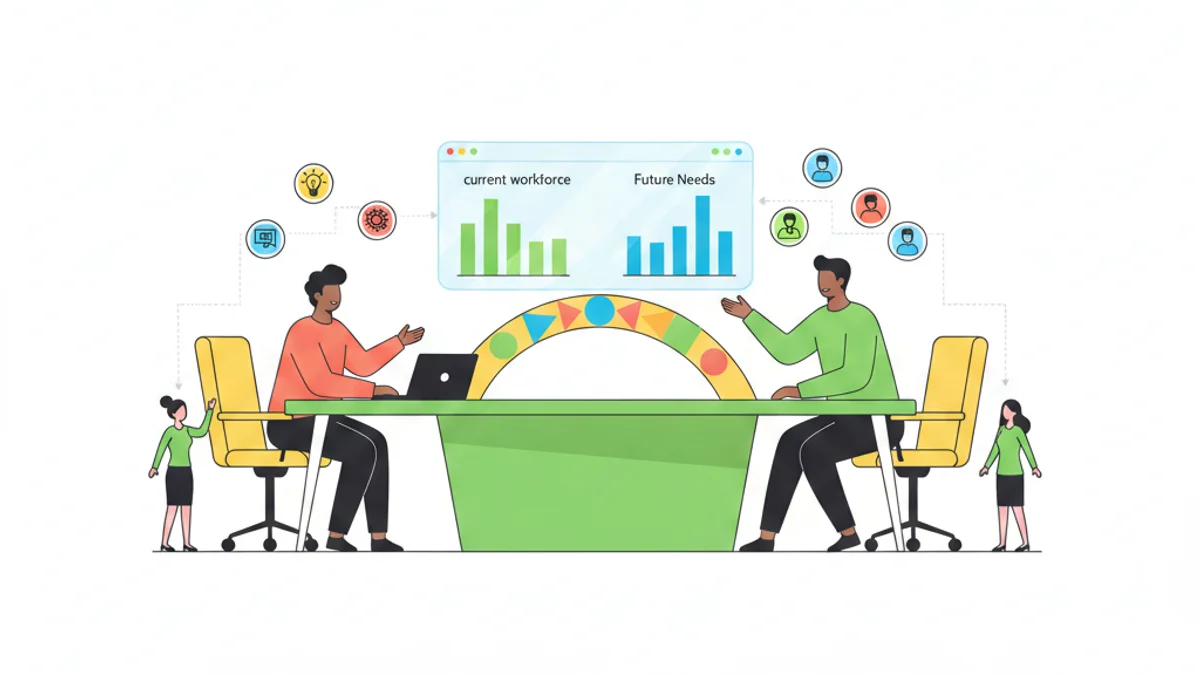
Strategic workforce planning has moved out of the HR back office and onto the boardroom agenda. It's the discipline of matching the skills your organisation will need in three to five years against the talent you actually have today — then closing the gap before it becomes a crisis. In 2026, with retirements accelerating and AI reshaping every role, treating hiring as a reactive scramble is a strategic liability.
Here's the uncomfortable truth for most CHROs: everyone agrees workforce planning matters, and almost nobody does it well. This guide breaks down what strategic workforce planning is, why 2026 makes it board-level, the framework to run it, the metrics to report upward, and how a talent community turns the plan into a living pipeline.
What you need to know in 60 seconds
- →Strategic workforce planning aligns future skill needs with your current talent, closing gaps before roles open, not after.
- →42% of CHROs named strategic workforce planning a top priority in 2025 (Gartner) — but only 11% of organisations reach real maturity (Deloitte).
- →Only 12% of US HR leaders plan with a three-year-plus horizon (McKinsey HR Monitor 2025). Most planning is still short-term firefighting.
- →A five-step framework — scan, model, gap-analyse, act, monitor — turns planning from an annual slide into an operating rhythm.
- →A branded talent community makes the plan executable: warm, pre-engaged pipelines for the roles you already know are coming.
- →Report on skills coverage, time-to-fill for critical roles, and internal fill rate — not headcount alone.
of CHROs ranked strategic workforce planning a top priority
Gartner, July 2025 (426 CHROs)
of organisations reach true workforce-planning maturity
Deloitte
overall hiring success rate in Europe — over half of hires miss
McKinsey HR Monitor 2025
What Strategic Workforce Planning Actually Means
Strategic workforce planning is the process of forecasting the skills, roles, and headcount your organisation will need to hit its business goals — then building the pipeline to get there. It answers one question: will we have the right people, with the right skills, in the right place, when the strategy needs them?
Note what it is not. It's not annual headcount budgeting. It's not a hiring plan for open requisitions. Those are operational exercises that look at the next quarter. Strategic workforce planning looks three to five years ahead and connects talent to revenue, expansion, and capability.
The distinction matters because the two get confused constantly. Gartner found that 73% of organisations run operational workforce planning, yet only 12% of US HR leaders plan with a genuine three-year-plus horizon (McKinsey HR Monitor 2025). Most teams think they're planning strategically. They're actually budgeting.
Why 2026 Makes It a Board-Level Priority
Three forces have pushed workforce planning from an HR nice-to-have to a board-level risk. Ignore them and you're planning to be short-staffed in your most critical functions.
First, demographics. In 2025 the largest-ever share of the global workforce reached retirement age, draining organisations of experienced talent faster than they can replace it (McKinsey). Second, the skills gap: 31% of European leaders cite limited visibility into their current skills as a core obstacle (McKinsey). You can't plan for gaps you can't see. Third, AI is redesigning roles — the jobs you'll hire for in 2028 may not exist on your org chart today.
The confidence gap is real
Only 29% of CHROs are confident in their organisation's ability to deliver on strategic workforce planning goals (Gartner). And while 92% of HR professionals say workforce planning is important, just 42% believe their organisation does it effectively.
That gap between intent and capability is exactly what a board wants closed — because unfilled critical roles stall the strategy they signed off on.
Reactive Hiring vs Strategic Workforce Planning
The core shift is from reactive to proactive. Reactive hiring starts when a role opens and the clock is already against you. Strategic workforce planning starts years earlier, so the pipeline is warm when the need lands. Here's the contrast on the metrics that matter.
| Dimension | Reactive Hiring | Strategic Workforce Planning |
|---|---|---|
| Trigger | A role opens or someone resigns | Business strategy and skills forecast |
| Time horizon | Weeks to a quarter | Three to five years |
| Pipeline state | Cold — sourcing starts from zero | Warm — a pre-engaged community |
| Cost pressure | High — agencies, premiums, overtime | Controlled — planned and budgeted |
| Board visibility | Reported after the fact | A forward-looking capability plan |
The 5-Step Strategic Workforce Planning Framework
A workable strategic workforce planning process runs in five steps — and it repeats. Treat it as an operating rhythm, not an annual slide that ages the moment it's presented.
Scan the strategy and the market
Start with the business plan, not the org chart. Where is revenue heading? Which markets, products, or capabilities are you betting on? Then read the external labour market — only 31% of recruiting teams currently use labour-market data to inform strategy (Gartner), which is a low bar to beat.
Output: a shortlist of the roles and skills that will make or break the strategy.
Model future demand
Translate the strategy into numbers. How many people, in which skills, by when? Model realistic scenarios — base case, growth case, downturn — so the plan survives a change in conditions rather than breaking at the first surprise.
Output: a demand forecast tied to specific business milestones.
Analyse the gap
Compare future demand against current supply — your existing skills, expected attrition, and retirements. This is where the retirement wave bites: you may lose your deepest expertise precisely when the strategy needs it most.
Output: a clear map of build, buy, borrow, and bridge decisions for each critical gap.
Act — build pipelines, not postings
Now execute. Reskill where you can, hire where you must, and start engaging future candidates long before the role opens. This is the step where a talent community earns its place: you nurture relationships with the people you'll need in two years, today.
Output: warm, pre-qualified pipelines mapped to forecasted roles.
Monitor and re-forecast
Plans decay. Track the gap quarterly, watch for drift between forecast and reality, and re-run the model when the strategy shifts. A living plan beats a perfect one that's already out of date.
Output: a dashboard the board can read at a glance.
The Metrics CHROs Should Take to the Board
Headcount is not a strategy metric. When you present strategic workforce planning to the board, lead with measures that connect talent to business risk and capability. These four do the heavy lifting.
Critical-role skills coverage
The share of business-critical roles for which you have a ready or near-ready pipeline. This is the single best proxy for strategic risk.
Time-to-fill for critical roles
Not average time-to-fill — the roles that stall the strategy when empty. A warm community collapses this number dramatically.
Internal fill rate
How many critical openings you fill from within. High internal mobility signals a healthy build strategy and cushions you against external market shocks.
Quality of hire
With European hiring success at just 46% and 18% of new hires leaving in probation (McKinsey), quality — not volume — is what protects the plan.
Where Talent Communities Fit Into the Plan
A strategic workforce plan is only as good as your ability to execute step four — building pipelines before the need lands. This is where a branded talent community turns the plan from a forecast into a functioning engine.
Instead of a cold database you scramble to activate when a role opens, a talent community is a warm, engaged pool of people who already know your brand and have opted in. When your model says you'll need 40 engineers in Bucharest by 2028, you start nurturing that community now — not the week the requisition lands.
Build this into your plan
- ✓ Opt-in pipelines mapped to forecasted critical roles
- ✓ Ongoing engagement so candidates stay warm for years
- ✓ Skills data captured through interaction, not just CVs
- ✓ A brand candidates already trust when you make the call
Leave this behind
- ✗ Cold databases that go stale within months
- ✗ Sourcing from scratch every time a role opens
- ✗ Agency premiums to fix gaps you saw coming
- ✗ Judging future fit on a backwards-looking CV
The results compound. When HEINEKEN Romania built a gamified, community-driven approach to attract young talent, it saw 43% more applications. Wyndham Hotels, planning for high-volume, multilingual franchise hiring, generated 290% more applications. Both were executing a plan — not reacting to a vacancy. See how they did it across our customer case studies.
Getting Started: Your First 90 Days
You don't need a perfect model to start strategic workforce planning — you need to start. Pick your five most business-critical roles, map their supply and demand three years out, and stand up a pipeline for the two with the biggest gap. That's a defensible first plan the board can react to.
From there, make it a rhythm. Re-forecast quarterly, widen coverage each cycle, and let your talent community do the patient work of keeping future hires warm. The organisations that treat strategic workforce planning as an operating capability — not an annual event — are the ones that will have the right people ready when the strategy needs them.
Turn your workforce plan into a living pipeline
Jobful helps talent leaders build branded, engaged communities that make strategic workforce planning executable — warm pipelines for the roles you already know are coming.
Frequently Asked Questions
Get More Insights Like This
Join 5,000+ HR professionals receiving monthly insights.