
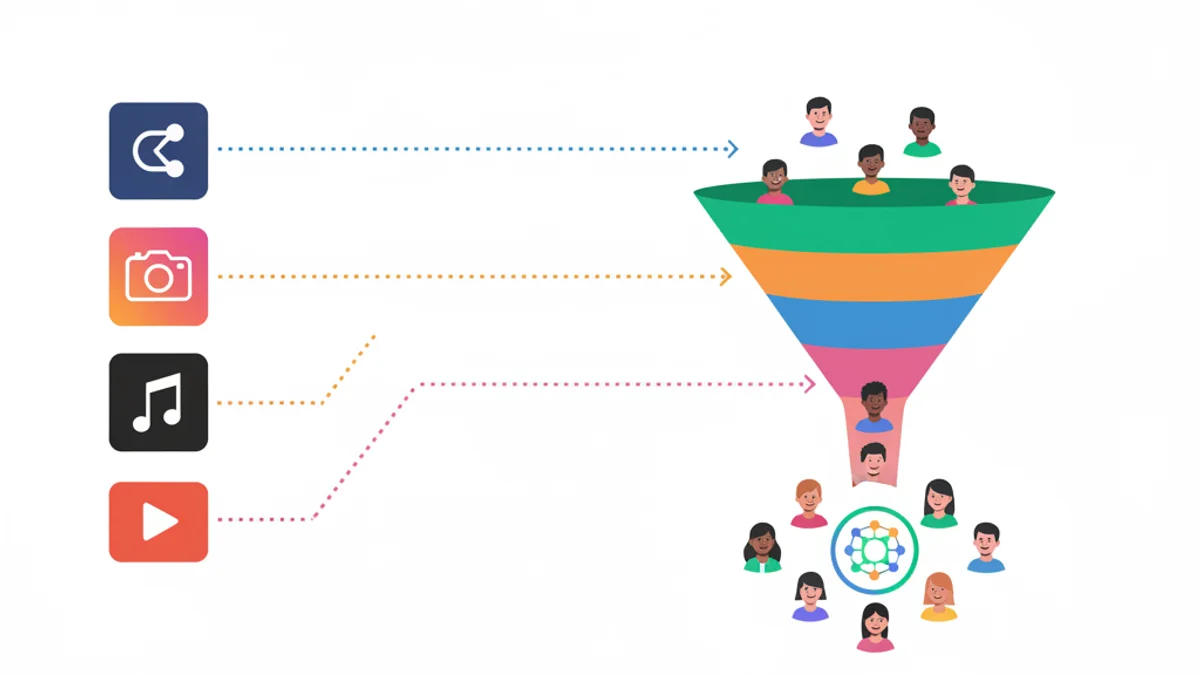
Social recruiting is a pipeline-building motion, not a campaign. Here's the 2026 playbook that turns followers into a measurable hiring asset.
Social recruitment is the practice of using social platforms to attract, engage, and convert candidates — before a job is even open. Done well, it replaces the cold-applicant pipeline with a warm, branded audience that already trusts you.
And that distinction matters. Posting a job to LinkedIn is not social recruitment. Boosting a hiring banner on Instagram is not social recruiting. Social recruitment is a continuous motion — content, community, conversation — that turns passive scrollers into engaged candidates long before the req hits your ATS.
What you need to know in 60 seconds
- → Social recruitment is a pipeline-building motion, not a campaign. It treats followers as future candidates and invests in them months before a role opens.
- → 84% of organisations now use social media to recruit, according to SHRM — but only the minority measure it as a revenue-style funnel rather than a branding exercise.
- → LinkedIn, Instagram, TikTok, YouTube, and Reddit each play a distinct role. Treat them as one channel and your results collapse.
- → Gen Z researches 4–6 employers on social before applying, per LinkedIn Talent Insights. If you're not there, you're invisible.
- → A follower is not a candidate. The winning move is to pipe social audiences into a branded talent community where engagement becomes measurable.
- → HEINEKEN Romania used this playbook — social content into a gamified talent community — to generate 43% more applications and halve time-to-shortlist.
What Social Recruitment Actually Is (And What It Isn’t)
Social recruitment is the strategic use of social platforms — LinkedIn, Instagram, TikTok, YouTube, Reddit — to build an engaged audience of potential candidates and convert that audience into hires over time. It is continuous, branded, and content-led. It is not a job post on LinkedIn with a budget behind it.
Let’s clear up the confusion. Most companies doing “social recruiting” are really doing paid job distribution on social channels. That’s still job boards — the platform just happens to have a feed. Real social recruitment looks different.
Social Recruitment Is
- ✓ Always-on content that shows how people actually work at your company
- ✓ Conversations with followers in DMs and comments before they ever apply
- ✓ Employee-generated content that carries more trust than corporate posts
- ✓ A feeder system into a measurable talent community
- ✓ Tied to hiring outcomes — applications, shortlist quality, time-to-hire
Social Recruitment Isn’t
- ✗ Pushing job ads into a feed and calling it a strategy
- ✗ The same polished stock post reused across every platform
- ✗ A branding exercise with no link to hires
- ✗ A one-off campaign pegged to a single hiring burst
- ✗ Measured only by likes, follows, and vanity metrics
Why Social Recruitment Beats Job Boards in 2026
Social recruitment beats job boards because it reaches candidates earlier — before they are actively looking — and builds the trust that job boards can never deliver. Job boards compete on offer and location. Social competes on narrative and identity.
The numbers make the case. According to LinkedIn’s 2024 Global Talent Trends, 70% of the global workforce is passive — employed but open. These people will never see your job board post. They will see a former colleague’s Instagram story or a three-minute TikTok about your engineering culture.
Of organisations use social media for recruiting
SHRM Talent Acquisition Benchmark
Of the global workforce is passive, not actively job searching
LinkedIn Global Talent Trends
Employers Gen Z researches on social before applying
LinkedIn Talent Insights
There’s a second structural reason. Job boards commoditise your employer brand — your post sits next to every competitor in the same format. Social recruitment lets you stand out on your own terms: your culture, your people, your story. That’s a tilt you can only win on platforms where content rules.
The result is simple. Companies that treat social as a pipeline-building motion spend less on paid media per hire, shortlist faster, and win candidates their competitors never reach.
The 5 Channels That Matter — and What Each One Is For
Five channels move the needle: LinkedIn, Instagram, TikTok, YouTube, and Reddit. Each rewards a different kind of content and attracts a different kind of candidate. Treat them as one channel and your results collapse.
| Channel | Best For | Content Format That Wins | Primary Audience |
|---|---|---|---|
| Senior, technical, and regulated-industry hires | Leader POVs, employee stories, behind-the-scenes of real work | Mid-career to exec | |
| Employer brand and culture signalling | Reels of teams, office moments, day-in-the-life stories | Young professionals, Gen Z | |
| TikTok | Early career and high-volume roles | Raw, employee-led, unpolished short video | Gen Z, entry-level |
| YouTube | Deep technical credibility and long-form EVP | Engineering talks, team intros, “how we work” docs | Specialists and senior engineers |
| Niche technical communities and honest Q&A | AMAs, thread participation, honest engineering content | Engineers, product, data |
A practical rule: pick two channels and run them seriously rather than five channels run badly. According to Gartner’s 2024 HR research, recruitment teams that concentrate budget on two well-run channels outperform teams spread across five by nearly 2x on applications per euro spent.
Build a Social Recruitment Strategy That Compounds
A social recruitment strategy compounds when each piece of content does two jobs: attracting a candidate today, and building the permission asset that lets you re-engage them tomorrow. Here’s the sequence that works.
Define the candidate archetypes you want to attract
Not personas in the marketing sense. Real archetypes: the senior backend engineer in Bucharest open to remote, the retail manager in Krakow considering a career shift. Specificity makes content work.
If you can’t describe the five archetypes driving 80% of your hiring plan, your social content will be generic — and generic doesn’t convert.
Match each archetype to one or two channels
Senior engineers live on LinkedIn and YouTube. Early-career retail on TikTok and Instagram. Healthcare professionals on LinkedIn and Facebook. Don’t spread yourself thin.
Focus beats coverage. Two channels worked deeply will outperform five worked casually every quarter.
Build a content engine with three layers
Top of funnel: culture, people, narrative. Mid: role-specific storytelling — what a day actually looks like. Bottom: open-role spotlights with a direct path into your talent community.
The ratio that works: roughly 60/30/10. Most companies do the inverse and wonder why nobody engages.
Activate your employees as the primary voice
Edelman’s Trust Barometer has shown for years that employees are trusted 3x more than CEOs when speaking about their own company. Corporate posts feel like ads. Employee posts feel like recommendations.
Give employees prompts, lightweight templates, and permission — then get out of their way.
Pipe engaged audiences into a talent community
A follow is a weak signal. A join — into a branded talent community where a candidate completes a challenge or profile — is a strong one. Every piece of content should include a path to join.
This is where social recruitment stops being marketing and starts being a measurable hiring asset.
Measuring Social Recruitment ROI — The Metrics That Actually Matter
Social recruitment ROI is measured by downstream hiring outcomes, not upstream vanity metrics. Impressions and followers are inputs. Applications, shortlist quality, time-to-hire, and cost-per-quality-hire are the outputs you track.
The problem: most teams only track the inputs. That’s why their boards treat social as a cost centre rather than a pipeline. Reframe the scoreboard.
Community joins per channel
The share of social engagement that converts into a profile inside your talent community. A reliable leading indicator of hiring output 60–90 days out.
Shortlist rate from social-sourced candidates
Do applicants who first engaged through social reach shortlist at a higher rate than generic job-board applicants? In most programs we see, the answer is yes — often 1.5–2x higher.
Time-to-shortlist
Warm, pre-engaged audiences shortlist faster because the trust and context are already in place. Track this against your cold-channel baseline.
Cost per quality hire by channel
The only number a CFO cares about. Attribute each hire back to the first social touchpoint and compare it against job-board cost per hire. The first time you produce this view, it usually changes the budget conversation.
From Social Follower to Talent Community Member
A follower is a weak signal. A talent community member is a hiring asset. The job of social recruitment is to move people from the first to the second — otherwise you’re renting attention on platforms you don’t control.
The mechanic is simple: every piece of content carries a path to join. That path leads not to an application form but to a branded environment where candidates build a profile, take a short challenge, and start a relationship with your brand before a role is open.
Why the community layer matters
Social platforms own your audience. Algorithms change. Organic reach declines. A talent community gives you first-party data, consent-based communication, and a pipeline that survives the next platform shift.
Think of it the way consumer brands think of email lists — except for hiring. The community is the asset. Social is the acquisition channel.
Case Study: How HEINEKEN Romania Turned Social Engagement Into 43% More Applications
HEINEKEN Romania wanted to reach Gen Z candidates who had little natural interest in FMCG careers. Traditional job boards weren’t solving the problem. The brand needed visibility on the platforms young talent actually used — and a credible way to turn attention into applications.
The team ran a social-first campaign built around a gamified talent community on Jobful. Candidates encountered HEINEKEN content on Instagram and TikTok, were invited into a branded community, and completed interactive challenges that mirrored real work at the company. Social platforms carried the brand. The community captured the intent.
The outcome: 43% more applications than the prior hiring cycle, a younger applicant mix, and a substantial improvement in time-to-shortlist because candidates arrived pre-engaged and pre-assessed. The social engagement built the brand; the community converted it.
See how HEINEKEN built this program end to end in our case studies library, or read our companion piece on employer branding for European companies.
Frequently Asked Questions
What is social recruitment?
Social recruitment is the practice of using social platforms — LinkedIn, Instagram, TikTok, YouTube, Reddit — to attract, engage, and convert candidates through continuous content and community, rather than one-off job ads. It builds an audience of future candidates before a role is open.
How is social recruiting different from social recruitment marketing?
The terms are often used interchangeably, but there’s a nuance. Social recruitment marketing usually refers to paid distribution and ad-driven campaigns. Social recruiting is the broader practice — organic content, employee advocacy, community building, and conversation — of which paid is one component.
Which social platform is best for recruitment?
It depends on who you’re hiring. LinkedIn is strongest for senior, technical, and regulated-industry roles. Instagram and TikTok work for Gen Z and high-volume hiring. YouTube builds deep technical credibility. The right answer is usually two channels — picked to match your top candidate archetypes — run seriously.
How do I measure the ROI of social recruitment?
Measure downstream outcomes, not upstream activity. Track community joins per channel, shortlist rate from social-sourced candidates, time-to-shortlist, and cost per quality hire. These numbers tell you whether social is building a real hiring pipeline or just a follower count.
Do I need a talent community to do social recruitment well?
You can run social recruitment without a talent community, but you’ll leave most of the value on the table. Without a community layer, engaged candidates disappear into platform algorithms you don’t control. A branded talent community turns social attention into an owned, first-party pipeline you can re-engage whenever you open a new role.
Turn your social audience into a hiring pipeline
Jobful helps recruitment teams convert social engagement into a branded talent community — the asset your competitors can’t copy, and the pipeline your CFO can measure.
Frequently Asked Questions
Get More Insights Like This
Join 5,000+ HR professionals receiving monthly insights.