
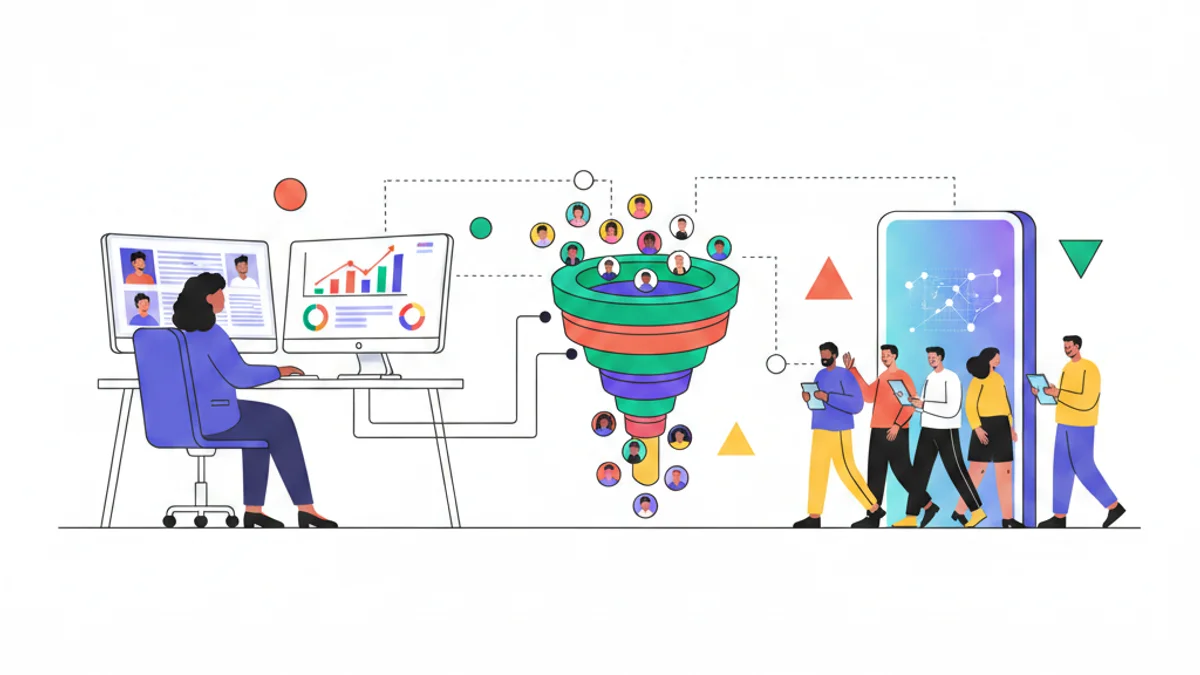
Most companies treat HR technology as a faster version of what they were already doing. That's why they don't see results. The organisations pulling ahead in recruitment aren't just using better tools — they've fundamentally changed how they think about attracting, matching, and retaining talent. Here's what modern HR tech actually does, and what separates the implementations that move the needle from the ones that don't.
TL;DR
The recruitment funnel is structurally broken: 94% of candidates never get hired, and 82% of top talent never applies in the first place. Pouring more resources into the same process doesn’t fix that — better technology deployed in the right model does. Organisations using proactive, relationship-based HR tech reduce time-to-hire by up to 40%, cut cost-per-hire by 35%, and improve quality of hire by 24%. This article explains how — and what separates implementations that move the needle from ones that don’t.
Key Takeaways
- →94% of candidates never get hired — the problem isn’t effort, it’s that traditional processes optimise for volume, not match quality.
- →82% of the best talent is passive — not job-hunting, not on boards. Reaching them requires a proactive model most ATS platforms don’t support.
- →AI recruitment tools reduce time-to-hire by up to 70% and improve candidate quality by 24% — but only when used for genuine matching, not faster CV sorting.
- →The HR tech market hits $76.5B by 2031 — but market size doesn’t mean every tool delivers. The capability gap between ATS and talent community platforms is significant and growing.
- →The most durable advantage isn’t speed — it’s the quality of the pipeline you’ve built before you need it. Proactive hiring changes your recruitment economics permanently.
The Recruitment Funnel Is Broken — and the Problem Isn’t Effort
Here’s a number that should stop every TA leader in their tracks: 94% of candidates who enter a typical recruitment funnel never get hired. Not at the company they applied to, not through the process they went through. The entire experience — the screening, the time, the investment from both sides — produces nothing.
The standard response from most organisations has been to push harder. More job board spend. More recruiter hours. More volume at the top of the funnel in the hope that something will convert at the bottom. It doesn’t work. It’s the equivalent of trying to fill a leaking bucket faster instead of fixing the holes.
The problem isn’t effort or budget. It’s that the traditional recruitment model was designed for a labour market that no longer exists. Post a vacancy, collect applications, screen by CV, interview, hire. That loop made sense when candidates were abundant, information was scarce, and the employer held all the power. None of those conditions apply anymore.
According to PwC research, 77% of CEOs rank the lack of key skills as one of the biggest threats to their business. That’s not a pipeline problem you solve by posting more jobs. It’s a structural problem you solve by changing the model — and choosing technology that supports the right one.
What Candidates Actually Want in 2026
Before talking about technology, it helps to understand what’s changed on the human side. Because the tools only matter if they’re designed around how people actually behave now — not how they behaved a decade ago.
82% of the workforce is passive at any given moment — not actively hunting for a new role, but open to the right opportunity if it finds them. These are, disproportionately, the people you most want to hire: the senior professionals, the high performers, the specialists who are already doing the work well somewhere else. They’re not on job boards. They’re not refreshing LinkedIn every morning. Traditional recruitment simply doesn’t reach them.
Among those who are looking, expectations have fundamentally shifted. Research from Harvard and the Washington Post shows that both Millennials and Gen Z consistently rank meaningful work, autonomy, flexibility, and collaborative culture above salary when evaluating employers. Julie Lee, director of technology and mental health at Harvard Alumni for Mental Health and an expert on Gen Z employment, puts it plainly: what Gen Z wants is meaningful work with autonomy, flexibility, work-life balance, and collaboration — not just a competitive package.
That shift has a direct implication for recruitment technology. 71% of candidates who have negative experiences during a hiring process share those experiences with their immediate networks. Your recruitment process is your employer brand in action — and a bad candidate experience isn’t just a missed hire, it’s reputational damage that compounds over time.
The organisations winning on talent attraction have understood that candidates are evaluating them as hard as they’re evaluating candidates. The technology they choose either supports that two-way dynamic or it doesn’t.
What “Competitive Recruitment” Actually Means Now
Ten years ago, competitive recruitment meant being faster and having a recognisable brand. Speed still matters — but it’s no longer the differentiator. The organisations pulling away from their competitors on talent acquisition aren’t the ones who respond to applications fastest. They’re the ones who don’t need to wait for applications in the first place.
Proactive recruitment — building and maintaining engaged talent pipelines before roles open — changes the entire economics of hiring. Traditional reactive hiring starts at zero when a requisition opens. That means 45–60 days on average to fill a role, sourcing costs on every position, and quality trade-offs under deadline pressure. Proactive hiring means contacting warm, pre-qualified, already-engaged candidates within hours of a role being approved.
The broader HR technology market reflects exactly this direction of travel. Allied Market Research projects the global HR tech market reaching $76.5 billion by 2031, growing at 9.2% CAGR from 2022. The growth isn’t coming from better versions of old tools — it’s driven by AI adoption, talent community platforms, and skills-based infrastructure that supports this proactive model.
The competitive gap between organisations that have made this shift and those still running reactive hiring is widening every year. The longer you wait to change the model, the further behind the pipeline you fall.
ATS vs Talent Community: Why the Tool Type Matters
Most organisations are trying to solve a 2026 recruitment problem with 2010 infrastructure. The ATS was built for a world where candidates came to you, you processed them, and you hired or rejected. It’s a management tool for inbound demand. It is excellent at what it was designed to do.
The problem is that inbound demand, for most roles in most markets, is no longer sufficient to fill positions with the right people. You need to create supply — and that requires a different category of tool entirely.
| Dimension | ATS | Talent Community Platform |
|---|---|---|
| Core purpose | Manage inbound applications | Build and engage talent pipelines |
| Hiring model | Reactive (wait for applicants) | Proactive (build pipeline first) |
| Candidate relationship | Transactional (apply → process → hire/reject) | Ongoing (engage before, during, after) |
| Starting point for a new role | Zero candidates; 45–60 day average fill | Warm pipeline; hours to first contact |
| Employer brand function | Minimal (apply form, email notifications) | Active (content, challenges, community engagement) |
| Best used for | Final-stage process management | Top-of-funnel through pre-hire engagement |
The answer isn’t to replace your ATS. It’s to add the layer your ATS was never designed to provide. The two work as a stack: the talent community builds and warms the pipeline, the ATS manages the structured process at the end. Companies that run only an ATS are missing the part of recruitment that’s become most valuable.
The Five Capabilities That Separate Useful HR Tech from Noise
The HR tech market is crowded. Every platform claims to be AI-powered, candidate-centric, and data-driven. Here’s what those words actually need to mean in practice — the five capabilities that genuinely move recruitment performance.
1. AI matching that evaluates fit, not just keywords
True AI matching goes beyond parsing CVs for keyword frequency. It evaluates behavioural signals, skills demonstrated through assessment, cultural alignment indicators, and career trajectory patterns to identify candidates who will perform and stay — not just candidates who look right on paper. According to HireTech’s 2024 analysis, AI-driven recruitment processes produce a 24% improvement in candidate quality when they’re operating on genuine fit signals rather than proxy variables like education or tenure.
The efficiency gain is also real. Demandsage data shows 86% of recruiters report AI tools enhance efficiency, with time-to-hire reductions of up to 70% in optimised deployments. But efficiency without quality is just a faster way to make the same mistakes. The matching logic is everything.
2. Gamified skills assessment that shows what candidates can actually do
The CV is a record of where someone has been, not a demonstration of what they can do. Skills-based assessment — structured challenges, gamified problem-solving, work simulations — evaluates capability directly. It removes the proxy variables that introduce bias and screens out capable candidates unfairly.
The secondary benefit is candidate experience. Gamified assessments are more engaging than form-filling, give candidates a genuine preview of what working with the organisation is like, and signal that the employer takes skills seriously rather than relying on credential shortcuts. For Gen Z candidates in particular, an assessment that respects their time and evaluates real ability is a differentiating employer brand moment.
3. Talent community infrastructure for pipeline building
The ability to maintain warm relationships with candidates who aren’t applying right now — alumni, silver medallists, passive prospects, university pipeline — is the capability that changes hiring economics most fundamentally. External sourcing is expensive: job board fees, recruiter commissions of 20–30% of salary, and LinkedIn Recruiter licences combine to push average cost-per-hire to €3,000–€5,000 in competitive markets. Building internal pipelines shifts those costs from transactional external sourcing to ongoing relationship maintenance — a fraction of the price, and far higher quality.
Jobful clients processing 1,000+ candidates monthly and achieving 2,000+ hires annually aren’t doing that through job board volume. They’re doing it through communities of engaged talent who already understand and value the employer brand.
4. Funnel analytics that tell you where you’re losing people
Only 17% of employers measure candidate experience at every stage of the funnel, according to industry research. That means 83% of organisations are operating their most competitive process blind — they don’t know where candidates drop off, why offers get declined, or which sourcing channels produce hires that stay. Data-driven recruitment isn’t about dashboards for their own sake. It’s about knowing which variables you can actually change and what the downstream effect will be.
5. Candidate experience design integrated into the platform
The World Economic Forum stated that talent, not technology, is the key to success in a digital future. That means the experience candidates have with your technology is the experience they have with your organisation. A clunky application process, an unresponsive careers site, an automated rejection with no feedback — these aren’t minor friction points. Research shows that organisations investing strongly in candidate experience improve average quality of hire by 70% and save hundreds of thousands of dollars annually on avoided bad hires. The platform is the product, from the candidate’s perspective.
The Metrics Modern HR Tech Actually Moves
Here’s what the numbers look like when organisations move from reactive to proactive hiring and invest in the right capability stack.
40%
reduction in time-to-hire with talent community model
Jobful platform data
35%
reduction in cost-per-hire through community-led sourcing
Jobful platform data
24%
improvement in candidate quality from AI-driven matching
HireTech 2024
70%
improvement in quality of hire for companies investing in candidate experience
Jobful / industry research
These numbers aren’t independent of each other. Time-to-hire reductions compound with cost savings. Better candidate quality drives down early attrition. Lower attrition reduces the number of roles you need to fill in the first place. The improvements stack — and they continue to compound as the talent community grows and the data quality improves over time.
Why Compatibility Beats Volume — and What That Means for Retention
There’s a seductive logic to high-volume recruitment: more candidates in means better selection at the end. In practice, it works the opposite way. High volume without strong fit signals means more noise, not more signal. Recruiters spend time processing applicants who were never right for the role while genuinely compatible candidates get lost in the stack.
Within 18 months of hiring, companies expect over 50% of new hires to fail to fully meet expectations — primarily because the process wasn’t designed to assess genuine fit, only surface-level criteria. That failure rate is a direct function of how you screen and match at the top of the funnel.
Compatibility-based recruitment — assessing skills, behavioural alignment, and cultural fit rather than credentials and interview performance under pressure — produces better matches that stay. The downstream effect on retention is significant: employees who are well-matched at hiring are substantially more likely to be engaged, productive, and committed at 12 months, according to Deloitte’s engagement research. And engaged, retained employees don’t generate the 33% of annual salary replacement cost that every departure creates.
The recruitment decision is the retention decision made early. Organisations that understand this build their entire talent technology stack around match quality — not application volume.
What to Look for Before You Invest in HR Tech
The market is full of platforms with compelling demos and overlapping feature lists. Before evaluating vendors, get clear on these five questions. They’ll save you months of implementation regret.
-
1
Is it people-centric or process-centric?
Does the platform create a good experience for candidates, or does it optimise purely for recruiter workflow? The best tools do both. Platforms that treat candidates as data points to be processed will produce the same attrition and experience problems you already have, just faster.
-
2
Does it integrate, or does it replace?
The strongest implementations add talent community capability on top of existing ATS and HRIS infrastructure rather than requiring a full rip-and-replace. Integration reduces implementation risk, shortens time-to-value, and avoids the data migration problems that kill HR tech projects before they start.
-
3
What is the AI actually doing?
Push vendors hard on this. “AI-powered” ranges from sophisticated behavioural matching to keyword frequency ranking with a machine learning label on it. Ask specifically: what signals does the matching algorithm use? How does it handle candidates with non-linear career histories? How is bias monitored and corrected? If the answers are vague, the AI is probably vague too.
-
4
Can it build a pipeline, or just process one?
The capability that changes economics most fundamentally is the ability to engage passive candidates, maintain relationships over time, and activate them when relevant roles open. Not every platform does this. Many still operate purely on the inbound application logic. If you’re investing in HR tech without this capability, you’re investing in the wrong layer.
-
5
What does the data actually show you?
Good analytics tell you where in the funnel you’re losing candidates and why, which sourcing channels produce hires that stay, and what the cost-per-hire looks like across different role types and markets. Vanity dashboards that show application volume and time-to-fill without causal insight are cosmetic, not useful. Know the difference before you sign.
Build the Pipeline Before You Need It
Jobful is the talent community platform built for organisations that want to stop starting from zero every time a role opens. AI matching, gamified skills assessment, and community infrastructure that works alongside your existing ATS — not instead of it.
- ✓ Process 1,000+ candidates monthly with AI-powered engagement
- ✓ Reduce cost-per-hire by 35% by eliminating reactive sourcing dependence
- ✓ Integrates with your existing ATS and HRIS — no rip-and-replace required
Key Statistics
94%
of candidates who enter a typical funnel never get hired
Jobful / industry research
70%
time-to-hire reduction with AI-driven recruitment tools
Demandsage 2024
$76.5B
projected HR tech market size by 2031
Allied Market Research
Frequently Asked Questions
What is the difference between an ATS and a talent community platform?
An ATS manages inbound applications through a structured hiring process. A talent community platform builds and maintains relationships with candidates before a role exists. The ATS is reactive; the talent community is proactive. The two work best as a stack: the community fills the pipeline, the ATS manages the final stages. Companies running only an ATS start from zero every time a requisition opens — typically a 45–60 day process. Companies with active talent communities are contacting pre-qualified candidates within hours.
How much does modern HR tech actually reduce recruitment costs?
Talent community platforms reduce cost-per-hire by 30–35% by eliminating dependence on external sourcing channels — job board fees, recruiter commissions of 20–30% of salary, and LinkedIn Recruiter licences that average €3,000–€5,000 per hire. AI screening reduces time-to-hire by 40–70%, cutting internal recruiter cost per role. Strong employer brand built through HR tech delivers a further 50% reduction in cost-per-hire from higher inbound quality. These numbers assume a proactive hiring model, not automation of an existing reactive one.
Why do so many HR tech implementations fail to deliver results?
The most common failure mode is using modern technology to do old things faster rather than changing the underlying model. Companies buy a talent community platform and use it as a fancier job board. They implement AI screening and use it to process the same poor-fit volume more quickly. Effective implementation requires a shift from reactive to proactive hiring, from volume to match quality, and from candidate management to candidate relationship. Without that shift, even excellent tools underdeliver. The second most common failure is insufficient investment in candidate experience — the platform exists but the content, engagement, and communication strategy don’t.
What does Gen Z actually want from employers, and how does that affect recruitment technology needs?
Gen Z prioritises meaningful work, autonomy, flexibility, and collaborative culture over salary and title. They research employer reputation before applying — and negative candidate experiences spread through peer networks faster than positive ones. This means careers sites must communicate culture authentically, assessment processes must be engaging and respectful of time, and communication quality during hiring is itself an employer brand signal. HR tech that creates engaging, transparent, two-way candidate experiences is the baseline expectation for Gen Z talent attraction, not a premium.
What should we evaluate when choosing HR technology for talent acquisition?
Five criteria matter most: (1) People-centric vs process-centric design — does the platform create a good candidate experience alongside recruiter efficiency? (2) Integration vs replacement — does it work with your existing ATS and HRIS? (3) Matching quality — does the AI evaluate genuine fit signals or do sophisticated keyword matching? (4) Pipeline capability — can it build and maintain relationships with passive candidates before roles open? (5) Data visibility — does it show you where and why you’re losing candidates across the funnel? Tools that score well on all five are rare. Know your priorities before evaluating vendors.
Frequently Asked Questions
Get More Insights Like This
Join 5,000+ HR professionals receiving monthly insights.