A practical, evidence-backed playbook for attracting Gen Z talent in 2026: what they actually want, the channels that move the needle, and the gamified, community-driven approach replacing traditional job posts.
Learning how to attract Gen Z talent is no longer a "nice-to-have" for talent acquisition leaders. It's the difference between a 90-day pipeline and a 90-day vacancy. Gen Z (born 1997–2012) will make up roughly 30% of the global workforce by 2030, and they're already the dominant pool for entry-level and early-career roles in Europe.
Here's the catch: most companies are still recruiting them with playbooks built for Millennials. The result? Half-finished applications, ghosted offers, and career sites with bounce rates that look like a horror story. This article gives you the practical, evidence-backed approach that's actually working in 2026.
What you need to know in 60 seconds
- → Gen Z will be 30% of the global workforce by 2030, and 75% reject employers without a clear values-based EVP. (Deloitte Gen Z & Millennial Survey 2024)
- → The average Gen Z candidate spends under 60 seconds on a careers page before deciding to apply or leave. CV-led job posts are dead on arrival.
- → Three non-negotiables: mobile-first applications, transparent salary, and an authentic culture proof point — not a stock-photo banner.
- → Gamified assessments lift completion rates by 3–4x versus traditional applications. HEINEKEN Romania saw 43% more applications after rolling out an interactive challenge.
- → Branded talent communities cut time-to-hire by up to 80% for early-career roles by replacing cold sourcing with warm pipelines you've already engaged.
- → Treat attraction as a year-round program, not a campaign. Measure pipeline health, not just hires.
Why Gen Z Won't Apply to Your Job Posts Anymore
Because the job post itself has become the bottleneck. Gen Z grew up scrolling — they evaluate employers the same way they evaluate everything else: in seconds, on their phone, with no patience for friction.
According to LinkedIn's Future of Recruiting 2024 report, 61% of Gen Z candidates abandon applications that take longer than 15 minutes. The traditional "submit your CV and three references" flow is built for a different generation. Worse, the cover letter is a hard "no" — over 70% of Gen Z applicants told Glassdoor researchers they'd rather skip a role than write one.
The deeper problem isn't speed. It's signal. A static job post tells Gen Z almost nothing about what working at your company actually feels like — and what you sell, they can't buy.
of Gen Z candidates abandon applications that take 15+ minutes
LinkedIn Future of Recruiting 2024
of Gen Z reject employers whose values don't match their own
Deloitte Gen Z & Millennial Survey 2024
application completion lift on gamified vs. standard flows
Aberdeen Talent Acquisition Benchmark 2023
What Gen Z Actually Wants From Employers
Authenticity, growth, and stability — in that order. The cliché says they want "purpose," but the data is more pragmatic than that. Gen Z wants a clear reason to trust you before they invest their time in your funnel.
McKinsey's 2024 Talent Trends study identified six attributes that consistently move the needle for Gen Z applicants. We've seen the same pattern play out across HEINEKEN, Wyndham, and Raiffeisen Bank engagements at Jobful.
Salary transparency
Listing a salary range increases application rates by 2–3x. EU Pay Transparency Directive makes this mandatory by 2026 anyway — get ahead of it.
Visible growth paths
Show the next two roles, not just the current one. Gen Z chooses employers where the next promotion is named, not implied.
Flexibility, not just remote
Hours-flexibility ranks higher than location-flexibility for Gen Z. Async work, four-day weeks, and study leave outperform "remote on Fridays."
Mental health support
Real benefits — therapy stipends, manager training, sane workloads — not a "wellness Slack channel." Gen Z can spot the difference.
Diverse, inclusive teams
Show your team page. Gen Z notices who's actually in the photo — and who's missing. DE&I claims without proof read as red flags.
Fast, respectful process
A 30-day silence after an application is read as rejection. Gen Z expects status updates the way they expect parcel-tracking.
The Six Channels Where Gen Z Decides You're Worth It
Long before they fill in your application form. Gen Z's evaluation happens across six surfaces, often within the same evening. If your message is inconsistent across them, you lose — and you usually never know why.
A coordinated employer brand presence on these channels is what separates "we get applicants" from "we get the right applicants."
| Channel | What Gen Z is checking | Most common own-goal |
|---|---|---|
| TikTok / Reels | Real day-in-the-life from real employees | Polished corporate edits with no faces |
| Team culture, office, events, perks | Logo dumps and recycled press kit | |
| Career growth stories, manager voices | Job-only posts, zero employee content | |
| Glassdoor / Indeed | How you respond to negative reviews | No responses at all |
| Career site | Mobile speed, salary range, real photos | Desktop-only design, 2017 stock images |
| Peer networks | "Has anyone actually worked here?" | No alumni, no community presence |
Build a Gen Z Attraction Engine: 5 Proven Strategies
Stop running attraction as a campaign. Start running it as an always-on engine. Here are the five strategies that consistently outperform job-board-first approaches when teams need to attract Gen Z talent at scale.
Replace the application form with a challenge
Gen Z will spend 10 minutes solving a relevant problem before they'll spend 10 minutes filling in a CV form. Swap the upload for an interactive scenario tied to the actual role — sales pitch simulation, customer-support roleplay, code review, design critique.
You convert more candidates and you collect signal you can't get from a CV. Win twice.
Build a branded talent community, not a candidate database
A database stores. A community engages. Branded talent communities replace cold sourcing with people who already know your brand and have opted in to hear from you.
For early-career roles, this is decisive — internal benchmarks across Jobful customers show time-to-hire drops by 40–80% when entry-level pipelines come from a warm community rather than a fresh job-board push.
Let employees do the talking
Edelman's Trust Barometer 2024 shows employees are trusted 2.5x more than CEOs when describing what a company is like to work for. Train and equip your Gen Z employees to post — don't script them.
Three honest 60-second videos from junior staff outperform a six-figure brand campaign every time.
Show the salary range. Show it loud.
Posts that include compensation get 75% more applications, according to LinkedIn data. Gen Z reads "salary on request" as "we'll lowball you."
If your range is competitive, your transparency becomes a differentiator. If it isn't, transparency tells you that quickly — which is also useful.
Run a feedback loop, not a one-way funnel
Every applicant — yes, even the rejected ones — should leave the process with one piece of useful feedback and a path to come back. Gen Z talks. Make the conversation a positive one.
Companies that automate post-application feedback see referral rates climb 25–40% within two quarters.
Gamification: Why Interactive Beats Boring
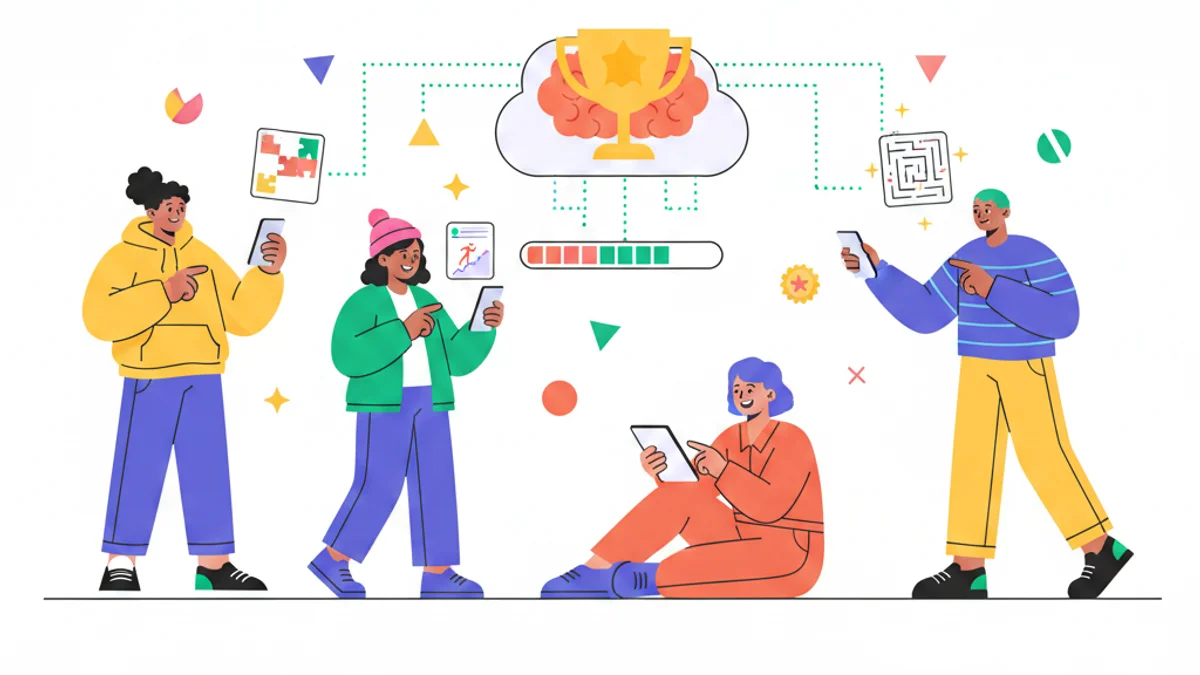
Because Gen Z's threshold for boredom is roughly four seconds. Gamified assessments work for Gen Z attraction for one reason and one reason only: they feel less like a job application and more like a TikTok challenge.
The data is hard to argue with. Aberdeen's 2023 benchmark found gamified application flows lift completion rates 3.4x. SHRM research correlates gamified assessments with a 25% improvement in quality-of-hire. And on the candidate-experience side, Net Promoter Scores from interactive flows consistently land 30+ points higher than from traditional ones.
What gamification gives you
- ✓ Higher application completion (3–4x lift)
- ✓ Behavioural signal a CV can never give you
- ✓ Built-in employer-brand storytelling
- ✓ Self-selecting candidates who actually engaged with the role
- ✓ Defensible scoring against EU AI Act fairness criteria
What CV-only flows give you
- ✗ 60%+ drop-off before the form is submitted
- ✗ Backwards-looking signal you can't verify
- ✗ Zero brand impression beyond the form
- ✗ Adverse-impact risk from CV-trained screening models
- ✗ No way to differentiate from the next job board
Case in point: HEINEKEN Romania
HEINEKEN Romania needed to attract Gen Z talent into commercial roles in a market where younger candidates increasingly skipped FMCG in favour of tech. The team replaced the standard application with a gamified challenge designed around real sales scenarios.
The result: 43% more applications, a measurable shift in the quality of the shortlist, and a lasting employer-brand asset Gen Z candidates voluntarily shared with peers. Read the full breakdown in the Jobful case studies.
Wyndham Hotels saw an even more dramatic outcome — a 290% lift in applications after rolling out a similar interactive flow across multilingual hospitality roles.
Measuring What Works: Gen Z-Specific KPIs
Tracking only "applications received" is how Gen Z attraction goes wrong slowly. The metrics that matter for this cohort are different from your standard recruitment KPIs because the funnel itself is different.
If your monthly TA dashboard doesn't include the next four numbers, you're flying blind on the demographic that will define your workforce by 2030.
Mobile completion rate
85%+ of Gen Z applies on mobile. If your mobile completion rate is below 70%, your pipeline is leaking before you even see it. Benchmark, segment, and fix UX before scaling spend.
Time-to-first-touch
Best-in-class TA teams respond within 48 hours. Gen Z drops out of the consideration set after 96. Treat this like an SLA, not a nice-to-have.
Talent community growth
Net new opted-in members per month, segmented by entry-level vs. experienced. This is your forward-looking pipeline indicator — far more reliable than open-role applications.
Candidate NPS (post-process)
Including from rejected candidates. Gen Z attraction compounds — or it cannibalises. NPS tells you which one is happening before Glassdoor does.
Common Mistakes That Repel Gen Z (And How to Fix Them Fast)
Most companies don't have a Gen Z attraction problem. They have a Gen Z repulsion problem and don't know it. These are the four self-inflicted wounds we see most often — and the unglamorous fixes that actually move conversion.
Mistake 1: Career site that doesn't load on mobile in under 3 seconds
Fix: audit Core Web Vitals on a mid-tier Android handset, not on your senior recruiter's iPhone. Compress images, kill carousels, reduce scripts. Most teams cut bounce rate 25–40% in two weeks.
Mistake 2: Asking for a CV before showing what the role is like
Fix: lead with a 30-second video, a manager intro, or an interactive day-in-the-life. The CV upload comes after the candidate has decided they care.
Mistake 3: Posting jobs but ignoring Glassdoor
Fix: assign a named owner to respond to every review within 7 days. Gen Z doesn't expect a perfect score — they expect a human reply.
Mistake 4: Treating attraction and retention as separate teams
Fix: connect them through your community. The same engagement model that helps you attract Gen Z is what keeps them — retaining Gen Z is mostly a continuation of how you attracted them in the first place.
Make Attraction a Year-Round Engine, Not a Spring Push
The teams winning the Gen Z race in 2026 share one habit: they recruit when they don't need to hire. They invest in community, content, and conversation 12 months a year, so that when a role opens, the pipeline is warm, the brand is established, and the salary conversation isn't a cold start.
If you're starting from scratch, pick one strategy from the list above and execute it for a full quarter before adding a second. Compounding beats sprinting on this demographic — the brands Gen Z trusts are the ones they've already heard of three times before they ever applied.
Build a Gen Z attraction engine that compounds
See how teams at HEINEKEN, Wyndham, and Raiffeisen turned interactive challenges and branded talent communities into self-sustaining Gen Z pipelines.
Frequently Asked Questions
Get More Insights Like This
Join 5,000+ HR professionals receiving monthly insights.