
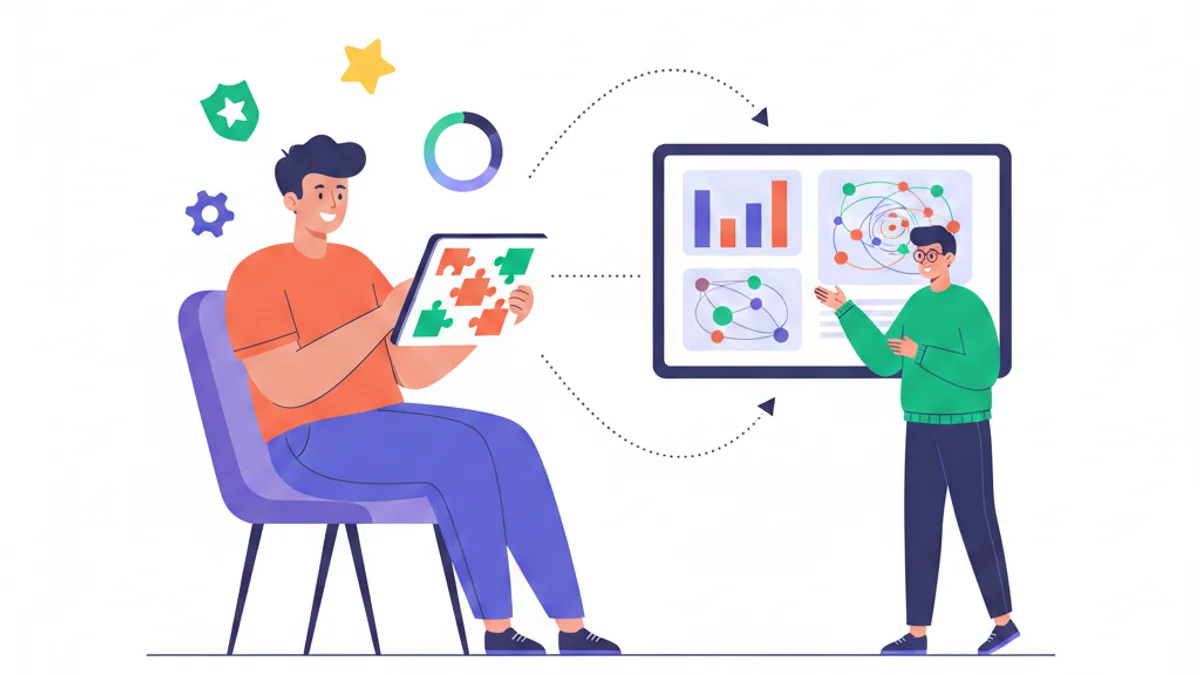
Gut feel has been running recruitment decisions for decades. Gamified assessments replace it with something better: real behavioural data collected while candidates are actually doing the work, not talking about it. Here's how gamification transforms both soft and hard skills assessment — and why it produces better hires, higher engagement, and a pipeline that self-selects for fit.
TL;DR
Gamified assessments turn hiring into an interactive experience that measures what candidates can actually do — not just what they claim on a CV. They increase completion rates by up to 40%, make 78% of applicants more motivated to pursue the role, and give recruiters a unified scorecard of hard skills, soft skills, and cultural fit. Unilever used them to cut time-to-hire from four months to four weeks. This guide covers how gamification works for both types of assessment and how to build it into your process.
Key Takeaways
- →Traditional assessments fail on two fronts: up to 40% of candidates abandon them before completion, and they don’t reveal soft skills at all.
- →Gamified assessments increase engagement by up to 40% and make 78% of applicants more motivated to pursue the role — before a single interview.
- →Soft skills like empathy, adaptability, and problem-solving under pressure emerge naturally in simulation-based challenges — without candidates gaming the response.
- →Hard skills challenges test applied capability, not claimed knowledge — a far better predictor of actual job performance.
- →The best gamified systems produce one unified candidate scorecard: hard skills + soft skills + behavioural signals + engagement data.
The Assessment Problem Nobody Talks About Honestly
Here’s what happens in most recruitment processes when it’s time to assess candidates. CVs get screened for keywords and credentials. A traditional psychometric test gets sent out — and roughly 40% of candidates never complete it. The ones who do sit a 45-minute battery of multiple choice questions that tells you very little about how they’d actually behave at work. Then comes a 30-minute video call where both sides are performing, anxiety is running high, and the recruiter is trying to form impressions from a completely unnatural interaction.
At the end of this process, the hiring manager asks: “How did they seem?” And the honest answer, most of the time, is: “Hard to say. I’ll go with my gut.”
Gut feel isn’t necessarily worthless — experienced recruiters develop genuine pattern recognition over time. But it’s a poor basis for decisions at scale, it’s heavily influenced by affinity bias and first impressions, and it tells you almost nothing reliable about the quality that’s hardest to hire for: soft skills.
Research consistently shows that only 22% of candidates are satisfied with traditional assessment experiences. That means 78% of the people going through your process are forming a negative impression of your company before they even receive a decision. In a tight talent market, that’s not just a candidate experience problem. It’s a pipeline problem.
What Gamification Actually Means in Recruitment
Before going further, let’s be clear about what gamification in recruitment isn’t. It’s not about turning hiring into Candy Crush. The word “gamified” refers to design principles borrowed from the gaming world — challenge progression, immediate feedback, achievement recognition, intrinsic reward — applied to experiences that have nothing inherently game-like about them.
What makes something feel game-like isn’t flashy graphics. It’s the feeling of clear goals, meaningful choices, visible progress, and earned outcomes. A well-designed recruitment challenge has all of those properties. A badly designed one — regardless of how it looks — has none of them.
In practice, gamified assessments in recruitment include: situational simulations that present candidates with realistic work scenarios; technical challenges that require candidates to apply skills to specific problems; knowledge academies with progressive difficulty and earned badges; emotional intelligence exercises that reveal behavioural tendencies through choice-based narratives; and competitive leaderboards that surface the highest-performing candidates across a cohort. Each of these collects data. And that data, aggregated into a unified candidate profile, gives recruiters something far more useful than a CV and a gut feeling.
The Soft Skills Problem — And Why Gamification Solves It
Soft skills are the ones that actually determine whether a hire will succeed long-term. Technical skills get someone through the door. Soft skills determine whether they thrive. The ability to handle pressure, communicate clearly under ambiguity, show empathy to colleagues and customers, adapt when plans change, contribute to a team without an ego crisis — these are the skills that separate good hires from great ones.
The problem is that traditional hiring is almost completely blind to them. Interviews are the most common tool for assessing soft skills — but interviews are fundamentally compromised by the fact that both parties know they’re being assessed. Candidates prepare answers to expected questions. They perform their best version of themselves. The resulting picture is a curated presentation, not a behavioural reality.
Gamified simulations sidestep this problem by assessing behaviour indirectly. When a candidate is placed in a scenario — say, their virtual team is facing a missed deadline and an unhappy client — and asked to make a series of decisions, they’re not answering “How do you handle conflict?” They’re actually navigating conflict. The decisions they make, how quickly they make them, and what they prioritise reveals far more than any rehearsed answer could.
Empathy & EQ
How candidates read social situations, respond to others’ needs, and navigate emotional dynamics in team scenarios.
Problem-Solving Under Pressure
How candidates approach ambiguous challenges, prioritise competing demands, and make decisions with incomplete information.
Adaptability
How candidates respond when conditions change mid-challenge — a strong predictor of performance in fast-moving work environments.
Motivation & Drive
Which challenges do they choose to complete first? How long do they persist when it’s difficult? Engagement patterns reveal intrinsic motivation.
Cultural Fit
The scenarios and academies candidates choose to engage with signal what they value — alignment with company culture becomes measurable, not guessed.
Teamwork
Collaborative challenges reveal whether candidates default to leading, supporting, or competing — and how they handle disagreement within a team.
The data produced by these simulations is quantifiable and comparable across candidates. Instead of comparing one recruiter’s gut feeling about candidate A against another’s gut feeling about candidate B, hiring managers can compare structured behavioural profiles built from the same assessment methodology. That’s what fairness looks like in candidate evaluation.
Hard Skills Assessment: Applied Capability vs. Claimed Knowledge
CVs are claims. A candidate who lists Python, project management, or financial modelling on their profile is telling you they have those skills. A gamified challenge is proof. It puts the candidate in a realistic context that requires those skills and measures what actually happens when they apply them.
Hard skills assessment through gamification typically involves: technical challenges that mirror real job tasks at progressively increasing difficulty; knowledge academies with assessments at each stage that build a verified skills profile; simulation environments where candidates use specific tools or frameworks under realistic conditions; and timed exercises that reveal not just whether someone can do something but how efficiently and accurately they can do it under pressure.
Unilever’s adoption of gamified assessments offers one of the most well-documented examples of this at scale. By replacing traditional graduate screening with digital games that evaluated cognitive skills and applied capability, Unilever reduced its average time-to-hire from four months to four weeks, expanded the size of their qualified applicant pool by 25%, and achieved a 70% increase in job offer acceptance rates, according to Accenture’s analysis of the programme.
Deloitte reported a similar outcome: 50% faster time-to-hire after integrating gamified assessments into their process. The mechanism is straightforward — when you can screen effectively at the top of the funnel using challenge data rather than CV filtering, the candidates who reach later stages are genuinely better qualified, shorter conversations are required to validate fit, and offers convert faster.
The Unified Candidate Scorecard: What AI Makes Possible
The real power of gamified assessment platforms isn’t any individual challenge — it’s what happens when all the data is aggregated and analysed together. This is where AI transforms the picture.
A modern gamified recruitment platform collects data from multiple sources: how a candidate performs across skill challenges, which academies they choose to join, what their engagement pattern looks like across the platform, how they approach scenario-based exercises, what their communication style reveals in written tasks. Individually, each data point is interesting. Together, they produce a candidate profile that is genuinely comprehensive.
The AI analysis layer takes this multi-source data and builds a unified scorecard that combines:
- Hard skills score: performance across technical challenges and knowledge academies relevant to the role.
- Soft skills profile: behavioural tendencies revealed through simulation exercises and scenario-based assessments.
- Cultural fit signals: which content the candidate engaged with, what their stated and revealed values suggest about alignment with company culture.
- Engagement quality: how the candidate approached the process — thoroughness, persistence, initiative in exploring beyond required challenges.
- Potential indicators: learning speed across progressive challenges, adaptability when conditions changed, performance trajectory rather than snapshot score.
This is the picture that historically required a full day’s assessment centre, an extensive interview process, and weeks of deliberation to approximate. A well-designed gamified platform produces a richer version of it before the first recruiter conversation — automatically, at scale, and in a way that’s consistent and comparable across every candidate in the cohort.
What This Means for Candidates
So far, the framing has been employer-side: better data, faster decisions, reduced bias. But gamification also transforms the experience for candidates — and that matters to the quality of your pipeline.
Traditional assessment processes are stressful, opaque, and often feel insulting to experienced candidates — particularly when they involve having to prove, again, through generic psychometric tests, things that their career history already demonstrates. Only 22% of candidates report being satisfied with conventional assessment experiences.
Gamified challenges change the emotional tone of the process entirely. A well-designed challenge feels like an opportunity to demonstrate what you can do — not a hurdle designed to catch you out. Gen Z and Millennials are 58% more likely to complete a gamified application than a traditional one, according to LinkedIn Talent Trends data. And 78% of applicants report being more motivated to work for a company after completing a gamified assessment.
That motivation signal compounds. Candidates who have genuinely engaged with your challenges, explored your academies, and invested time in the assessment process are already partly sold on the role. Conversion from offer to acceptance is materially higher for candidates sourced through engaged talent communities with gamified assessment pathways than for candidates cold-screened from job boards. You’re not just getting a better assessment — you’re getting a more committed candidate at the end of it.
How to Build Gamified Assessment Into Your Process
You don’t need to replace your entire hiring process to start benefiting from gamified assessment. The highest-leverage entry points are typically:
| Stage | Traditional approach | Gamified approach |
|---|---|---|
| Initial screening | CV keywords + application form | Short skill challenge; immediate ranking by demonstrated capability |
| Skills verification | Static tests; psychometric batteries; often 40% abandonment | Progressive academies with instant feedback; 40% higher completion rates |
| Soft skills assessment | Interview impressions; gut feel; highly variable across interviewers | Scenario simulations; behavioural data collected before first conversation |
| Cultural fit | Inferred from interview conversation; highly subjective | Content engagement patterns; academy choices; value-alignment signals |
| Output | Recruiter opinion + hiring manager opinion | Unified scorecard: hard skills + soft skills + cultural fit + engagement quality |
Practical starting points:
- Replace your CV screen with a short challenge. Design a 15–20 minute task that directly tests the most important skill for the role. Route everyone who applies through it. The candidates who perform well and complete it enthusiastically are already a better-qualified shortlist than any keyword-filtered CV stack.
- Build academies for your talent community. Candidates in your pipeline who aren’t quite ready for a current role can develop relevant skills through your academies — demonstrating motivation while building the capability you need. When a role opens, the first people you consider are the ones already engaged with your challenges.
- Use scenario challenges as interview preparation. Sharing challenge results with interviewers replaces the “so, tell me about a time when…” section of the interview entirely. The interviewer already knows how the candidate handles pressure. The conversation can go deeper, faster.
- Track engagement quality, not just performance scores. A candidate who completes every available challenge, explores academies beyond what’s required, and engages with your content repeatedly is demonstrating something that no test score captures: genuine interest. That signal predicts cultural fit and early performance as reliably as any formal assessment.
Jobful’s gamified platform gives you the full stack: challenge builder, branded academies, simulation environments, AI scoring, and a unified candidate profile — all connected to your talent community so every assessment interaction builds your pipeline. See how it works in a 15-minute demo.
A Note on Fairness and Design Quality
Gamified assessments can reduce bias — but only if they’re well-designed. Poorly designed challenges can introduce their own biases: favouring candidates who are comfortable with technology, who have more time to spend on non-essential application steps, or who happen to enjoy the particular type of challenge chosen. These are real risks that assessment designers need to actively audit for.
The principles of fair gamified assessment design:
- Challenges should directly assess skills relevant to the role — not general intelligence or cultural knowledge that advantages certain groups.
- Mobile accessibility matters: if your challenge only works well on desktop, you’re disadvantaging candidates whose primary device is a phone.
- Time limits should be calibrated to reflect actual work conditions — not set to create artificial pressure that disadvantages neurodiverse candidates or those with caregiving responsibilities.
- Outcome data should be regularly audited for demographic disparity — if one group consistently underperforms, the challenge design needs to be reviewed, not the group.
When gamification is designed with these principles in mind, it becomes one of the most equitable screening tools available — because it judges on demonstrated performance, not background. That’s the standard every assessment should be held to.
Replace Gut Feel with Real Data
Jobful’s gamified assessment platform gives you challenges, academies, simulations, and AI scoring in one system — connected to your talent community so every assessment builds your pipeline and every hire is backed by data, not guesswork.
- ✓ Customisable challenges and academies built for your roles
- ✓ AI-powered unified candidate scorecard across hard skills, soft skills, and cultural fit
- ✓ Up to 40% higher assessment completion rates vs. traditional methods
Key Statistics
78%
of applicants more motivated to work for a company after gamified assessment
AmplifAI, 2025
58%
more likely: Gen Z & Millennials to complete a gamified vs. traditional application
LinkedIn Talent Trends, 2024
50%
faster time-to-hire reported by Deloitte after implementing gamified assessments
Deloitte Case Study
Frequently Asked Questions
What is gamification in recruitment?
Gamification in recruitment applies game-design elements — challenges, points, badges, simulations, progression — to the hiring process to make it more engaging and more revealing. It’s not about making hiring fun for its own sake. It’s about designing experiences that naturally surface how candidates think, behave, and perform — producing better data than CVs and unstructured interviews combined.
How does gamification assess soft skills?
Soft skills like empathy, adaptability, and teamwork emerge naturally in simulation-based challenges. Candidates navigate realistic scenarios — a team conflict, a deadline crisis, an ambiguous problem — and their decisions reveal behavioural tendencies without triggering defensive self-presentation. The resulting data is more reliable than interview impressions because it’s collected behaviourally, not verbally.
Can gamification work for hard skills assessment too?
Yes. Technical challenges, coding simulations, analytical exercises, and knowledge tests can all be gamified with progressive difficulty, time pressure, and immediate feedback. This assesses applied capability rather than claimed knowledge — a candidate who completes a gamified coding challenge has demonstrated they can write working code, which is more predictive of performance than any credential.
Does gamification reduce bias in hiring?
Well-designed gamified assessments reduce the most common forms of hiring bias by evaluating observable behaviour rather than CV signals susceptible to demographic bias. That said, poorly designed challenges can introduce their own biases. The key is regular auditing of outcome data for demographic disparity and challenges designed to assess job-relevant skills rather than general cognitive style.
How do candidates respond to gamified assessments?
Generally very positively, particularly younger candidates. Gen Z and Millennials are 58% more likely to complete a gamified application than a traditional one. 78% of applicants report being more motivated to work for a company after a gamified assessment. A well-designed challenge feels like an opportunity to demonstrate capability, not a hurdle designed to catch candidates out — and that emotional difference matters for pipeline quality and offer conversion rates.
Frequently Asked Questions
Get More Insights Like This
Join 5,000+ HR professionals receiving monthly insights.