
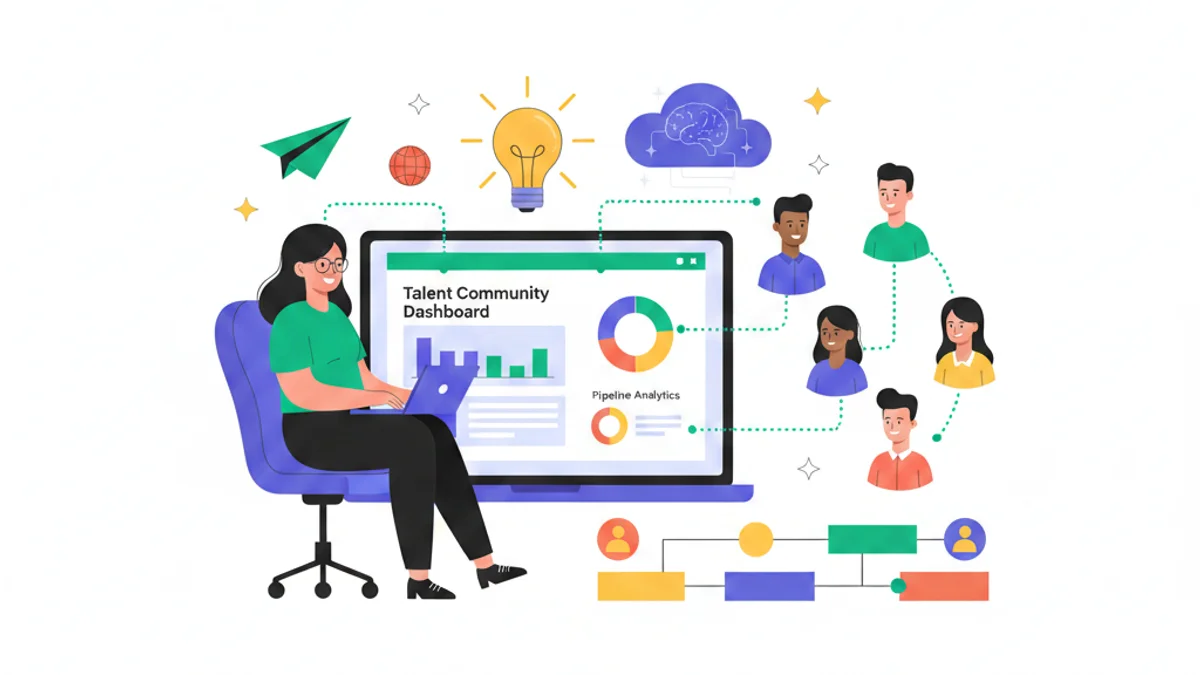
Not all talent community platforms actually build community. This buyer's guide shows what to look for, what questions to ask, and what real results look like — before you sign anything.
What you need to know in 60 seconds
- → A community recruitment platform is not an ATS — it builds a warm, engaged talent pool before a role opens, replacing cold sourcing with proactive pipelines.
- → Companies using community platforms report time-to-hire reductions of 50–80% versus traditional job board-first recruiting.
- → The five non-negotiable features: branded candidate experience, gamified assessments, automated nurture, CRM-grade analytics, and ATS integration — not all platforms deliver all five.
- → HEINEKEN Romania saw 43% more qualified applications after switching to a community-first approach; Wyndham Hotels achieved 290% more applications for multilingual roles.
- → Before you buy: ask vendors six specific questions about community engagement, assessment depth, data portability, and EU AI Act compliance.
- → This guide walks you through what separates a genuine community platform from a rebranded database — and how to choose the right one for your organisation.
Most recruiting teams have an ATS. Fewer have a community recruitment platform. And almost none of them realise the difference is the reason their time-to-hire hasn't moved in three years.
An ATS stores candidates. A community recruitment platform engages them — before, during, and after the hiring moment. That distinction sounds subtle until you're racing to fill 40 roles in Q3 and your talent pool is warm, interested, and pre-qualified. Or until you're staring at a wall of 800 CVs from a job board blast that will take your team two weeks to screen.
This guide cuts through the vendor noise. You'll learn what a community recruitment platform actually does, what features matter, how it compares to an ATS, and the six questions to ask before committing budget.
of companies say sourcing qualified candidates is their biggest challenge
LinkedIn Talent Trends Report
higher quality-of-hire when candidates are sourced from an engaged talent community vs cold job board
Aberdeen Group Research
reduction in cost-per-hire for organisations with a mature talent community strategy
Deloitte Human Capital Trends
What Is a Community Recruitment Platform?
A community recruitment platform is software that helps organisations build, engage, and hire from a branded talent community — a pool of interested candidates who have opted in to hear from you, before any specific role is open.
Think of it this way: a job board is a fishing trip. You bait a hook, cast it out, and wait for strangers to bite. A community platform is a fish farm. You build the environment, nurture the population, and harvest at the right moment.
According to Aptitude Research, companies with active talent communities fill roles 50% faster than those relying on reactive sourcing. The pool is already there. The screening is already done. You're not starting from zero.
Community platforms typically include: a branded candidate-facing hub, engagement tools (content, events, challenges), assessment capabilities, a CRM for managing candidate relationships, and integrations with your existing ATS. What they're not is a passive CV database — though some vendors will try to sell you one under that name.
Why Your ATS Can't Build a Talent Community
ATS platforms are built for one thing: tracking applicants through a funnel. They're exceptional at that. They're the wrong tool for everything that happens before someone applies — and that's exactly where a community recruitment platform operates.
Here's the structural problem. Your ATS starts its clock when a candidate submits an application. A community platform starts its clock when a candidate raises their hand to say "I'm interested in working for you someday." That's months — sometimes years — earlier. All that relationship-building, brand exposure, and talent intelligence happens outside your ATS's field of vision.
Community Recruitment Platform does…
- ✓ Engages passive candidates before roles open
- ✓ Builds a branded talent hub with employer story
- ✓ Runs gamified assessments to surface skills pre-interview
- ✓ Nurtures candidate relationships over time with automated touchpoints
- ✓ Provides CRM-grade analytics on engagement and candidate quality
- ✓ Integrates with ATS to hand off warm, pre-qualified candidates
Your ATS alone does NOT…
- ✗ Engage candidates who haven't applied yet
- ✗ Create a branded candidate destination beyond the apply page
- ✗ Run skills-based challenges or gamified assessments
- ✗ Send nurture sequences to keep candidates warm for future roles
- ✗ Measure candidate engagement or community health over time
- ✗ Give candidates a reason to stay connected to your brand
The most effective TA teams don't choose between an ATS and a community platform. They use both — with the community platform feeding warm, pre-qualified candidates into the ATS workflow at the moment a role opens.
5 Features That Separate Real Community Platforms from Rebranded Databases
Not every "talent community platform" actually builds community. Some vendors have slapped that label on what is, functionally, a searchable CV database with a nice front end. Here's what to look for to tell the difference.
Branded Candidate Hub
Candidates should arrive at a destination that looks and feels like your employer brand — not a generic white-label portal. The best platforms let you customise everything: colour, copy, culture content, and the stories you tell. If the vendor's logo is more visible than yours, that's a red flag.
Gamified Skills Assessments
Engagement without assessment is just marketing. The best community platforms embed challenges, mini-games, or scenario-based tasks that assess real competencies while keeping the candidate experience compelling. This is how you get skills data on passive candidates who would never sit through a traditional test.
Automated Nurture Sequences
A community that doesn't communicate isn't a community — it's a list. Look for platforms that let you send role-relevant updates, content, and event invites based on candidate profile and engagement history. Automated doesn't mean impersonal; the best sequences feel tailored and timely.
CRM-Grade Analytics
You should be able to answer: how many active candidates are in my community, what's their engagement score, which roles are they best matched for, and what's my time-to-fill from community vs. external sources? If the platform can't answer these questions, you're flying blind.
Native ATS Integration
The community platform and ATS must talk to each other. When a role opens, your team should be able to surface the right community members instantly and pass them to your existing workflow without re-entering data. Poor integration creates manual work and data silos — two things that kill adoption.
Community Platform vs ATS: The Full Comparison
The question isn't which one to choose. It's understanding what each system does best — and where the handoff happens. Use this table to map the two systems to your hiring workflow.
| Capability | Community Recruitment Platform | ATS |
|---|---|---|
| Passive candidate engagement | ✅ Core function | ❌ Not designed for this |
| Applicant tracking | ⚡ Partial (handoff to ATS) | ✅ Core function |
| Branded employer experience | ✅ Fully customisable | ⚡ Apply page only, limited |
| Skills-based assessments | ✅ Gamified, pre-application | ⚡ Via third-party add-ons |
| Candidate nurture automation | ✅ Built-in sequences | ❌ Not standard |
| Offer and onboarding workflows | ❌ Not in scope | ✅ Core function |
| Community health analytics | ✅ Engagement, match scores, pipeline depth | ❌ Not available |
| GDPR / EU AI Act compliance tools | ✅ Consent management built in | ⚡ Varies by vendor |
| Time-to-hire impact | ✅ Significant (pre-qualified pipeline) | ⚡ Streamlines process, doesn't change pipeline quality |
According to Gartner's HR Technology Report, organisations that deploy a community recruitment platform alongside their ATS reduce time-to-hire by an average of 47% compared to those using an ATS alone. The platforms aren't competing — they're complementary.
How to Choose: 6 Questions to Ask Before You Buy
Vendor demos are optimised to impress. Here are the six questions that cut through the presentation and reveal whether a platform will actually deliver — or just create a new line item on your tech budget.
How does your platform keep candidates engaged between roles?
This is the real test. Any platform can collect candidate registrations. What distinguishes community platforms is what happens next: automated content, events, challenges, re-engagement sequences. Ask for a specific example of the nurture workflow and how engagement rates are measured.
Red flag: "We send them job alerts." That's not community building — that's a mailing list.
What does the candidate assessment experience look like?
Ask to see the actual candidate view — not a screenshot, but a live walkthrough. Is the assessment experience branded? Is it engaging? Does it feel like a chore or a challenge? Skills data is only useful if enough candidates actually complete the assessment. Completion rates below 60% usually indicate a design problem.
What good looks like: A branded challenge or game-like task that takes 10–15 minutes and produces a skills profile the hiring team can act on immediately.
How does your platform integrate with our existing ATS?
Native integrations beat custom API builds every time. Ask specifically which ATS systems they integrate with out of the box, what data fields sync bidirectionally, and whether the integration has been stress-tested at high volumes. Then ask for a reference customer using the same ATS stack.
Red flag: "We support all major ATS platforms via Zapier." Manual data pipelines break at scale.
What's your approach to EU AI Act compliance for screening?
As of 2025, any AI system used for employment screening that uses biometric data or infers psychological traits falls under the EU AI Act's high-risk classification. Ask specifically how the platform handles consent, model explainability, and audit logs. Any vendor without a clear answer here is a liability risk.
What good looks like: Documented compliance posture, candidate consent flows, and a roadmap for high-risk AI system registration if applicable.
How quickly can we launch and what does implementation look like?
Enterprise platform implementations that drag on for six months kill internal adoption before the first candidate registers. The best platforms go live in weeks, not quarters. Ask for a realistic timeline, what your team will be responsible for, and what vendor support is included during onboarding.
Target benchmark: A well-designed community platform should be live and accepting candidates within four to six weeks of contract signature.
What does data portability look like if we switch vendors?
Your talent community data — candidate profiles, engagement history, assessment scores — is an asset you built. Make sure you can take it with you. Ask for the data export spec, what formats are supported, and whether there's any contractual restriction on using that data post-contract.
Red flag: Any vendor who is vague or evasive on this point. Your community data should be yours, always.
What Results Look Like: Numbers from Real Communities
Theory is useful. Numbers are better. Here's what organisations actually achieved after deploying a community recruitment platform — not pilot data, not projections.
HEINEKEN Romania needed to attract a new generation of talent in a competitive CEE market. The team built a branded talent community on Jobful, combining employer storytelling with gamified challenges that assessed candidates before any application. The result: a 43% increase in qualified applications within the first season, with a measurably younger, more engaged candidate pool. The community didn't replace their ATS — it fed it better candidates.
Wyndham Hotels faces a challenge familiar to any hospitality brand: high volume, multilingual hiring across dozens of properties with no time to waste. Their community platform centralised candidate attraction while maintaining property-level brand customisation. Applications increased by 290% for multilingual roles — roles that had historically taken four to six weeks longer to fill than average.
According to McKinsey Global Institute, organisations that invest in proactive talent pipelines spend 40–60% less per hire on sourcing costs over a two-year horizon. The savings compound: the longer your community runs, the warmer your pool becomes, and the less you spend reactivating cold databases for every new opening.
The compounding advantage
Community recruitment platforms don't just reduce time-to-hire for the next role you open. Every candidate who joins your community, completes an assessment, and stays engaged becomes a permanent asset in your pipeline. Unlike a job board post that disappears when the budget runs out, your community keeps growing between hiring cycles.
The organisations that start building communities today will have a structural hiring advantage in 18 months that their competitors will struggle to close. This is the core argument for moving now rather than waiting for a hiring crisis to force your hand.
You can explore more case studies — including results from Raiffeisen Bank, Regina Maria, and Publicis Groupe — at Jobful's case study hub.
Build the Right Community Recruitment Platform Stack
The best community recruitment platform for your organisation is the one your team will actually use — and that candidates will actually engage with. That means branded, easy to manage, integrated with your existing stack, and backed by assessment capabilities that give you data, not just CVs.
Start with the six questions above in your next vendor conversation. They'll reveal more than any demo will.
A community recruitment platform isn't a replacement for your ATS or your sourcing channels. It's the layer that makes all of them work harder — by ensuring that when a role opens, you're not starting from scratch.
See What a Community Recruitment Platform Looks Like in Practice
Jobful's branded talent community platform combines gamified assessments, automated candidate nurture, and ATS integration — built for TA teams that want to hire faster without sacrificing quality.
Frequently Asked Questions
Get More Insights Like This
Join 5,000+ HR professionals receiving monthly insights.