Reactive retention loses — 51% of employees are already watching the market. Here's the 90-day playbook for community-driven retention, the four engagement loops that keep talent loyal, and the KPIs that prove it works.
Most retention programs activate the moment a high-performer hands in their resignation. That's too late. Community-driven retention moves the work upstream — engaging your people inside a living talent ecosystem long before disengagement starts. It treats retention as a continuous relationship, not a counter-offer.
This playbook breaks down why traditional employee retention strategies stall, what a community-driven model actually does differently, and how to build one in 90 days. The data is sourced from Gallup, McKinsey, SHRM, and LinkedIn — and the framework is drawn from real Jobful deployments at Wyndham, HEINEKEN, and Regina Maria.
What you need to know in 60 seconds
- → Reactive retention loses. Gallup finds 51% of employees are actively looking for a new role — counter-offers stop fewer than 1 in 5.
- → Community-driven retention embeds people in a private talent ecosystem with continuous learning, peer connection, and visibility loops — disengagement gets caught early.
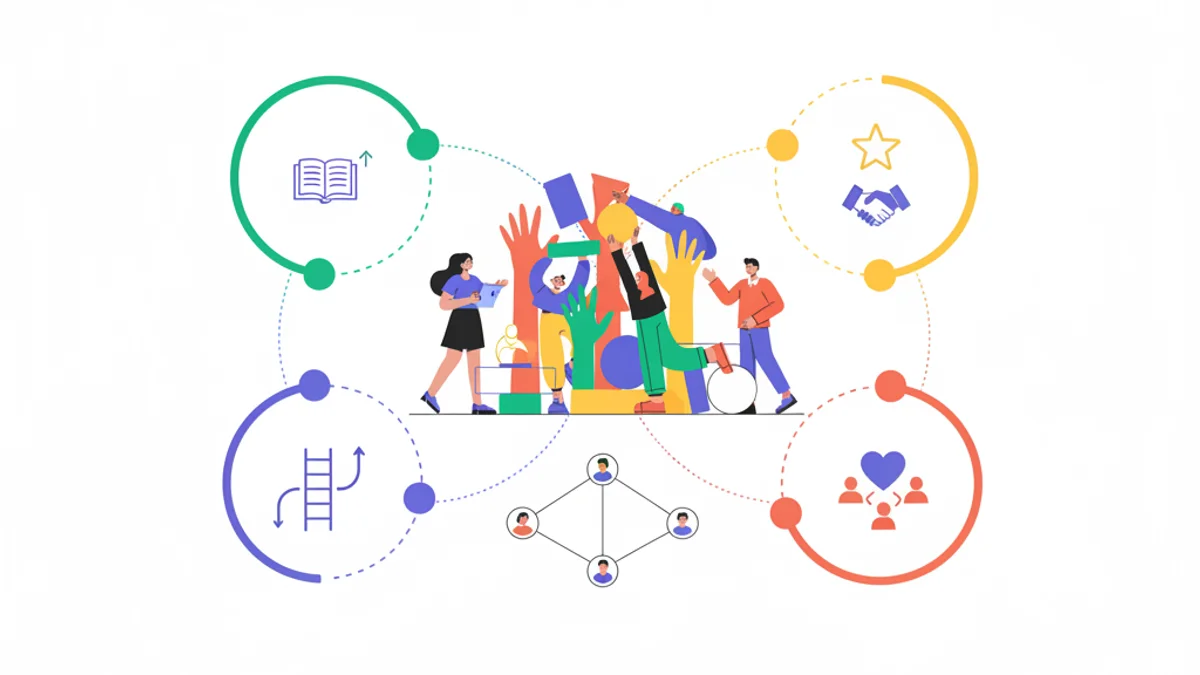
- → Four engagement loops drive the model: learning, recognition, mobility, and belonging. Run all four — not just one — for compounding retention gains.
- → The 90-day plan moves from audit to launch in three phases: map your retention risk, build the engagement architecture, then measure with three core KPIs.
- → Wyndham, HEINEKEN, and Regina Maria all use Jobful's community engine to keep talent close — attrition drops, internal mobility rises, and rehires happen at zero cost.
Why Most Retention Programs Fail
Most retention programs fail because they're reactive. They get triggered by a resignation letter, a counter-offer becomes the play, and by then the relationship is already gone. The decision to leave was made months earlier — usually inside a quiet six-week window after a missed promotion, a project cancellation, or a manager change.
Traditional talent retention strategies rely on three blunt instruments: pay increases, annual engagement surveys, and exit interviews. According to Gallup's 2024 State of the Global Workplace report, 51% of employees are actively watching or applying for a new role. None of those three instruments catches that drift.
The deeper problem is structural. Most companies treat employees and candidates as separate populations — different databases, different teams, different rituals. The moment someone signs an offer letter, they drop out of "talent acquisition" and into "HR." The moment they leave, they drop out of "HR" and into nothing. The community that surrounded their hiring evaporates the day they start.
Community-driven retention rejects that split. The relationship doesn't reset at the offer letter — it continues, deepens, and includes alumni. Disengagement gets noticed because there's something to disengage from.
of employees are actively watching or applying for a new role
Gallup, State of the Global Workplace 2024
annual global cost of disengaged employees (lost productivity)
Gallup, 2024
retention rate for employees with strong internal community ties
McKinsey, 2023
The Real Cost of Disengagement (And Why It's Bigger Than You Think)
Disengagement costs more than turnover. Gallup estimates the global productivity loss from disengaged workers at $8.9 trillion annually — roughly 9% of global GDP. That number dwarfs the line-item cost of replacing a single hire, which SHRM puts at six to nine months of an employee's salary.
Pull that apart for a 250-person mid-market company with 18% attrition and a €55,000 average salary. That's 45 leavers, €27,500 in replacement cost per leaver, and roughly €1.24 million per year in pure replacement spend — before you count productivity drag, lost institutional knowledge, or the morale tax on the people who stay.
Then the second-order effects. LinkedIn's 2024 Workplace Learning Report finds that 94% of employees would stay longer at a company that invests in their development. The flip side: when development stalls, retention collapses. It's not the pay packet. It's the trajectory.
A community-driven model is built precisely to keep trajectory visible. People see what's next — for them, for their peers, for the company — and that visibility is what binds them.
Traditional Retention Approach
- ✗ Activates only after resignation
- ✗ Annual engagement survey as the main signal
- ✗ Pay rises as the default lever
- ✗ Employees and candidates kept in separate silos
- ✗ Alumni disappear the day they leave
- ✗ Manager dependency — one bad manager = mass exit
Community-Driven Retention
- ✓ Continuous engagement from day-one onwards
- ✓ Behavioural signals tracked in real time
- ✓ Learning, mobility, and recognition as primary levers
- ✓ Unified pool — employees, candidates, alumni in one community
- ✓ Alumni stay reachable for rehires and referrals
- ✓ Cross-team relationships reduce manager dependency
What Community-Driven Retention Actually Means
Community-driven retention is a model that keeps employees, candidates, and alumni inside one engaged ecosystem — a private talent community — so engagement is continuous, signals are visible, and the relationship outlasts any single job.
It rests on a simple shift. Employees aren't just headcount inside an HRIS — they're members of a community that started before they were hired and continues after they leave. That community is where learning happens, where recognition flows, where internal jobs get surfaced first, and where alumni stay close enough to refer, rejoin, or buy from you later.
The mechanic is engagement at scale. Instead of one annual survey, you get continuous behavioural signal: who's completing challenges, who's mentoring, who's gone quiet. Instead of a press release announcing the new EVP, you get a feed where employees experience the EVP every week.
This is what people mean when they say "engaging and retaining talent" needs to be one motion, not two. The community is the motion.
Definition in one sentence
Community-driven retention is the practice of using a private talent community — with continuous learning, recognition, mobility, and belonging loops — as the primary engine for keeping employees engaged, and for keeping alumni and candidates close enough to rehire, refer, or return.
The Four Engagement Loops That Keep Talent Loyal
Community-driven retention runs on four engagement loops. Each loop creates its own gravitational pull. Run all four and the pulls compound — that's what produces the doubling effect McKinsey saw in connected workforces.
Skip one and the model leaks. Most companies build the learning loop and stop there. The reason retention still slips: belonging and mobility are doing the heavier lifting on whether someone stays for year three.
1. The Learning Loop
Skills challenges, peer-led workshops, and micro-credentials inside the community. Visible progression is the strongest single retention signal — LinkedIn's data shows 94% of employees stay longer when development is visible.
2. The Recognition Loop
Peer-to-peer kudos, badge unlocks, gamified milestones. SHRM's recognition research finds employees who receive consistent peer recognition are 5x more likely to stay than those who get none.
3. The Mobility Loop
Internal jobs surfaced inside the community first. McKinsey finds organisations with strong internal mobility retain employees 41% longer. The community becomes the internal LinkedIn — and the alternative to looking outside.
4. The Belonging Loop
Cross-team groups, alumni circles, regional chapters. Belonging is the slowest loop to build and the hardest to fake — but it's what makes the other three stick. Without it, learning and recognition feel transactional.
Building a Retention-Focused Talent Community: A 90-Day Plan
A community-driven retention model takes about a quarter to launch and another quarter to mature. The work splits into three 30-day phases: audit, architect, activate. Each phase has a deliverable you can show your CHRO or CFO at the end.
The point of a 90-day window is forcing concrete decisions. Many "how to retain top talent" plans die in PowerPoint because they're vague. This one ends with a live community, three KPIs, and a retention dashboard.
Days 1–30 — Audit your retention risk
Run an honest diagnostic. Segment attrition by tenure band (0–1 year, 1–3 years, 3+ years), function, and manager. Identify the top three "leak points" — usually a tenure band where attrition spikes 2x the company average. Layer in engagement-survey data and exit-interview themes for those segments.
Deliverable: a one-page retention-risk map. This becomes the brief for everything that follows. Without it, you're building loops for problems you can't see.
Days 31–60 — Architect the four loops
Design each loop against the retention-risk map. If your worst leak is the 0–1 year tenure band, the learning and belonging loops need to fire hardest in onboarding. If it's the 3+ year band, mobility and recognition matter more. Pick a platform that runs all four in one interface — fragmenting them across tools kills participation.
Deliverable: a community blueprint with content calendar, badge taxonomy, peer-kudos mechanics, and an internal-mobility funnel. Soft-launch with one business unit as a pilot.
Days 61–90 — Activate and measure
Open the community to the wider organisation. Run weekly challenges, surface internal jobs first inside the community, and invite alumni to rejoin. Stand up the dashboard: weekly active members, mobility conversion rate, and a 90-day retention delta against the baseline you captured in Phase 1.
Deliverable: live community, live dashboard, and a CFO-ready memo with the first measurable retention impact. The first 90 days won't show the full effect — but they'll show direction.
Measuring Community-Driven Retention: KPIs and Frameworks
You can't run this model on vibes. Three KPIs separate community-driven retention from a glorified Slack channel: community engagement rate, internal-mobility conversion, and 90-day retention delta.
The first measures whether people show up. The second measures whether the community actually moves talent. The third connects the work back to the metric the CFO cares about.
| KPI | What it measures | Healthy benchmark | Cadence |
|---|---|---|---|
| Community engagement rate | % of members active in a 30-day window (logins, challenge completion, kudos given/received) | 40%+ for healthy communities | Weekly |
| Internal mobility conversion | % of internal hires sourced from community members vs external pipeline | 30%+ at maturity (12 months in) | Monthly |
| 90-day retention delta | Change in voluntary attrition for community-active employees vs non-members | 10–25% lower attrition in active cohort | Quarterly |
| Alumni return rate | % of departures who rejoin or refer within 24 months | 8–15% for mature programs | Quarterly |
| Peer recognition density | Average kudos given per active member per month | 2+ per member per month | Monthly |
Track these five and you'll have an early-warning system that no annual engagement survey can match. The community engagement rate alone will tell you, six months before resignations spike, that something is wrong in a function. That's the value of continuous signal.
Case Study: How Wyndham, HEINEKEN, and Regina Maria Use Community to Retain
The pattern shows up across very different industries. Wyndham Hotels runs a multilingual community across franchise locations — the same platform that drove a 290% increase in applications now keeps frontline staff engaged through challenges and peer recognition. HEINEKEN Romania built a Gen Z talent community that delivered 43% more applications and made internal mobility into operational and commercial roles visible to early-career hires.
Regina Maria, Romania's largest private healthcare network, uses the same Jobful community engine to manage high-volume hiring while keeping nurses and medical staff connected across clinics. Alumni stay reachable. Returnees skip the full hiring pipeline. The community works because the same logic drives both acquisition and retention — one ecosystem, four loops, continuous signal.
The common thread: none of them treat retention as a separate program. They treat the community as the program — and retention is what falls out of it. You can read the full breakdowns in our case study library.
Where to Go From Here
If you take one thing away: stop treating retention as a salvage operation. The work has to start before the resignation, and it has to be continuous. Community-driven retention is the cleanest available model for doing that — and it has the McKinsey, Gallup, and LinkedIn data behind it.
Start with the audit. Map your retention risk in 30 days, design the four loops in the next 30, and activate in the last 30. By day 91 you'll have a working community, a dashboard, and a defensible answer when your CEO asks why people stay.
The companies that get this right won't just retain better. They'll build a private talent ecosystem that compounds for years — and that's a moat no competitor can copy with a counter-offer.
Build retention into your talent community
See how Jobful's community engine runs all four engagement loops — learning, recognition, mobility, and belonging — inside one private talent ecosystem. Most teams have a working community pilot in under 90 days.
Frequently Asked Questions
Get More Insights Like This
Join 5,000+ HR professionals receiving monthly insights.