The average career site converts 11% of visitors into applicants. Top-decile sites hit 25%. Here's the 2026 playbook for closing that gap in 30 days.
Your career site is the single most important page in your recruitment funnel. It's where employer branding, job discovery, and the decision to apply collide — and where most companies quietly lose half their applicants before a single role is read.
This playbook shows you what a high-converting career site actually looks like in 2026, the benchmarks to measure against, and a 30-day plan to fix the leaks. Based on the career site performance patterns we've seen across Wyndham Hotels, HEINEKEN Romania, and Regina Maria, plus the most recent industry data.
Career site optimization in 60 seconds
- → The average career site converts around 11% of visitors into applicants, while top-decile sites convert 25% or more — a 2.3x gap you can close with layout, speed, and mobile fixes (Phenom, 2024).
- → Applications longer than 15 minutes lose 60% of starters. Mobile-first design and five-click applies are the single biggest conversion levers (Appcast 2024 Recruitment Marketing Benchmark Report).
- → Career sites that push into a talent community — not just a job cart — retain 3-5x more re-engageable candidates over 12 months (Jobful platform data).
- → Wyndham Hotels saw a 290% lift in applicants after rebuilding its career site on Jobful, with a multilingual community layer replacing its flat job board.
- → You can fix 80% of career site conversion problems in 30 days: measure drop-offs, collapse the apply flow, fix mobile, add a talent community CTA for passive visitors.
Why Most Career Sites Lose Applicants Before the Apply Button
Most career sites are built for the recruiter, not the candidate. The page opens with a corporate values slideshow, the job search is buried three scrolls down, and the apply flow asks for a CV upload before it asks for a name. Visitors take one look and bounce.
According to the Appcast 2024 Recruitment Marketing Benchmark Report, the average apply-start-to-complete rate across industries sits at roughly 30%. That means for every ten people who click "apply," seven walk away mid-form. The problem isn't interest. It's friction.
Career site optimization is the practice of treating your jobs page like a product surface — measured, tested, and tuned the same way e-commerce teams tune checkout. The stakes are similar. Every abandoned application is money you already paid to advertise the role, walking out the door.
of applicants abandon forms longer than 15 minutes
Appcast 2024
of career-site traffic now arrives on mobile
LinkedIn Talent Solutions, 2024
applicant increase after Wyndham rebuilt on Jobful
Jobful case study, 2024
The Conversion Math: What "Good" Actually Looks Like in 2026
Good career site optimization starts with honest numbers. Before you redesign anything, measure what you have. Most teams can't answer the three basic conversion questions, and that's the first problem to fix.
The three metrics that matter: visitor-to-applicant rate, apply-start-to-complete rate, and mobile conversion delta. Track these three and you'll spot 80% of the problems inside a week.
Phenom's 2024 State of Candidate Experience research found the median visitor-to-applicant rate across enterprise career sites hovers around 11%. The top decile crosses 25%. That's a two-and-a-half times gap, and almost none of it is explained by employer brand — it's explained by load speed, mobile design, and form length.
| Metric | Industry Median | Top Decile | What It Signals |
|---|---|---|---|
| Visitor → applicant | ~11% | 25%+ | Site discoverability & layout |
| Apply-start → complete | ~30% | 70%+ | Form length & friction |
| Mobile conversion gap | -45% vs desktop | -5% or better | Responsive design quality |
| Time on job description | 0:42 | 1:50+ | Copy relevance & readability |
| Return visits in 90 days | 6% | 22%+ | Talent community & re-engagement |
Sources: Phenom 2024 State of Candidate Experience, Appcast 2024 Recruitment Marketing Benchmark Report, Jobful platform data.
The Six-Stage Career Site Conversion Funnel
Think of your career site as a six-stage funnel. Each stage has its own drop-off rate and its own fix. You don't need a redesign — you need to find the leakiest stage and close it first.
Arrival — Speed and first impression
Google's Core Web Vitals data shows a one-second delay in load time drops conversion by 7%. Your career site hero image should be under 200KB, the page interactive in under 2.5 seconds, and the first CTA visible without scrolling.
Fix first: compress images, defer non-critical scripts, and move any "join our community" pop-up to a delayed trigger.
Discovery — Search and browse
Candidates arrive with a specific role in mind. If they can't find it in two clicks, they leave for LinkedIn. Your job search needs filter chips (role, location, seniority), a clean results layout, and a "saved search" option that doubles as a talent community entry point.
Fix first: audit your search-to-result time. If it's over 4 seconds, that's your bottleneck.
Evaluation — The job description page
This is where brand and role meet. According to LinkedIn Talent Insights, job descriptions between 300–500 words convert 8.4% better than longer ones. Lead with impact, not requirements. Show salary bands where legally possible — pages that disclose pay earn 30% more apply-clicks.
Fix first: rewrite your five most-viewed job descriptions using the format: "What you'll own → Who we're looking for → What's in it for you."
Apply intent — The moment of friction
The apply button is the conversion cliff. Don't ask for account creation before someone can start. Don't require a CV upload before asking for a name. The highest-converting flows open with three fields — name, email, CV — and let candidates fill the rest later.
Fix first: time your own apply flow on a phone. If it's over three minutes to first save, your funnel is bleeding.
Confirmation — The under-used moment
Your thank-you page is the highest-intent real estate you own. Candidates who just applied are the single most engaged audience you'll ever have. Use it — invite them into your talent community, recommend similar roles, and set expectations on response time.
Fix first: replace the default "thanks, we'll be in touch" with a community sign-up that gates future events and insider roles.
Re-engagement — Turning a "no" into a "not yet"
The typical career site loses 85% of visitors who don't apply on first visit and never hears from them again. A talent community layer captures those passive visitors, keeps them warm with newsletter content, gamified challenges, or company updates, and surfaces them the next time a fitting role opens.
Fix first: add a single "Not ready to apply? Join our community" CTA above the fold on every job page.
Five Career Site Mistakes That Quietly Kill Your Apply Rate
Most career site problems aren't visible in a redesign mock-up — they live in the apply flow, the mobile render, and the invisible load time. Here's where to look.
Conversion Killers
- ✗ Forcing account creation before the apply form loads
- ✗ Asking for a CV upload as the first step on mobile
- ✗ Job descriptions over 1,000 words with no summary
- ✗ No salary, no location filter, no "remote" toggle
- ✗ A thank-you page that ends the conversation
Conversion Drivers
- ✓ One-click LinkedIn or CV-parse apply on mobile
- ✓ Salary ranges and hybrid policy in the first 100 words
- ✓ Role-based filters with instant results
- ✓ A talent community sign-up as the "soft apply"
- ✓ A thank-you page that recommends the next role
Career Site vs Talent Community: Why You Need Both
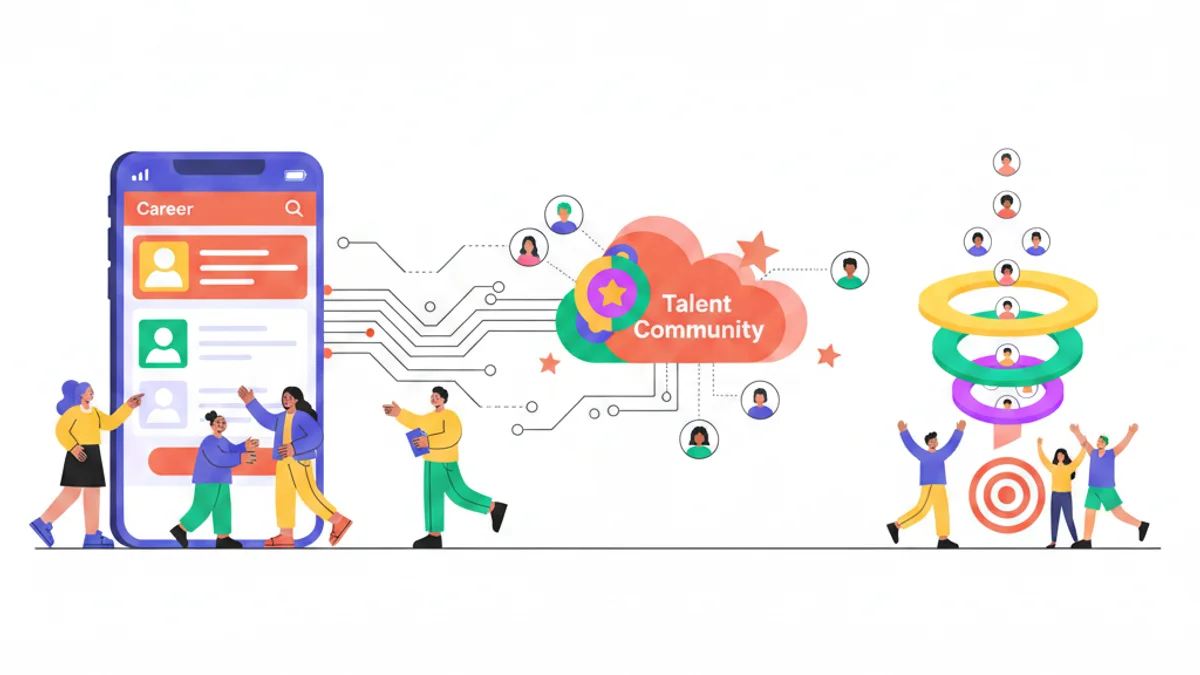
A career site captures today's applicants. A talent community captures tomorrow's. The mistake most teams make is treating them as separate projects — or, worse, treating the career site as the whole recruitment marketing stack.
The best 2026 career sites blur the line. Every page has two exits: "apply now" for active candidates and "stay in touch" for passive ones. The second exit is how you turn one-time traffic into a pipeline.
| Dimension | Career Site Only | Career Site + Talent Community |
|---|---|---|
| Audience captured | Active applicants only | Active + passive candidates |
| Time-to-fill | 40–60 days average | 12–20 days (Jobful data) |
| Cost per hire | ~$4,700 (SHRM 2024) | 30–50% lower (re-use) |
| Re-engagement | Email blast to dead database | Warm community, opt-in |
| Best for | Low-volume, reactive hiring | Scale hiring, Gen Z, regulated markets |
How Wyndham Hotels Turned Its Career Site Into a Community Engine
Wyndham Hotels & Resorts runs one of the most demanding recruitment operations in hospitality — multi-country, multilingual, franchise-driven, with thousands of roles open at any moment. Their legacy career site was a flat job board with a CV drop form.
After rebuilding on Jobful's talent community platform, Wyndham turned the same traffic into a 290% increase in applicants. The changes weren't cosmetic. They were structural.
Multilingual, one domain
One career site, five languages, role-based content switching. Candidates landed in their own language inside two clicks — no country-picker maze.
Mobile-first apply flow
Three-field apply, LinkedIn auto-fill, CV parse to prefill the rest. Average time-to-apply dropped from 11 minutes to under 3.
Franchise-aware community
Candidates could opt into a property-level community, not just a brand-level one — increasing re-engagement when new roles opened in their preferred location.
Conversion measured per market
Dashboards tracked visitor-to-applicant rate by country, language, and role family. Optimisation became continuous, not annual.
HEINEKEN Romania ran a similar playbook in a CEE context, adding gamified assessments at the top of the funnel to engage Gen Z candidates. The result: a 43% increase in applications and a measurable shift in the quality of top-funnel traffic (Jobful HEINEKEN case study).
Your 30-Day Career Site Optimization Plan
You don't need a six-month redesign to move the numbers. Here's the four-week plan we'd run if we were taking over a career site today.
Week 1: Measure
Install basic analytics on every career page. Track visitor-to-applicant, apply-start-to-complete, and mobile vs desktop split. Benchmark against the table above. Pick the worst stage.
Week 2: Fix the apply flow
Collapse to three mandatory fields. Enable LinkedIn or CV-parse auto-fill. Time the flow on a phone — target under three minutes. Remove account creation.
Week 3: Fix mobile and speed
Compress hero images, defer non-critical scripts, audit the mobile render of your five most-viewed jobs. Aim for a Lighthouse score above 85 on the job page.
Week 4: Add the community layer
Add a "join our community" CTA above the fold on every job page and on the thank-you screen. Replace the dead-end confirmation with a next-role recommendation.
The counter-intuitive move
The fastest career site conversion lift isn't a new design — it's removing things. Cut form fields. Cut pages. Cut clicks. The top-decile career sites are shorter, faster, and more opinionated than the median.
If you can't decide what to cut, watch five real candidates apply on a phone. The friction will point at itself.
Frequently Asked Questions
What is career site optimization?
Career site optimization is the practice of measuring, testing, and improving every stage of your recruitment funnel on your career pages — from first visit to completed application. It treats the career site as a conversion surface, not a static brand page, and focuses on load speed, mobile render, job description clarity, apply friction, and re-engagement mechanisms like talent communities.
What's a good career site conversion rate in 2026?
The industry median visitor-to-applicant rate sits around 11%, according to Phenom's 2024 State of Candidate Experience report. Top-decile career sites convert 25% or more. If you're below 8%, you almost certainly have a mobile or apply-flow problem that can be fixed in weeks.
Do I need to replace my ATS to improve my career site?
No. Most modern career site platforms, including Jobful, integrate with your existing ATS and handle the front-end candidate experience while the ATS continues to manage the back-end workflow. The right model is extension, not replacement — keep what works, fix the part candidates actually see.
How long should a job description be on a career site?
Between 300 and 500 words is the sweet spot. LinkedIn Talent Insights data shows job descriptions in that range convert 8.4% better than longer ones. Lead with impact and role ownership, include salary and location up front, and save detailed requirements for the bottom of the page.
What's the difference between a career site and a talent community?
A career site captures candidates who are ready to apply today. A talent community captures candidates who aren't — the 85% of visitors who leave without applying. The best 2026 strategies run both on the same platform, with the career site feeding the community and the community re-activating passive candidates when roles open.
How do I measure career site optimization ROI?
Track three headline metrics: cost per applicant, time-to-fill, and quality-of-hire at 90 days. A career site rebuild typically pays back within a single hiring cycle by lowering paid-media spend per applicant and reducing reliance on agency sourcing. Wyndham's 290% applicant lift, for example, translated directly into lower cost per hire across its multi-country footprint.
Your career site should be your best recruiter.
See how Jobful turns career sites into talent communities that keep converting — long after the job posting closes.
Frequently Asked Questions
Get More Insights Like This
Join 5,000+ HR professionals receiving monthly insights.