
One platform or best-of-breed tools? A clear-eyed 2026 guide to all-in-one recruitment platforms — what they cover, where consolidation pays off, and how to evaluate one.
Most recruiting teams didn't choose a fragmented tech stack. They inherited it — a job board here, an assessment tool there, a separate CRM for candidates who said "not now." An all-in-one recruitment platform promises to collapse that sprawl into a single system. But is one platform actually better than the best-of-breed tools you already run?
This guide breaks down what an all-in-one recruitment platform really includes, where consolidation pays off, and where it quietly costs you. Let's face it — the wrong call here locks you into a five-figure contract you can't easily unwind.
What you need to know in 60 seconds
- →An all-in-one recruitment platform unifies sourcing, career site, assessment, candidate relationship management, and analytics in one system — replacing five to ten disconnected tools.
- →The average enterprise runs 10+ separate HR and recruiting applications, and data fragmentation is one of the top barriers HR leaders name — according to Gartner.
- →Consolidation wins on data continuity, candidate experience, and total cost — but a single suite can be weaker than a specialist tool on any one feature.
- →An all-in-one platform is the right call when you hire at volume, run lean, or need one source of truth. It's the wrong call when a single specialist capability is business-critical.
- →Jobful's unified platform helped HEINEKEN Romania lift applications by 43% and Wyndham by 290% — proof that one connected system can outperform a bolted-together stack.
What Is an All-in-One Recruitment Platform?
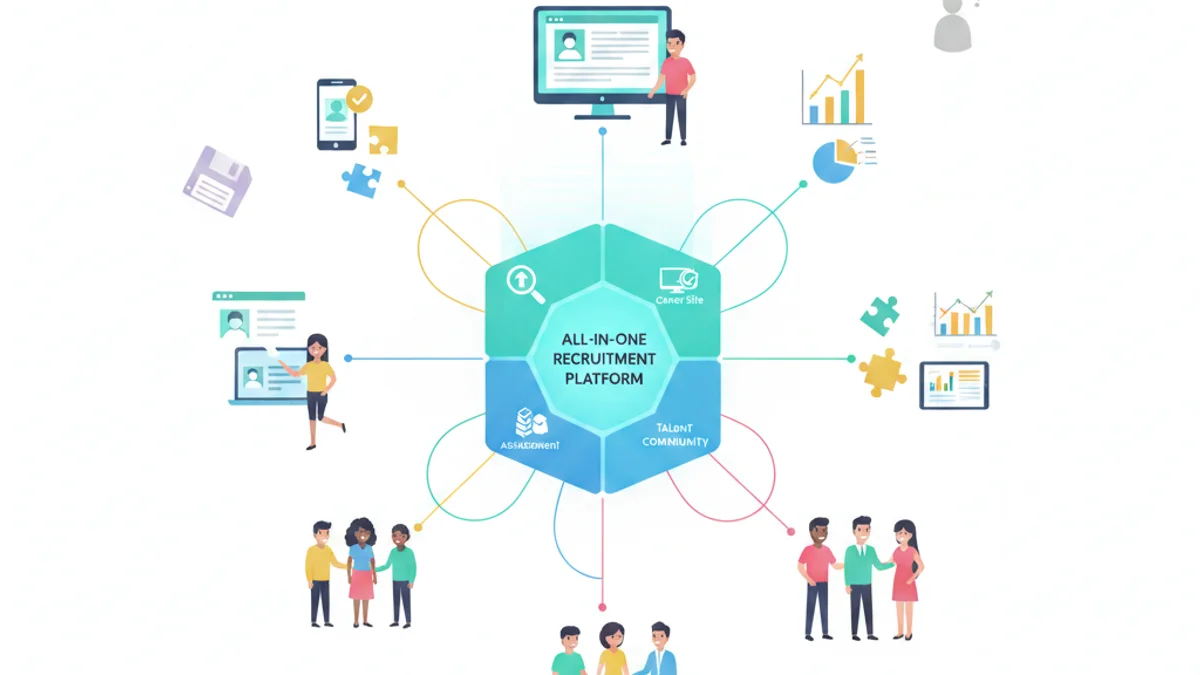
An all-in-one recruitment platform is a single system that runs the entire hiring journey — from attracting candidates to measuring quality of hire — without stitching together separate tools. One login, one candidate record, one dataset.
Contrast that with the typical "point solution" setup: an ATS for applications, a job-marketing tool for reach, a psychometric vendor for assessment, a CRM for nurturing, and a BI dashboard bolted on to make sense of it all. Each tool is good at its job. The problem is the seams between them.
A true all-in-one platform — sometimes called an end-to-end or personalised hiring platform — owns those seams. Candidate data flows from first click to signed offer without a single manual export.
The one-sentence definition
An all-in-one recruitment platform replaces a fragmented stack of single-purpose tools with one connected system that handles sourcing, engagement, assessment, hiring, and analytics on shared data.
Why Fragmented Hiring Stacks Quietly Drain Your Budget
Tool sprawl doesn't announce itself. It shows up as duplicated candidate records, reporting that takes a full day to assemble, and a candidate experience that feels like five different companies. The cost is real, even when it's invisible on the invoice.
Consider where the money actually leaks. Every integration you maintain is a point of failure. Every tool you license carries a per-seat fee, an admin, and a renewal negotiation. And every handoff between systems is a place candidates drop out.
Separate HR and recruiting tools the average enterprise runs
Gartner
Average cost-per-hire before tool overhead is counted
SHRM
Of companies plan to consolidate their recruiting technology
Aptitude Research
According to Aptitude Research, the appetite for consolidation is now mainstream — teams are tired of paying for overlap and reconciling numbers that never quite match. The pull toward a single platform isn't about buying more technology. It's about buying less, and connecting what's left.
All-in-One vs Point Solutions: The Real Trade-Offs
One connected platform beats a fragmented stack on data, cost, and candidate experience. A best-of-breed point solution beats a suite on raw depth in its single specialty. Here's the honest comparison, side by side.
| Factor | All-in-One Platform | Point Solutions |
|---|---|---|
| Data continuity | One candidate record, end to end | Records fragmented across tools |
| Feature depth | Strong across the board | Deepest in one specialty |
| Total cost | One contract, predictable | Stacked licences and integration fees |
| Candidate experience | Seamless, single-branded journey | Disjointed across handoffs |
| Reporting | Unified analytics out of the box | Manual stitching or extra BI tool |
| Switching risk | Higher lock-in to one vendor | Swap any single tool freely |
The pattern is clear. Point solutions win the feature-by-feature battle. All-in-one platforms win the war on continuity, cost, and experience — the things that actually move quality of hire.
Six Capabilities a True All-in-One Platform Must Cover
A real all-in-one recruitment platform covers the full journey — not just an ATS with a few add-ons. If a vendor is missing any of these six, you'll end up rebuilding the fragmented stack you were trying to escape.
Sourcing and reach
Job distribution, social recruiting, and a branded career site that converts visitors into applicants — not a link out to a third-party board.
Talent community and CRM
A warm, owned pipeline of engaged candidates you can re-activate — so you're not paying to source the same person twice.
Assessment and gamified screening
Skills-based, engaging evaluation built into the flow — measuring what predicts performance, not just what fits on a CV.
Applicant tracking and workflow
Structured pipelines, collaborative hiring, and automation that moves candidates forward without manual chasing.
Analytics and quality-of-hire tracking
Cost-per-hire, time-to-fill, source effectiveness, and post-hire performance — from one dataset, updated in real time.
Integrations and compliance
Open APIs to your HRIS and payroll, plus GDPR and EU AI Act readiness baked in — not sold as a premium module.
When an All-in-One Platform Is the Right Call — and When It Isn't
Choose an all-in-one platform when connected data and a single candidate journey matter more than best-in-class depth on any one feature. Stick with specialists when a single capability is so business-critical that "very good" isn't good enough.
Go all-in-one when you...
- ✓ Hire at volume and need a smooth candidate experience at scale
- ✓ Run a lean team that can't babysit ten integrations
- ✓ Need one source of truth for reporting to the board
- ✓ Want to build an owned talent community, not rent reach
- ✓ Are consolidating to cut licence and admin overhead
Keep specialists when you...
- ✗ Depend on one niche capability no suite matches
- ✗ Have deep, custom integrations you can't easily replace
- ✗ Face heavy internal resistance to a big migration right now
- ✗ Hire so rarely that a full platform is overkill
- ✗ Are mid-contract on tools with steep exit penalties
Most mid-market and enterprise teams sit firmly in the left column. The question is rarely whether to consolidate — it's when, and onto which platform.
How to Evaluate an All-in-One Platform Without Getting Burned
Evaluate on outcomes, not feature checklists. A demo that dazzles can still hide shallow analytics, a clunky candidate journey, or hidden fees. Run these four checks before you sign.
Test the candidate journey yourself
Apply as a candidate on a phone. If it takes more than a few minutes or feels generic, your applicants will feel it too.
Ask to pull a live quality-of-hire report
If the platform can't connect source to post-hire performance in one view, its "analytics" are just an activity log.
Map the total cost, not the sticker price
Add implementation, integration, and support fees. Then compare against every licence the platform lets you retire.
Demand proof, not promises
Ask for named results from teams like yours. Jobful's work with HEINEKEN Romania drove a 43% jump in applications; Wyndham saw 290% more. Numbers beat feature lists.
One platform, measurable results
When HEINEKEN Romania needed to reach young talent, a unified, gamified hiring experience lifted applications by 43% — without a patchwork of tools behind the scenes.
Wyndham Hotels used the same connected approach across multilingual, multi-site franchise hiring and saw 290% more applications. See how it works across sectors on the Jobful case studies hub.
Replace the stack. Keep the results.
See how Jobful unifies sourcing, community, gamified assessment, and analytics into one platform your candidates and your finance team will both thank you for.
Frequently Asked Questions
Get More Insights Like This
Join 5,000+ HR professionals receiving monthly insights.