
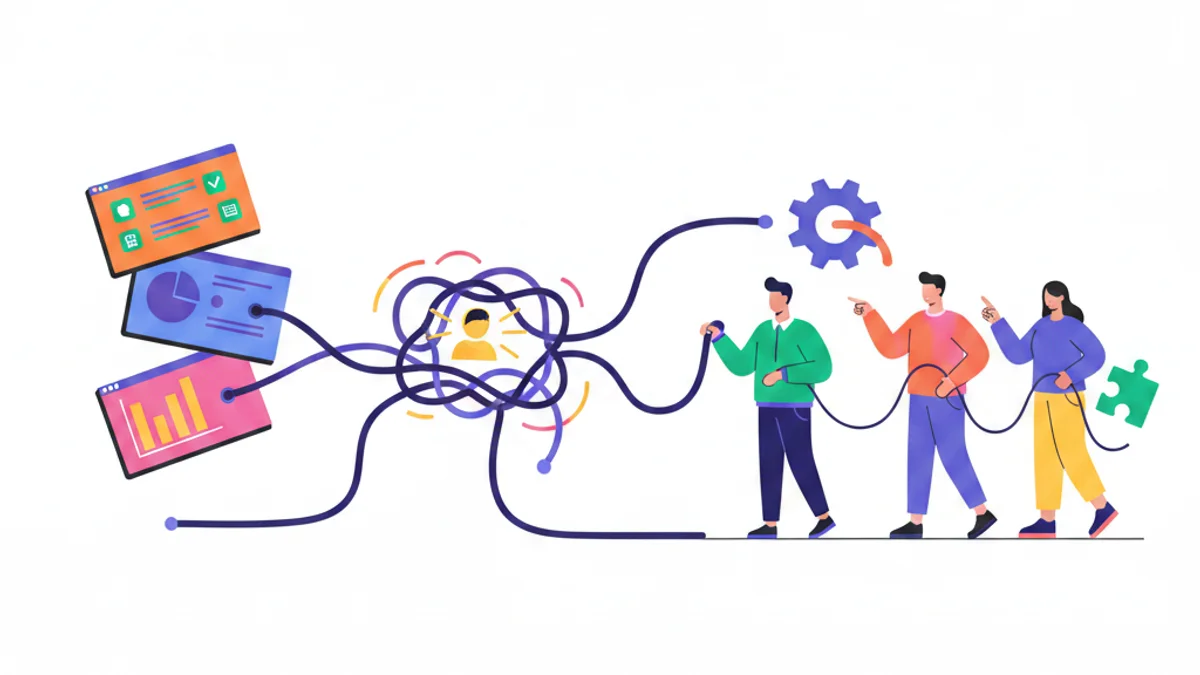
Fragmented recruitment tech stacks are costing TA teams time, candidate quality, and competitive advantage. This guide breaks down why agility and consolidation — combined with a long-term talent engagement strategy — are the two foundations that will define high-performing recruitment functions over the next three years.
TL;DR
Most recruitment teams are working harder than they need to — not because they lack effort, but because their tools are fighting each other. Fragmented tech stacks cost time, damage candidate experience, and leave hiring teams blind to the talent market between job postings. The fix isn't more tools. It's fewer, better-connected ones — built on a platform agile enough to adapt as the market shifts. This article breaks down why consolidation and long-term talent engagement are the two strategies that will separate high-performing TA teams from the rest over the next three years.
Here's a question most TA leaders can't answer cleanly: how many tools does your team use to fill a single role?
If you counted — honestly — the number is probably somewhere between seven and twelve. A job board here. An ATS there. A separate tool for video interviews. Another for assessments. A spreadsheet for tracking. A CRM your team half-uses. An email sequence tool someone set up two years ago that nobody fully understands anymore.
Each one made sense when you added it. Together, they've become a mess.
This is the state of recruitment technology in 2026. Not broken in one dramatic way — broken in a thousand small ones. Slow handoffs. Duplicated data. Candidate information that lives in three systems and matches in none of them. Recruiters who spend more time logging into dashboards than talking to people.
The market has changed faster than most tech stacks have. Remote work rewired candidate expectations. Gen Z entered the workforce demanding interactive, mobile-first experiences. The EU AI Act started putting regulatory pressure on automated hiring tools. And AI-driven layoffs created a talent market that's simultaneously flooded with applicants and starved of the right ones.
The recruitment teams winning right now aren't the ones with the most tools. They're the ones with the right platform — agile enough to adapt, consolidated enough to actually work.
The Recruitment Tech Stack Has a Fragmentation Problem
The average enterprise talent acquisition team uses between 7 and 12 separate tools to manage a single hiring process. That number comes from research by Aptitude Research, and it should give every HR leader pause.
Seven to twelve tools. Each with its own login. Its own data model. Its own support contract. Its own renewal date that someone has to remember to review.
This is what the industry calls a "tech stack" — but stack implies structure. What most TA teams are actually running is closer to a Frankenstein system: parts bolted together over years of quick fixes, vendor promises, and "we'll integrate that later" decisions that never quite happened.
The fragmentation shows up in three ways that matter:
Data silos that distort reality
When candidate information lives across multiple systems, you never have a clean picture of what's working. Where did your best hires come from? How long did each stage actually take? Which sourcing channel delivers quality, not just volume? If answering those questions requires exporting three spreadsheets and cross-referencing them manually, your data isn't an asset — it's a liability.
Recruiter time that disappears into admin
Every tool switch costs time. Logging in, updating records, copying information from one system to another — research from Deloitte suggests recruiters spend up to 40% of their working week on administrative tasks that technology should be handling automatically. That's two full days per week not spent on sourcing, building relationships, or improving candidate experience.
A candidate experience that exposes the cracks
Candidates don't see your internal systems. But they feel the consequences of them. Slow responses. Application processes that break on mobile. Follow-up emails that reference the wrong role. These aren't minor inconveniences — they're brand moments. And in a market where employer reputation travels fast, every friction point costs you.
The fragmentation problem isn't new. What's new is the cost of ignoring it.
What Agility Actually Means in Recruitment (It's Not What You Think)
Agility gets thrown around a lot in HR circles. Usually it means moving fast — cutting time-to-hire, accelerating screening, getting offers out before the competition. Speed matters, but that's not what agility actually means for recruitment technology.
Real agility is adaptability. The ability to change how you hire — who you target, how you engage them, which markets you prioritise, which tools you deploy — without rebuilding your entire process from scratch every time the market shifts.
And the market has been shifting constantly.
Think about what TA teams have had to absorb in the last four years alone. A global pandemic that overnight made remote hiring the default. A talent shortage that flipped the power dynamic toward candidates. A Gen Z workforce entering at scale with completely different expectations about what a job application should feel like. A wave of AI-driven restructuring across industries that simultaneously flooded the market with applicants and created anxiety and mistrust among passive talent. And now, EU AI Act enforcement timelines that are putting legal pressure on the automated hiring tools many teams quietly rely on.
Each of these shifts required a different response. The teams that handled them well weren't necessarily the ones with the biggest budgets. They were the ones whose technology could bend without breaking.
Here's what that looks like in practice:
Configurable workflows, not fixed processes
Agile recruitment platforms let you adapt your hiring stages, assessment criteria, and candidate communications to match the role, the market, and the moment — without raising a support ticket every time.
Modular architecture that grows with you
Adding a new market? Launching a graduate programme? Scaling from 50 hires a year to 500? An agile platform accommodates that growth without requiring a full reimplementation.
Real-time data that informs decisions
Agility without insight is just guessing faster. The platforms that enable true adaptability give recruiters and TA leaders live visibility into what's working — so they can adjust before a bad quarter becomes a bad year.
The opposite of agility isn't slowness. It's rigidity. And rigid systems, however feature-rich they looked at the time of purchase, are the ones that leave teams scrambling when the market moves again.
It will move again. It always does.
The Hidden Costs of a Fragmented Tech Stack
Nobody builds a fragmented tech stack on purpose. It happens gradually — one tool at a time, one problem at a time — until the day someone asks a simple question like "how much are we actually spending on recruitment technology?" and nobody can give a clean answer.
The direct costs are visible enough. Licence fees. Implementation costs. Annual renewals. But the hidden costs are where fragmentation really bleeds a recruitment function dry.
of recruiter time lost to admin in fragmented stacks
Source: Deloitte
average time to regain focus after a system switch
Source: UC Irvine
tools used by the average enterprise TA team per hire
Source: Aptitude Research
The productivity tax nobody is measuring
Context switching — moving between different tools and interfaces throughout the day — has a measurable cognitive cost. Research from the University of California Irvine found it takes an average of 23 minutes to fully regain focus after an interruption. Multiply that by every system switch a recruiter makes in a day, and you start to understand why talented people feel exhausted by Wednesday despite not having spoken to a single candidate.
Compliance exposure that compounds over time
The EU AI Act isn't the only regulation TA teams need to think about. GDPR candidate data requirements, right-to-explanation obligations, audit trail mandates — these all become significantly harder to manage when candidate data is scattered across eight different systems with different retention policies and access controls. Fragmentation isn't just inefficient. In a tightening regulatory environment, it's a liability.
The reporting gap that makes strategy impossible
Here's a test. Ask your team to produce a report showing cost-per-hire by channel, broken down by role type, for the last 12 months. If that report takes more than an hour to produce — or requires pulling data from more than one system — your tech stack is actively preventing strategic decision-making. You're flying blind between job postings, reacting to problems rather than anticipating them.
Candidate experience inconsistency that damages your employer brand
When your ATS doesn't talk to your employer branding platform, and neither talks to your assessment tool, candidates fall through gaps. They apply and hear nothing. They receive generic emails that don't reflect the engaging careers page they just spent twenty minutes exploring. They complete a video interview and get a response that references details from a different role. Each of these moments erodes trust — and trust, once lost in a hiring process, rarely comes back.
The hidden costs of fragmentation don't show up on a single invoice. They show up in recruiter turnover, quality-of-hire decline, employer brand scores, and the quiet frustration of a team that knows they could be doing better work if their tools would just get out of the way.
What a Consolidated Recruitment Platform Actually Looks Like
Consolidation doesn't mean stripping your recruitment function down to a single tool that does everything poorly. It means building around a platform that does the critical things excellently — and connects everything else cleanly.
The difference matters. A consolidated platform isn't a compromise. It's a deliberate architectural choice that puts candidate data, employer branding, engagement, assessment, and analytics in the same ecosystem — so information flows naturally instead of being manually transferred between disconnected systems.
In practice, it looks like this:
One source of truth for candidate data
Every interaction a candidate has with your brand — from the first careers page visit to the moment they receive an offer — is captured, stored, and accessible in one place. No duplicate records. No conflicting information.
Employer branding and recruitment from the same engine
The story you tell about your company on your careers page should be the same story a candidate experiences when they start an application. When branding and recruitment live on the same platform, that consistency happens automatically.
Integrated assessment and engagement tools
Screening, skills evaluation, gamified challenges, video content — these should be native features of the same platform, feeding candidate insight directly into the recruiter's workflow without an export or an integration call.
Analytics that connect activity to outcomes
Not vanity metrics — actionable data. Which sourcing channels deliver candidates who actually accept offers? Which assessment scores correlate with six-month retention? A consolidated platform answers these questions because it holds all the data needed to do so.
The results of this approach are well documented. When Wyndham Hotels & Resorts moved from a fragmented, property-by-property recruitment model to a unified platform across their 9,100+ hotels in 95 countries, applications per job increased by 290% — jumping from an average of 10 applicants to 39. Recruiter administrative time dropped by 65%. Time-to-hire fell by 35%.
HEINEKEN Romania saw a similar transformation. By consolidating their graduate recruitment onto a single gamified platform, they increased Gen Z applications by 43%, pushed application completion rates from 67% to 91%, and watched average candidate engagement time jump from 8 minutes to 52 minutes.
These aren't technology success stories. They're strategy success stories — enabled by technology that was finally working as a system rather than a collection of parts.
See it working in practice
Jobful's Recruitment Suite connects every stage of your hiring process — from first employer brand impression to final offer — in one platform built for scale. Explore how our Integrations keep your existing tools connected without the fragmentation.
Explore the Recruitment Suite →Agility vs. Consolidation — Aren't These Opposites?
It's a fair objection. Consolidation sounds like the opposite of agility — like trading a nimble collection of best-in-class tools for a monolithic enterprise system that takes eighteen months to implement and requires a dedicated administrator to change a single workflow.
That was true once. It isn't anymore.
The generation of consolidated platforms being built today — and the one Jobful sits firmly within — are architected differently from the enterprise HR systems of the 2000s and 2010s. The old model was rigid by design: one configuration, one workflow, one way of doing things, applied uniformly across an entire organisation whether it fit or not.
The new model is modular by design. Consolidation and agility aren't in tension — they're complementary. Here's why.
Consolidation creates the stable foundation that makes agility possible
When your data lives in one place and your workflows run on one engine, making changes becomes fast rather than complicated. You're not coordinating updates across eight vendors. You're configuring one platform. That's not rigidity — that's leverage.
Modularity means you activate what you need, when you need it
A consolidated platform built on modular architecture lets you run a lean hiring process for high-volume roles and a sophisticated, multi-stage engagement programme for senior or specialist positions — from the same system. You're not locked into one mode of operating. You're choosing from a menu of capabilities that all speak the same language.
Integration flexibility preserves what's already working
Consolidation doesn't have to mean ripping out every tool you currently use. A well-architected platform connects cleanly with your existing ATS, HRIS, job boards, and assessment providers — reducing fragmentation without demanding a full replacement on day one. You consolidate progressively, capturing efficiency gains at each stage.
Think of it this way. A fragmented stack is like a city where every neighbourhood has its own power grid, its own water system, and its own road network — each optimised locally, none connected. Getting from one side of the city to the other is possible, but it's slow, expensive, and unreliable. A consolidated platform is the shared infrastructure that lets everything run faster — while still leaving room for each neighbourhood to have its own character.
Agility and consolidation aren't opposites. Fragmentation and agility are.
Stop Hiring Like It's an Emergency: The Case for Long-Term Talent Engagement
Here's an uncomfortable truth about how most recruitment teams operate. They're invisible to the talent market for roughly 90% of the year — and then they expect candidates to appear, engaged and enthusiastic, the moment a job gets posted.
That's not a recruitment strategy. That's hoping.
The "post and pray" model has always been inefficient. But in 2026, with AI-driven layoffs generating unprecedented noise in the talent market, passive candidates drowning in automated outreach, and the best people rarely actively job hunting, it's become actively dangerous to rely on it as your primary approach.
The talent market doesn't pause between your job postings
Candidates are forming opinions about your employer brand constantly — when they read an article about your company, when a friend mentions working there, when they scroll past your content on LinkedIn, when they visit your careers page out of curiosity with no immediate intention to apply. These moments happen whether you're hiring or not. The question is whether you're present for them.
Most recruitment teams aren't. They're present when they're panicking.
The AI era has made this worse — and created a genuine opportunity
The wave of AI-driven restructuring across industries has put an enormous number of skilled professionals into a state of career uncertainty. Some are actively looking. Many more are quietly watching — not ready to apply, but paying attention to which employers seem like safe, interesting, values-aligned places to land if and when they decide to move.
This is a window. A significant one. The organisations that use this moment to build genuine relationships with displaced and anxious talent — rather than blasting them with automated InMails the moment a role opens — will have a material advantage when they actually need to hire.
But capturing that window requires infrastructure. It requires thinking about talent engagement the way a good marketing team thinks about lead nurturing — not as a single transaction, but as a relationship that develops over time.
The difference between a talent pipeline and a talent community
A pipeline is transactional. You source candidates, move them through stages, hire or reject them, and the relationship ends. A talent community is different. It's an ongoing relationship between your employer brand and people who are interested in your organisation — at varying levels of readiness to engage.
Ready Now
Active candidates ready to apply today. Engage with open roles and direct calls to action.
6 Months Out
Passive candidates open to conversation. Nurture with culture content, events, and career insights.
2+ Years Out
Long-term interested talent. Build brand affinity through thought leadership and mission-driven content.
A mature talent community strategy nurtures all three groups simultaneously — with different content, different touchpoints, and different calls to action — so that when a role opens, you're not starting from zero.
The data supports this approach. Companies with active talent communities fill roles up to twice as fast as those relying solely on inbound applications, and at significantly lower cost-per-hire. The sourcing work has already been done. The relationships have already been built. The employer brand has already done its job.
Medium-term engagement: staying relevant between hiring cycles
In the medium term — think three to twelve months — talent engagement is about staying on the radar of people who aren't ready to move yet. This means consistent, valuable content that reflects your culture and values. It means personalised communication that acknowledges where someone is in their career rather than treating everyone as an active job seeker. It means events, webinars, and community touchpoints that give potential candidates a reason to stay connected without the pressure of an open application.
This is employer branding doing its real job — not a careers page refresh or a LinkedIn banner update, but an always-on signal to the market about who you are and why working with you matters.
Long-term engagement: building the talent pools that make future hiring predictable
In the long term — twelve months and beyond — the goal is talent pool depth. Knowing that when you need a senior data engineer in six months, or a cohort of graduate trainees next September, you have a warm, engaged audience to activate rather than a cold market to penetrate.
This kind of foresight changes the economics of recruitment entirely. Time-to-hire compresses. Agency dependency reduces. Offer acceptance rates improve because candidates who've been nurtured over time are more invested in the outcome. And recruiter stress — the constant firefighting that drives burnout in TA teams — drops significantly when hiring feels planned rather than reactive.
Think about how the best marketing teams operate. They don't only run campaigns when the sales team needs leads by Friday. They build brand equity continuously, so that when it's time to convert, the audience is already warm. Recruitment should work the same way.
The teams that treat talent engagement as an always-on function — not an emergency response — are the ones that will consistently out-hire their competition. Not because they move faster in the moment, but because they've been building longer.
Build relationships before you need to hire
Jobful's Talent Community gives you the infrastructure to engage, nurture, and activate talent pools — so you're never starting from zero when a role opens. Pair it with our Employer Branding tools to build an always-on presence that attracts the right people before they're even looking.
The 5 Signs Your Recruitment Tech Stack Needs Consolidation
Most TA leaders know something is wrong before they can articulate what it is. There's a general sense of friction — of working harder than the results justify, of technology that was supposed to help somehow making things slower.
These are the five signs that friction has a name. And that name is fragmentation.
Your recruiters spend more time in admin than talking to candidates
Recruitment is a relationship function. When the people responsible for building those relationships are spending the majority of their day updating records, switching between systems, and chasing information that should already be in front of them — the technology has failed its primary job. If your recruiters' calendars are full but their candidate interaction logs are thin, the stack is the problem.
You can't answer basic sourcing questions without a spreadsheet
"Where did our best hires come from last quarter?" should take thirty seconds to answer. If it takes thirty minutes — and involves exporting data from multiple systems, cross-referencing it manually, and still arriving at a result you're not entirely confident in — your reporting infrastructure is broken. Strategic talent acquisition requires clean, real-time data. Fragmented systems make that impossible.
Candidate experience varies depending on which property, brand, or market they're applying to
If a candidate applying to your London office has a fundamentally different experience from one applying to your Paris office — different application process, different communication style, different employer brand presentation — you don't have a recruitment strategy. You have a collection of local experiments with no coherent identity. Wyndham Hotels faced exactly this before consolidating across 9,100+ properties. The inconsistency wasn't just inefficient — it was actively undermining their global employer brand.
Compliance reporting is a project, not a process
In a tightening regulatory environment — GDPR, EU AI Act, right-to-explanation requirements — being able to produce a clean audit trail of your hiring decisions quickly and accurately isn't optional. If generating a compliance report requires pulling data from multiple systems, reconciling inconsistencies, and hoping nothing has been deleted or overwritten in the interim, you're one regulatory inquiry away from a serious problem.
Adding a new tool feels like launching a project
When your stack is already fragmented, every new tool you consider adding requires an integration assessment, a data mapping exercise, a vendor negotiation, and an internal change management process. The overhead of managing the stack starts to exceed the value any individual tool delivers. That's the point at which consolidation stops being a nice-to-have and becomes a strategic necessity.
If two or more of these sound familiar, the question isn't whether to consolidate. It's how quickly you can start.
How to Build an Agile, Consolidated Recruitment Tech Stack
Consolidation doesn't happen overnight. And it shouldn't — rushed platform migrations that ignore existing workflows and team habits tend to create new problems faster than they solve old ones. The good news is that a structured approach to consolidation delivers measurable wins at every stage, not just at the end.
Here's how to do it without the chaos.
Audit your current stack honestly
Start by mapping every tool your recruitment function currently uses — officially sanctioned ones and the shadow IT your team has quietly adopted because the official tools weren't cutting it. Document what each tool does, what it costs, what data it holds, and how it connects (or doesn't) to everything else. Most TA leaders who go through this process discover they're paying for capabilities they already have elsewhere, maintaining integrations that have silently broken, and holding candidate data in systems nobody has reviewed in years. This isn't a technical exercise. It's a strategic one.
Define your non-negotiables
Not everything in your current stack needs to go. Some tools are genuinely best-in-class for specific functions and worth keeping. Others are legacy systems that survive purely through inertia. Define the capabilities your recruitment function absolutely cannot operate without — then define the capabilities you wish you had but currently don't. This gap analysis becomes the brief for your consolidated platform evaluation.
Evaluate platforms on flexibility, not just features
Feature checklists are the wrong way to evaluate recruitment platforms. Every vendor can demonstrate a feature. What matters is whether the platform can adapt to your specific workflows, your market complexity, your employer brand requirements, and your compliance obligations — without requiring a custom development project every time your needs evolve. Ask vendors the questions that reveal architectural flexibility: Can workflows be configured without engineering support? How does the platform handle multi-brand or multi-market hiring? How does it approach EU AI Act compliance?
Pilot before you commit at scale
Choose a specific hiring programme, market, or role type as your pilot. Something real enough to generate meaningful data, contained enough to manage the change carefully. HEINEKEN Romania's approach is instructive here — they piloted Jobful's platform for their graduate trainee programme before broader deployment, generating 43% more Gen Z applications and 91% completion rates. Results like that make the case for wider adoption without requiring anyone to take it on faith.
Measure what changes — and what doesn't
Consolidation creates efficiency. But efficiency isn't the only metric that matters. Track time-to-hire and cost-per-hire, yes — but also track candidate experience scores, recruiter satisfaction, quality-of-hire at six months, and talent community growth. The platforms that deliver genuine value show up across all of these dimensions, not just the ones that are easiest to measure.
Let AI do the heavy lifting
Jobful's AI & Productivity tools cut screening time by 70% — so your recruiters can spend less time on administration and more time on the candidate relationships that actually move the needle. Built for transparency and full EU AI Act compliance.
Explore AI & Productivity →What the Next 3 Years Look Like for Recruitment Technology
Predicting the future of any technology landscape is a humbling exercise. But recruitment technology in 2026 has enough clear signal — regulatory, demographic, and structural — to make some confident calls about where the next three years are heading.
The teams preparing for these shifts now will have a significant advantage. The ones waiting to react will find themselves consolidating under pressure rather than by design.
EU AI Act enforcement will reshape the vendor landscape
The EU AI Act's high-risk classification for automated hiring tools becomes fully enforceable in August 2027. Black-box AI screening tools that can't explain their decisions, demonstrate bias monitoring, or produce clean audit trails will face an existential compliance challenge. Some vendors will adapt. Many won't.
This isn't a reason to avoid AI in recruitment. It's a reason to be deliberate about which AI you use and how it's implemented. Transparency and auditability aren't obstacles to effective automation — they're the foundation of sustainable automation.
Gen Z will raise the bar for every candidate interaction
By 2028, Gen Z will represent the largest share of the global workforce. Mobile-first applications, interactive employer brand content, gamified assessments, transparent career path information, fast and personalised communication — these will shift from differentiators to baseline expectations.
HEINEKEN Romania's experience is a preview of this dynamic. The investment they made in gamified, mobile-first recruitment wasn't just about winning a talent generation — it was about building the muscle for a candidate experience standard that will only become more demanding over time.
Skills-based hiring will go mainstream — and demand integrated infrastructure
The shift from credential-based to skills-based hiring is accelerating. Major employers across Europe and North America are dropping degree requirements. The ESCO framework is becoming a common language for skills classification across industries and borders.
The organisations that will lead on skills-based hiring aren't necessarily the ones with the most sophisticated assessment tools. They're the ones whose entire recruitment infrastructure — from employer branding to talent community to screening to analytics — is connected well enough to make skills data actionable at every stage.
The platforms that survive will be the ones that adapt
The recruitment technology market is heading toward consolidation at the vendor level too. The proliferation of point solutions that characterised the 2010s and early 2020s is giving way to a market that rewards platforms — integrated, agile, compliance-ready ecosystems that can serve the full recruitment lifecycle.
The next three years will not be kind to fragmented stacks, opaque AI, or reactive hiring strategies. They will reward the teams that have built the infrastructure, the talent communities, and the employer brand presence to hire with intention rather than desperation.
The question isn't whether the market is moving in this direction. It clearly is. The question is whether your recruitment function is moving with it.
Frequently Asked Questions
Get More Insights Like This
Join 5,000+ HR professionals receiving monthly insights.