
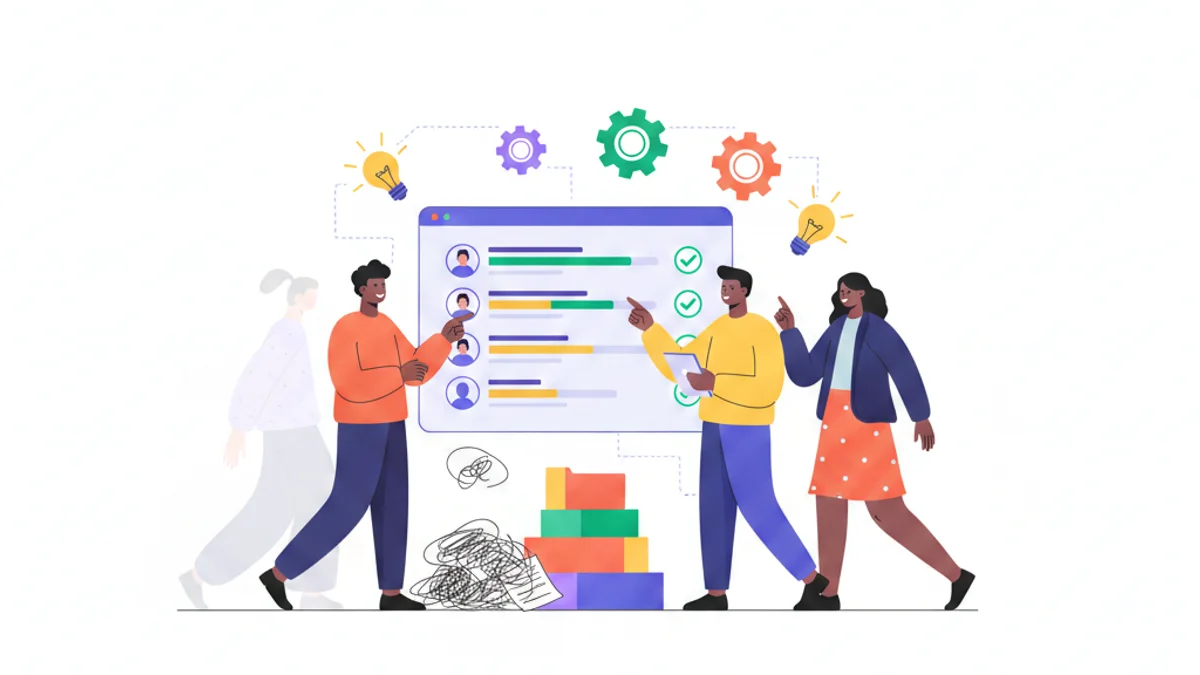
The founder-led hiring that got you to 80 people breaks at 300. A CPO's framework for keeping quality of hire high while headcount explodes.
Structured hiring for scale-ups is the discipline of hiring every candidate against the same defined criteria, in the same sequence, scored the same way — so quality of hire holds steady even when headcount doubles in a year. It's the difference between a company that scales its culture and one that dilutes it. And it's the single highest-leverage system a Chief People Officer can install before the wheels come off.
Here's the tension every scaling company hits. The hiring that got you from 20 to 80 people — gut feel, founder interviews, "we just know a good fit" — quietly becomes the thing that breaks you between 80 and 300. This playbook shows you how to fix it without turning your team into a bureaucracy.
What you need to know in 60 seconds
- →Structured hiring nearly doubles predictive validity. Schmidt & Hunter's landmark meta-analysis found structured interviews far outperform unstructured ones at predicting on-the-job performance.
- →Scale-ups break their own hiring because ad-hoc processes don't survive volume — the founder can't sit in every loop past ~100 hires a year.
- →A bad hire can cost up to 30% of that role's first-year earnings, per the U.S. Department of Labor — and scale-ups make bad hires faster than anyone.
- →The framework has five parts: a scorecard, a fixed interview plan, skills-based evidence, calibrated scoring, and a decision meeting.
- →You can roll this out in 90 days — start with your two highest-volume roles, then expand.
What Structured Hiring Actually Means for a Scale-Up
Structured hiring means every candidate for a role faces the same evaluation: the same competencies, the same questions or exercises, and the same scoring rubric, assessed by trained interviewers who record evidence before they compare notes. Unstructured hiring is the opposite — a different conversation every time, scored on vibe.
For a scale-up, the definition matters because the stakes compound. When you hire five people a quarter, an inconsistent process is survivable. When you hire fifty, inconsistency becomes your dominant cost. Every interviewer running their own playbook means fifty different bars, fifty different biases, and no way to learn what "good" actually looks like.
Structured hiring for scale-ups isn't about adding process for its own sake. It's about making one good decision repeatable — so the thirtieth hiring manager makes the same quality call the founder made on hire number three.
Predictive validity of structured vs unstructured interviews
Schmidt & Hunter meta-analysis
Of first-year earnings — the cost of a single bad hire
U.S. Department of Labor
Higher odds of a great hire when recruiters use skills data
LinkedIn Future of Recruiting
Why Scale-Ups Break Their Own Hiring
Scale-ups break their hiring because the system that worked at 50 people was never a system — it was a founder. Founder judgment doesn't scale, and the moment hiring outpaces the founder's calendar, quality falls off a cliff nobody sees coming.
The pattern is predictable. Growth targets demand headcount. Hiring managers who've never been trained to interview get handed reqs. Speed becomes the only metric anyone tracks. Six months later you're managing out people who never should have passed the loop — and the ones who did pass are quietly wondering who they'll be sitting next to.
Google learned this the hard way and rebuilt around it. As former SVP of People Operations Laszlo Bock described in the company's reWork research, Google's data showed unstructured interviews had almost no power to predict performance — which is why the company standardised on structured interviews across the board. If it broke at Google's scale, it will break at yours.
The three failure signals every CPO should watch
Diverging quality: two managers hiring for the same role produce wildly different first-year performance. That's a process problem, not a talent-market problem.
Interviewer drift: when you ask five interviewers why they said yes, you get five unrelated reasons. Nobody is measuring the same thing.
Regret hires: early attrition climbs and exit interviews point to "not what I expected." The role was sold, not assessed.
The Cost of Getting It Wrong at 10x Speed
A bad hire is expensive for anyone; for a scale-up it's radioactive. The U.S. Department of Labor puts the cost of a bad hire at up to 30% of the person's first-year earnings — and that figure ignores the drag on a small, fast team where one wrong hire can stall an entire function.
The real damage isn't the salary you wasted. It's the opportunity cost of the great hire you didn't make, the morale hit to the people carrying the slack, and the manager hours burned on remediation instead of building. Structured hiring is the cheapest insurance policy against all three.
Structured hiring gives you
- ✓ A consistent bar across every hiring manager
- ✓ Evidence you can audit for fairness and bias
- ✓ Faster loops, because everyone knows their role
- ✓ Data to improve — you can see what predicts success
- ✓ A candidate experience that feels professional, not random
Ad-hoc hiring leaves you with
- × A bar that moves with whoever's in the room
- × Decisions you can't defend or explain later
- × Duplicated questions and drawn-out, chaotic loops
- × No way to learn — every hire is a fresh gamble
- × Candidates who ghost after a disjointed experience
Build the Structured Hiring Framework in Five Steps
The structured hiring framework has five moving parts, and they work in sequence. Skip one and the others weaken. Here's the build order a CPO should follow.
Write the scorecard before you write the job ad
Define what success in the role looks like in 12 months, then translate that into four to six measurable competencies. This is the contract everyone hires against — no scorecard, no interview.
Keep it tight. A scorecard with fifteen "must-haves" isn't rigorous, it's a wish list nobody can assess.
Fix the interview plan — same stages, same owners
Assign each competency to a specific stage and interviewer so nothing is assessed twice and nothing is missed. Every candidate for the role runs the identical loop.
Consistency here is what makes candidates comparable — and what makes your process defensible.
Gather skills-based evidence, not impressions
Replace "tell me about yourself" with work samples, structured behavioural questions, and gamified assessments that show what a candidate can actually do. Evidence beats eloquence.
This is where skills-based hiring and structured hiring converge — and where scale-ups win the candidates enterprises miss.
Score independently, then calibrate
Every interviewer records a rating and written evidence before seeing anyone else's. This kills groupthink and the loudest-voice-wins problem that plagues fast-moving teams.
Calibrate your rubric quarterly so a "3" means the same thing in every function.
Decide in a structured debrief
Bring the evidence, not the anecdotes. The debrief reviews scores against the scorecard and makes a clear hire / no-hire call with a documented rationale.
Six months on, that documented rationale is how you learn which signals actually predicted performance.
Structured vs Ad-Hoc Hiring: A Side-by-Side
The clearest way to see the payoff is to put the two approaches next to each other. The same growth pressure produces opposite outcomes depending on which system you run.
| Dimension | Structured Hiring | Ad-Hoc Hiring |
|---|---|---|
| The bar | Fixed, written, applied to everyone | Moves with whoever runs the interview |
| Basis of decision | Recorded evidence against competencies | Gut feel and cultural "vibe" |
| Scales to volume | Yes — the system carries the load | No — breaks past the founder's calendar |
| Bias exposure | Auditable, reducible, defensible | Invisible and unaccountable |
| Learns over time | Yes — data links signals to outcomes | No — every hire starts from zero |
| Candidate experience | Clear, fair, professional | Inconsistent and often chaotic |
Where Skills Assessments Fit the Framework
Skills assessments are the evidence engine of structured hiring — they turn "seems capable" into a measured, comparable score. For scale-ups hiring at volume, they're also the fastest way to widen the top of the funnel without lowering the bar.
According to LinkedIn's Future of Recruiting research, recruiters who use skills data are around 12% more likely to make a great hire. The reason is simple: a demonstrated skill predicts performance far better than a credential on a CV ever could. Structured hiring gives that evidence a consistent home in the process.
Work samples
A short, realistic task that mirrors the job. It shows how a candidate thinks and executes under real conditions — the strongest single predictor of performance.
Gamified assessments
Interactive challenges that measure competencies while keeping candidates engaged. They cut drop-off at the top of the funnel and generate clean, comparable data for the scorecard.
Structured behavioural questions
The same questions, asked the same way, scored on the same rubric. They surface how a candidate has actually operated — not how well they tell a story.
This is exactly how HEINEKEN Romania rebuilt its early-career hiring with Jobful. By putting a gamified, skills-based assessment at the front of a consistent process, the company saw a 43% increase in applications while sharpening the quality signal on every candidate. Structured doesn't mean slower — done right, it means both faster and fairer. You can see the full breakdown in our case studies library.
The CPO's 90-Day Rollout Plan
You don't roll out structured hiring for scale-ups everywhere at once — you prove it on your highest-volume roles and let the results sell the rest of the org. Here's the 90-day sequence.
From zero to a working system in one quarter
Days 1–30 — Pick and design. Choose your two highest-volume roles. Write their scorecards, fix the interview plans, and build the assessment for each. Train the interviewers who'll run those loops.
Days 31–60 — Run and record. Put every candidate for those roles through the structured loop. Capture independent scores and written evidence for all of them, and hold structured debriefs for every decision.
Days 61–90 — Review and expand. Compare time-to-hire, offer-accept rate, and interviewer agreement against your old baseline. Show the numbers to the exec team, then extend the model to the next three roles.
Ninety days is enough to build proof. From there, structured hiring becomes how your company hires — not a project, but the default.
The scale-ups that keep their edge past 300 people aren't the ones that hired fastest. They're the ones that made one good hiring decision repeatable before growth forced the question. Structured hiring for scale-ups is how you get there — a system that holds the bar steady while everything else around it moves.
Build the scorecard, fix the loop, gather real evidence, score it honestly, and decide on the facts. Do that, and quality of hire stops being a casualty of growth and starts being a competitive advantage.
Scale your hiring without lowering the bar
See how Jobful's gamified, skills-based assessments plug into a structured hiring process — so your thirtieth hire is as strong as your third.
Frequently Asked Questions
Get More Insights Like This
Join 5,000+ HR professionals receiving monthly insights.