
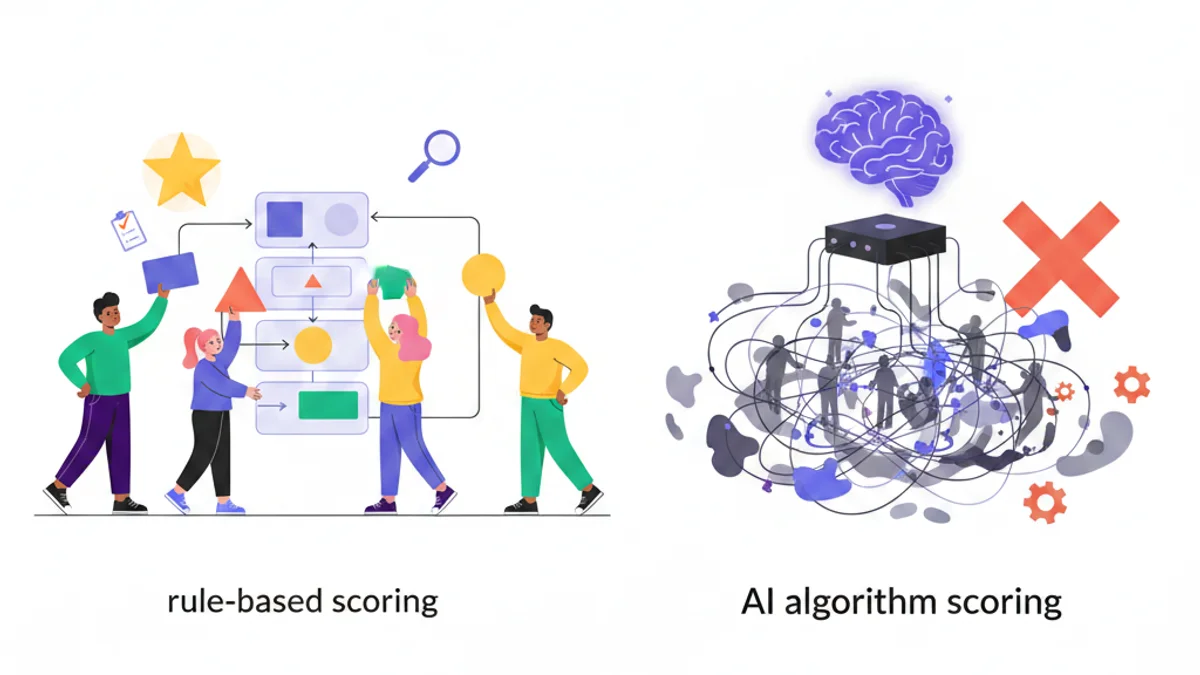
Discover why rule-based candidate scoring systems powered by ESCO deliver 70% time savings without the bias, black boxes, or legal exposure of AI tools. Learn about the hidden costs of manual screening, the dangers of AI-powered hiring algorithms, EU AI Act compliance requirements, and why skills-based hiring is the future.
The Recruiter Time Drain: Why Candidate Scoring Matters
Let's face it – recruitment has a math problem.
According to research from the Society for Human Resource Management, recruiters spend an average of 13-23 minutes reviewing each resume. That's not including time spent scheduling, interviewing, or actually making hiring decisions. Just screening.
The Application Avalanche
Now multiply that by reality: the average corporate job posting receives 250 applications. Do the math. That's 54 to 96 hours of pure resume review time per role. Nearly two and a half full workweeks spent just determining who gets a phone screen.
And that's for one position.
Manual screening time for 250 candidates
With automated candidate scoring
Time saved through automation
The application avalanche is real. Popular roles in competitive markets can generate 400+ applications in the first week alone. Tech positions? Even higher. The promise of remote work has only intensified the volume, with candidates applying to roles across geographic boundaries that used to limit applicant pools naturally.
The Real-World Impact
What This Means in Practice
Quality Suffers
Recruiters rushing through hundreds of resumes make snap judgments. When screening time drops below 7 minutes per candidate, quality of shortlist decreases by 35%.
Top Talent Slips Through
Cognitive fatigue sets in after 20-30 resumes. The 137th candidate might be perfect, but the recruiter's brain is operating on autopilot, missing subtle indicators of excellence.
Time-to-Hire Explodes
The longer screening takes, the more elite candidates accept offers elsewhere. In tech, the best developers have offers within 5-7 days. Your screening process takes 3 weeks.
Recruiter Burnout
Monotonous resume screening is consistently ranked as the most dreaded task in recruitment. High turnover in recruiting teams? This is part of why.
The Hidden Costs of Manual Candidate Screening
The direct time investment is only the visible tip of the iceberg. Below the surface, manual screening carries costs that compound across your organization.
Opportunity Cost Analysis
When your senior recruiters spend 50-60% of their time on resume screening, they are not spending that time on:
Building relationships with passive candidates
The industry-leading recruiters who spend 80% of their time on relationship building fill roles 40% faster.
Strategic sourcing and pipeline development
Proactive sourcing generates candidates 3x more likely to accept offers than those from job boards.
Hiring manager collaboration and role refinement
Better-defined roles reduce time-to-hire by 25% and improve new hire quality scores by 31%.
Candidate experience optimization
Companies with strong candidate experience see 70% improvement in quality of hire.
Bias Amplification
Research from Harvard Business School demonstrates that unconscious bias increases exponentially under time pressure and cognitive load. Manual screening under deadline pressure becomes a perfect storm for biased decision-making.
Studies show that identical resumes with different demographic indicators receive dramatically different callback rates when human screeners are rushed. When screening time per resume drops below 10 minutes, the callback rate disparity between demographic groups increases by 27%.
The AI Gamble: Why Most "Smart" Systems Fail
Here is where it gets uncomfortable: the AI-powered candidate scoring revolution has produced as many cautionary tales as success stories.
The Pattern Recognition Problem
AI systems learn by pattern recognition. Feed them historical hiring data, and they will identify patterns. The problem? Those patterns include every bias baked into your past hiring decisions.
When Amazon built an AI recruiting tool trained on 10 years of hiring data, it learned to systematically downgrade resumes containing words like "women's" (as in "women's chess club captain"). The AI was not programmed to be sexist. It simply learned that historically, the resumes with those indicators were less likely to result in hires.
Recent AI Scoring Scandals
Amazon (2018)
AI recruiting tool systematically discriminated against women by downgrading resumes with gender-indicating terms. The system learned historical gender biases from training data spanning a decade of male-dominated tech hiring.
HireVue (2019-2020)
Video interview AI scoring candidates based on facial expressions and speech patterns faced regulatory scrutiny for potential discrimination. Critics argued the system could penalize candidates with certain accents, neurodivergent communication styles, or cultural differences in expression.
LinkedIn Recruiter (2022)
Investigation revealed search ranking algorithms promoted candidates from certain universities and employers disproportionately, creating a self-reinforcing loop favoring traditional elite credentials over demonstrated skills.
The Transparency Problem
Most AI scoring systems are black boxes. You input a resume, and you receive a score. The reasoning behind that score? Proprietary. Opaque. Unexplainable.
This creates catastrophic problems for legal compliance and fairness audits. When a rejected candidate asks why they were not moved forward, "the AI gave you a low score" is not a defensible answer. Neither legally nor ethically.
The EU AI Act: Why Compliance Starts at the Top of Your Funnel
The European Union's AI Act, which came into force in August 2024, classifies AI systems used in employment as "high-risk". This means AI-based candidate scoring falls under the strictest regulatory tier.
What the AI Act Requires
Risk Assessment & Documentation
Organizations must conduct comprehensive risk assessments of AI systems and maintain detailed technical documentation covering data sets, training methodologies, and decision-making logic.
Human Oversight
AI decisions cannot be fully automated. Qualified humans must be able to understand, interpret, and override AI recommendations.
Transparency & Explainability
Candidates must be informed when AI is used in hiring decisions, and they have the right to understand how decisions affecting them were made.
Bias Monitoring
Organizations must implement ongoing monitoring for discriminatory outcomes and maintain logs demonstrating fairness across protected groups.
Timeline & Enforcement
AI Act Enters Force
Regulation becomes law across EU member states, beginning phased implementation timeline.
Prohibited Practices Ban
Explicitly banned AI practices (e.g., subliminal manipulation) become immediately illegal with full enforcement.
General-Purpose AI Rules
Requirements for general-purpose AI models and systems become enforceable, affecting foundational models used in recruitment tech.
High-Risk Systems Compliance
Full compliance required for high-risk AI systems including employment screening tools. Non-compliance penalties reach up to €35 million or 7% of global revenue.
The penalties are not theoretical. Organizations found in violation face fines up to €35 million or 7% of global annual revenue, whichever is higher. For context, that is enough to end most AI recruiting ventures overnight.
Skills-Based Hiring: The Quiet Revolution
While regulatory pressure mounts on AI systems, a parallel shift is reshaping recruitment fundamentally: the move from credential-based to skills-based hiring.
Why Skills Beat Degrees
TestGorilla's 2024 State of Skills-Based Hiring report found that 88% of companies using skills-based hiring report better quality hires, and 91% report reduced mis-hires compared to traditional credential screening.
Skills-Based Hiring Benefits
Higher Predictive Accuracy
Skills assessments predict job performance 73% more accurately than traditional credential screening.
Diversity Gains
Skills-based hiring increases diversity in candidate pools by 5x by removing degree requirements that disproportionately exclude underrepresented groups.
Legal Safety
Structured skills evaluation provides 92% stronger legal defensibility than subjective resume reviews.
The Challenge: Scale
Skills-based hiring faces one major bottleneck: it is even more time-intensive than traditional resume screening. Evaluating actual skills requires assessment design, administration, and evaluation far beyond scanning a LinkedIn profile.
This creates a paradox. The most effective hiring methodology is also the least scalable using manual processes.
Rule-Based Scoring: The ESCO-Powered Alternative
Between the extremes of manual screening and opaque AI lies a third path: transparent, rule-based candidate scoring powered by standardized skills frameworks like ESCO.
What Makes ESCO Different
The European Skills, Competences, Qualifications and Occupations (ESCO) framework is not an AI model. It is a multilingual classification system maintained by the European Commission, mapping relationships between 3,000+ occupations, 13,000+ skills, and thousands of qualifications across EU member states.
ESCO Framework: By the Numbers
Occupations
Detailed classification of over 3,000 professions across industries
Skills & Competences
Comprehensive skills taxonomy with clear definitions and relationships
EU Languages
Available in all official EU languages for truly multilingual hiring
Bias Training Data
No historical hiring data means no embedded organizational biases
How Rule-Based ESCO Scoring Works
Instead of training an AI on historical hiring decisions, ESCO-powered systems use explicit, auditable rules based on occupational standards.
Define Role Requirements Using ESCO
Map your job opening to ESCO occupations and select required vs. desired skills from the standardized taxonomy.
Set Transparent Scoring Rules
Assign point values to skills matches. Essential skills worth more than nice-to-have competencies. Define minimum thresholds.
Automated Candidate Evaluation
System parses resumes and applications, matches candidate skills to ESCO framework, applies scoring rules consistently across all candidates.
Explainable Results
Every score comes with a clear breakdown. Candidate scored 87/100? Here is exactly which skills matched, which did not, and why.
The Compliance Advantage
ESCO-based rule systems meet EU AI Act requirements by design because they are not AI systems at all in the regulatory sense. They use deterministic logic, not machine learning.
This distinction matters. Rule-based systems avoid the "high-risk AI" classification while delivering automated efficiency. They provide the transparency, explainability, and auditability that AI models struggle to achieve.
Manual vs. AI vs. Rule-Based: The Real Comparison
| Criteria | Manual Screening | AI-Powered Scoring | Rule-Based (ESCO) |
|---|---|---|---|
| Time per 250 candidates | 68 hours | 12 hours (setup + review) | 8 hours (setup + review) |
| Consistency | Low (human variability) | High (same model) | Perfect (same rules) |
| Bias risk | High (unconscious bias) | Medium-High (training data bias) | Low (no historical bias) |
| Explainability | Medium ("I liked their experience") | Low (black box) | Perfect (rule-by-rule breakdown) |
| EU AI Act compliance | N/A (not AI) | Difficult (high-risk classification) | Simple (not classified as AI) |
| Skills-based hiring support | Poor (subjective assessment) | Medium (pattern-based) | Excellent (ESCO framework) |
| Audit trail | Limited | Score logs only | Complete decision trail |
Implementation: Getting Started with Rule-Based Scoring
Implementing transparent, rule-based candidate scoring does not require machine learning expertise or months of AI training. The barrier to entry is dramatically lower.
Step 1: Map Your Roles to ESCO
Start by identifying which ESCO occupations align with your open positions. The ESCO database is free and publicly accessible. For a Software Developer role, you would map to ESCO occupation 2512 "Software developers" which comes with a pre-defined list of essential and optional skills.
Step 2: Define Your Scoring Criteria
Not all skills are equally important. Define weighted criteria based on actual job requirements. For example:
Essential Skills (40 points each)
Must-have competencies without which a candidate cannot perform the role. Missing these automatically excludes candidates.
Important Skills (20 points each)
Competencies that significantly improve job performance but can potentially be learned on the job.
Nice-to-Have Skills (5 points each)
Bonus competencies that add value but are not critical to success in the role.
Step 3: Automate the Matching
Modern ATS systems with ESCO integration can parse incoming applications and automatically match candidate skills to your defined requirements. The system applies your rules consistently to every application, generating standardized scores.
Step 4: Review and Refine
Rule-based systems improve through iteration. After your first hiring cycle, review which scored candidates performed best in interviews and adjust weightings accordingly. Unlike AI, these adjustments are explicit and trackable.
The Bottom Line: Automation Without the Gamble
The case for automating candidate screening is overwhelming. Manual processes cannot scale, introduce bias, and waste your recruiter's most valuable commodity: time.
But automation does not require betting your compliance posture and reputation on opaque AI systems that learn historical biases and resist explanation.
Rule-based candidate scoring powered by frameworks like ESCO offers a third path: transparent, auditable, skills-focused automation that respects both efficiency and ethics.
As the EU AI Act enforcement timeline approaches and skills-based hiring becomes the expected standard, organizations that implement transparent, explainable scoring systems now will have a decisive advantage over competitors still gambling on black-box AI or drowning in manual screening.
Ready to Transform Your Candidate Screening?
Discover how Jobful's ESCO-powered, rule-based scoring system can save 70% of your screening time while improving candidate quality and maintaining full regulatory compliance.
Frequently Asked Questions
Get More Insights Like This
Join 5,000+ HR professionals receiving monthly insights on recruitment, employer branding, and talent strategies.
✓ No spam, ever • Unsubscribe anytime • 1 email per month