
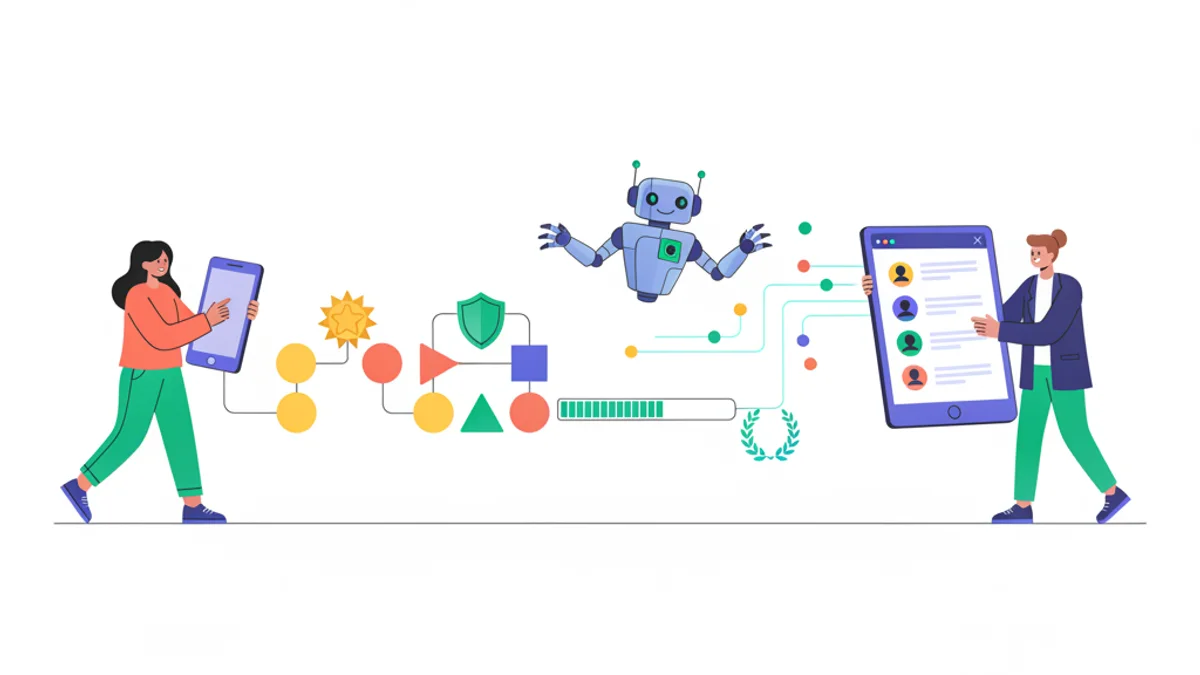
AI gives hiring scale; gamification gives it signal. Here's how to combine both into one compliant funnel that screens faster and predicts real performance.
What you need to know in 60 seconds
- →AI and gamification solve opposite halves of hiring: AI handles volume, gamification produces the behavioural signal AI can't extract from CVs.
- →A corporate job opening attracts roughly 250 applications (Glassdoor) — you need AI-grade speed just to keep up, but speed alone doesn't tell you who'll perform.
- →78% of candidates say gamification makes an employer more desirable (TalentLMS) — the assessment itself becomes an attraction tool.
- →Under the EU AI Act, AI that screens or ranks candidates is high-risk. Pairing AI sourcing with transparently scored gamified assessments keeps selection decisions explainable.
- →HEINEKEN Romania used gamified campaigns to attract 43% more Gen Z applicants; Wyndham Hotels grew applications by 290% on the same platform model.
- →The combined funnel runs in five steps: audit, automate the admin, gamify the assessment, score by transparent rules, and feed every result into your talent community.
AI and gamification in hiring are usually treated as separate bets. One team buys an AI sourcing tool, another pilots a gamified assessment, and the two never meet. That's a missed opportunity — because each one fixes exactly the problem the other can't touch.
AI gives your funnel scale. Gamification gives it signal. Run them together and you get a hiring process that's fast at the top, predictive in the middle, and compliant all the way through.
This guide shows you how the combination works, where the EU AI Act fits in, and the five steps to build it.
Average applications per corporate job opening
Glassdoor
Of candidates say gamification makes a company more desirable to work for
TalentLMS
More Gen Z applicants for HEINEKEN Romania via gamified recruitment
Jobful case study
Why AI and Gamification Solve Opposite Halves of Hiring
AI fixes hiring's volume problem. Gamification fixes its signal problem. Most teams invest in one and then wonder why the other half of the funnel still hurts.
The volume problem is real. Glassdoor's long-running benchmark puts the average corporate opening at around 250 applications — and AI-written CVs have pushed that number up, not down. No recruiter reads 250 applications properly. Software has to do the first pass.
The signal problem is older. Frank Schmidt and John Hunter's landmark meta-analysis of 85 years of selection research found that work-sample tests are among the strongest predictors of job performance, while years of education and experience rank near the bottom. CVs are made of the weak predictors. Games — built properly — are work samples.
So the question isn't “AI or gamification?” It's how to wire them into one funnel where each does the job it's actually good at.
What AI Does Well — and Where It Gets Risky
AI earns its keep on sourcing, matching, and admin. It gets risky the moment it starts making — or heavily shaping — selection decisions.
Where AI delivers
- ✓ Sourcing — surfacing matching profiles from your talent community and external pools in minutes
- ✓ Matching open roles to people who already engaged with your brand
- ✓ Drafting outreach, answering candidate FAQs, scheduling interviews
- ✓ Spotting funnel drop-off patterns humans miss
Where AI gets risky
- ✗ Predicting performance from CV proxies — the data measures pedigree, not ability
- ✗ Opaque screening and ranking — classified as high-risk under the EU AI Act
- ✗ Amplifying historical bias baked into past hiring data
- ✗ An arms race with candidates whose CVs are now AI-written too
That last point matters more than most teams admit. When both sides use AI on the CV, the CV stops carrying information. You're left ranking prompt quality, not people. The fix isn't better CV-parsing — it's a richer source of evidence.
What Gamification Adds That AI Can't Extract From a CV
Gamified assessments generate first-party behavioural evidence: how a candidate actually solves problems, persists, and decides under pressure. That's data no CV parser can produce, because it doesn't exist until the candidate plays.
Problem-solving in context
Scenario challenges built on real job tasks show how candidates approach problems — the closest thing to a work sample you can run at scale.
Persistence signals
Completion behaviour, retries, and time-on-task reveal grit and motivation — qualities every CV claims and none can prove.
Values and culture alignment
Choice-based scenarios let candidates experience your culture before day one — and show you how they'd act inside it.
Engagement that attracts
According to TalentLMS, 78% of candidates say gamification makes a company more desirable. The assessment doubles as employer branding.
This is exactly the playbook behind HEINEKEN Romania's gamified campaign on Jobful, which attracted 43% more Gen Z applicants — the assessment itself became the reason to apply. Gamification in graduate recruitment works because it meets early-career candidates where CVs fail them: they have little history, but plenty of ability.
AI and Gamification in Hiring: How the Combined Funnel Works
The combined model assigns each technology a lane. AI compresses time at every stage; gamification produces the evidence decisions are based on. Here's the division of labour across the funnel.
| Funnel stage | AI's job (scale) | Gamification's job (signal) |
|---|---|---|
| Attract | Match roles to talent community members; personalise outreach | Branded challenges give candidates a reason to engage before a role opens |
| Apply | Chat-assisted applications; auto-answered FAQs; instant acknowledgement | Progress bars and milestones cut application abandonment |
| Assess | Administer and proctor at any volume, any time zone | Gamified work samples generate behavioural performance data |
| Shortlist | Aggregate scores and flag for human review | Transparent, rule-based scoring keeps every decision explainable |
| Engage long-term | Re-match silver-medallists when new roles open | Points, badges, and challenges keep the talent community warm |
Notice what never happens in this model: an opaque algorithm rejecting a human. AI moves information; gamified evidence plus transparent rules — with a recruiter in the loop — make the call. That design choice is also your compliance strategy.
Stay Compliant: The EU AI Act Question
The EU AI Act classifies AI systems used to screen, evaluate, or rank job candidates as high-risk — with obligations around transparency, human oversight, and documentation. The combined model is the practical way to keep using AI without betting your funnel on a black box.
The compliance logic in one paragraph
Use AI where the Act's risk is lowest and the value is highest: sourcing, matching, communication, and admin. Then base selection decisions on gamified assessment results scored by transparent, auditable rules — criteria you defined, can explain to a candidate, and can defend to a regulator.
Every shortlist decision stays explainable: this candidate advanced because they scored X on a job-relevant challenge — not because a model produced an unexplainable ranking.
We covered the sourcing-versus-screening risk split in depth in our EU AI Act guide for recruiters — the short version: keep AI assistive on selection, keep humans accountable, and keep your scoring criteria documented.
Implement the Combined Model in 5 Steps
You don't need to rebuild your stack. Most teams can stand up a combined AI-plus-gamification funnel in a quarter. Here's the sequence that works.
Audit your funnel for volume gaps and signal gaps
Map where recruiters lose time (volume problems) and where bad hires slip through (signal problems). Time-to-shortlist and 6-month quality-of-hire are your two diagnostic metrics.
Volume gaps get AI. Signal gaps get gamified assessment. Don't buy either until you know which gap you're closing.
Point AI at sourcing, matching, and admin first
Automate the work nobody defends: outreach drafts, FAQ responses, scheduling, talent-pool matching. This is where AI's ROI is fastest and its regulatory exposure lowest.
Keep AI out of reject decisions from day one — it's easier than retrofitting oversight later.
Design gamified assessments around real job tasks
Work backwards from what top performers actually do in the role, then build challenges that sample those behaviours. Schmidt and Hunter's research is your design brief: the closer to a work sample, the stronger the prediction.
Keep it short — 15 to 25 minutes — and mobile-first. Completion rate is a feature, not a vanity metric.
Score with transparent rules and a human in the loop
Define scoring criteria before the first candidate plays. Weight the skills that matter, document the logic, and have recruiters review every shortlist — AI aggregates, humans decide.
This single step covers most of your EU AI Act exposure on selection.
Feed every result into your talent community
Candidates who scored well but missed the role are your cheapest future hires. Keep them engaged with challenges and content, and let AI re-match them when new roles open.
This turns assessment spend into pipeline — one investment, multiple hires.
Measure What Matters: Proving the Combined Model Works
Four metrics tell you whether the model is working: assessment completion rate, time-to-shortlist, 6-month quality-of-hire, and candidate NPS. If all four move in the right direction, the funnel is doing both of its jobs.
Benchmarks help. Wyndham Hotels grew applications by 290% after moving to an engagement-first platform model, and HEINEKEN's gamified campaigns lifted Gen Z applications by 43% — both while shortening screening time, not extending it.
Track completion rate weekly. A gamified assessment under 70% completion is usually too long or poorly targeted — fix the experience before questioning the model. And compare quality-of-hire for game-assessed hires against CV-screened hires from the same period; that head-to-head is the business case your CFO will actually believe.
The bottom line: AI and gamification in hiring aren't competing line items. They're two halves of one funnel — scale from the machine, signal from the game, and judgment from your recruiters. Teams that wire all three together hire faster, predict better, and sleep easier when the auditors call.
See AI + Gamification in One Platform
Jobful combines gamified assessments, AI-assisted matching, and a living talent community — the full funnel from this guide, out of the box.
Frequently Asked Questions
Get More Insights Like This
Join 5,000+ HR professionals receiving monthly insights.